

Riesgos de seguridad de la IA: lo que los equipos de DevSecOps deben saber para proteger los sistemas de IA.
Los riesgos de seguridad de la IA ya no se limitan al comportamiento del modelo o a la privacidad de los datos. Hoy en día, también afectan la forma en que se escribe, revisa, construye y distribuye el software. A medida que las herramientas de codificación de IA, los sistemas de IA con agentes y los flujos de trabajo impulsados por IA entran en la SDLCLos equipos de DevSecOps se enfrentan a un nuevo tipo de riesgo: código más rápido, automatización más rápida y errores más rápidos.
Sin embargo, esto no significa que los equipos deban ralentizar la adopción de la IA. En cambio, necesitan controles de seguridad que coincidan con la velocidad del desarrollo asistido por IA. En esta guía, explicamos los riesgos de seguridad de la IA más importantes, cómo aparecen en los flujos de trabajo de ingeniería reales y cómo los equipos pueden reducir la exposición en el código, las dependencias, Secretos, pipelines y agentes.
Para obtener una visión general más amplia de cómo la IA cambia el panorama de amenazas, consulte nuestra guía sobre Ciberseguridad de IA.
¿Cuáles son los riesgos de seguridad de la IA?
Los riesgos de seguridad de la IA son debilidades, amenazas o modos de fallo que aparecen cuando la inteligencia artificial se diseña, entrena, integra o utiliza dentro de sistemas reales. Estos riesgos pueden afectar a los modelos, los datos, las indicaciones, las API, el código, pipeliney las herramientas que las conectan.
El Guía del NCSC sobre IA y ciberseguridad explica que la ciberseguridad es un requisito fundamental para los sistemas de IA seguros y fiables. Del mismo modo, la Marco de gestión de riesgos de IA del NIST Proporciona a las organizaciones una estructura para gestionar el riesgo de la IA mediante la gobernanza, la medición y los controles prácticos.
Para los equipos de DevSecOps, el problema es más específico. La IA ahora forma parte de la cadena de entrega de software. Escribe código, sugiere dependencias, genera configuración, llama a las API y, a veces, actúa de forma autónoma. Como resultado, los riesgos de seguridad de la IA deben manejarse dentro de la SDLC, no solo en la capa del modelo.
¿Por qué los riesgos de seguridad de la IA son diferentes ahora?
Los riesgos tradicionales de ciberseguridad suelen provenir de código escrito por humanos, paquetes vulnerables, credenciales débiles o infraestructura mal configurada. Estos riesgos aún existen. Sin embargo, la IA está cambiando la rapidez con la que aparecen y la dificultad para detectarlos.
El código generado por IA puede parecer correcto, pero aun así omitir las comprobaciones de autorización. Un asistente de codificación de IA podría sugerir un paquete vulnerable. Un flujo de trabajo automatizado podría usar la herramienta incorrecta, acceder al archivo erróneo o exponer una vulnerabilidad en un registro. Además, los sistemas de IA suelen depender del contexto, las indicaciones, los conectores y las herramientas externas, lo que crea más puntos débiles en la seguridad.
El Los 10 mejores candidatos para el Máster en Derecho de OWASP Se destacan riesgos como la inyección instantánea, la divulgación de información sensible, problemas en la cadena de suministro y la excesiva intervención de la IA. Estas categorías son útiles porque vinculan el comportamiento de la IA con problemas reales de seguridad de las aplicaciones.
En otras palabras, los riesgos de seguridad de la IA no se limitan al modelo en sí, sino que afectan a todo el sistema que lo rodea.
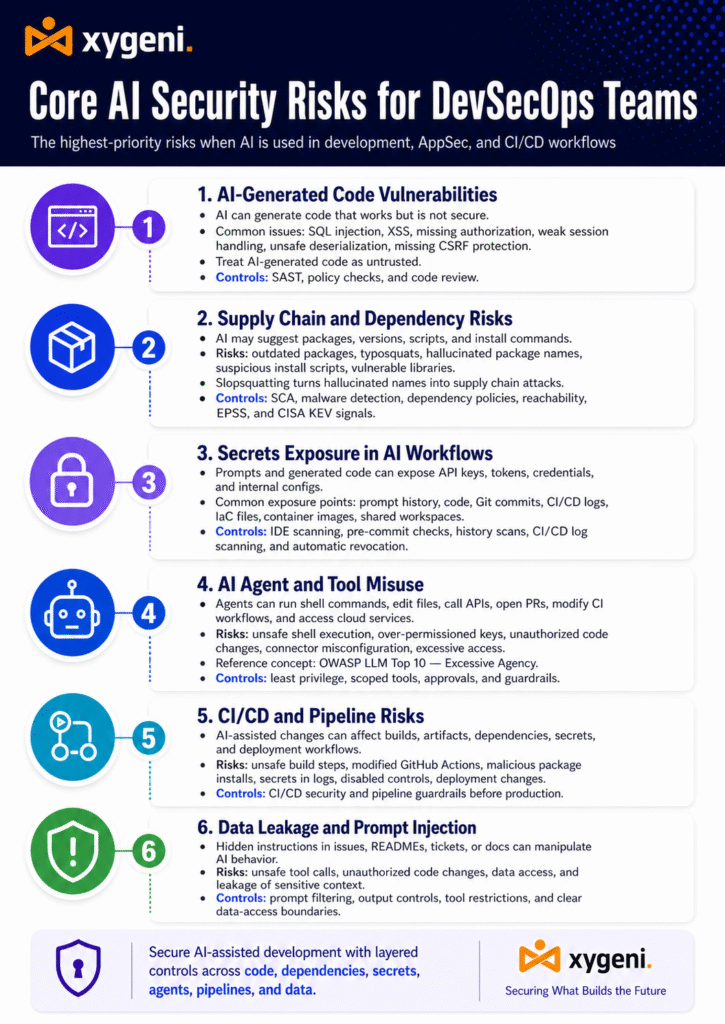
Principales riesgos de seguridad de la IA para los equipos de DevSecOps
A continuación se detallan los riesgos que más importan cuando se utiliza IA dentro del desarrollo, la seguridad de las aplicaciones y CI/CD flujos de trabajo.
1. Vulnerabilidades del código generado por IA
Las herramientas de codificación de IA pueden generar código que funciona, pero no es seguro. Por ejemplo, pueden crear consultas SQL sin la parametrización adecuada, omitir la validación de entrada o implementar una lógica de autenticación débil.
Esto sucede porque muchos sistemas de IA generan patrones de código probables a partir de datos de entrenamiento. Sin embargo, un código probable no siempre es un código seguro. En la práctica, el modelo puede reproducir ejemplos inseguros porque son comunes en repositorios públicos.
Los ejemplos más comunes incluyen:
- inyección SQL
- Cross-site scripting
- Faltan comprobaciones de autorización
- Manejo deficiente de sesiones
- deserialización insegura
- Falta protección CSRF
Por lo tanto, el código generado por IA debe tratarse como no confiable hasta que pase SAST, comprobaciones de políticas y revisión.
Sugerencia de enlace interno: conecta esta sección con tu publicación en AI SAST.
2. Riesgos de la cadena de suministro y de la dependencia
Las herramientas de IA no solo generan código, sino que también sugieren paquetes, versiones, scripts y comandos de instalación. Esto crea una conexión directa entre las recomendaciones de la IA y el riesgo en la cadena de suministro de software.
Por ejemplo, una herramienta de IA podría sugerir:
- Un paquete obsoleto
- Una dependencia typosquat
- Un nombre de paquete alucinado
- Un paquete con scripts de instalación sospechosos
- Una biblioteca vulnerable pero aún muy utilizada.
Además, los atacantes pueden explotar este comportamiento registrando nombres de paquetes que las herramientas de IA probablemente inventen. Este riesgo se conoce como slopsquatting y transforma la ilusión del modelo en un ataque a la cadena de suministro de paquetes.
Para reducir este riesgo, los equipos necesitan SCAdetección de malware, aplicación de políticas de dependencia y análisis de accesibilidad. También deberían utilizar señales de explotabilidad como EPS y la inteligencia de explotación activa de la CISCatálogo de vulnerabilidades explotadas conocidas.
3. Exposición de Secretos en flujos de trabajo de IA
La exposición a Secretos es uno de los riesgos de seguridad más prácticos para la IA. Los desarrolladores suelen insertar contexto en las herramientas de IA. Este contexto puede incluir claves de API, tokens, credenciales, URL o configuraciones internas.
Además, el código generado por IA puede incluir marcadores de posición que parecen reales o, peor aún, copiar Secretos de nuevo en los archivos fuente, pipeline scripts o registros. Una vez que Secretos ingrese al historial de Git o CI/CD Los registros pueden seguir siendo explotables mucho después de su creación. commit.
Los puntos de exposición comunes incluyen:
- Historial de avisos
- Código generado
- Git commits
- CI/CD los registros
- IaC archivos
- Imágenes de contenedores
- Espacios de trabajo compartidos
Por esta razón, los equipos deberían combinar el escaneo a nivel de IDE, pre-commit comprobaciones, escaneos del historial del repositorio, CI/CD escaneo de registros y revocación automática.
Sugerencia de enlace interno: conecte esta sección con su producto Protección de secretos o contenido relacionado.
4. Mal uso de agentes y herramientas de IA
IA agente Esto introduce una nueva capa de riesgo porque los agentes no solo sugieren acciones, sino que también pueden llevarlas a cabo.
Un agente de IA puede ejecutar comandos de shell, editar archivos, llamar a API, abrir pull requestsmodificar los flujos de trabajo de integración continua o interactuar con servicios en la nube. Si bien esto genera enormes aumentos de productividad, también incrementa el alcance de los errores.
Los riesgos clave incluyen:
- Ejecución de shell insegura
- Claves API con permisos excesivos
- Cambios de código no autorizados
- Configuración incorrecta del conector MCP o API
- Llamadas a herramientas fuera del alcance aprobado
- Acceso al entorno más allá de lo que requiere la tarea.
La categoría Top 10 de OWASP LLM sobre acceso excesivo a recursos es especialmente relevante en este caso. Si un agente tiene demasiado acceso, una instrucción incorrecta, una inyección de código o una herramienta comprometida pueden convertirse en un verdadero incidente de seguridad.
5. CI/CD y Pipeline Riesgos
El código generado por IA finalmente llega a la pipelineEn ese momento, el riesgo se traslada del código fuente a las compilaciones, los artefactos, los Secretos, las dependencias y los flujos de trabajo de implementación.
Por ejemplo, un cambio asistido por IA puede:
- Agregar un paso de compilación no seguro
- Modificar un flujo de trabajo de GitHub Actions
- Se ha extraído un paquete malicioso durante la instalación.
- Imprimir Secretos en los registros de compilación
- Deshabilitar un control de seguridad
- Cambiar la lógica de despliegue
En consecuencia, Seguridad en CI/CD se vuelve esencial para la adopción de la IA. Pipeline guardrails Se deben bloquear los patrones inseguros antes de que lleguen a producción. Para obtener un contexto más profundo, consulte nuestro contenido sobre Seguridad en CI/CD y software supply chain security.
6. Fuga de datos e inyección rápida
La inyección de mensajes es uno de los riesgos de seguridad más conocidos en la IA, pero a menudo se malinterpreta. No es solo un problema de los chatbots; puede afectar a cualquier flujo de trabajo de IA que acepte información externa y la utilice para guiar acciones.
Por ejemplo, una descripción maliciosa de un problema, un archivo README, un ticket de soporte o una página de documentación de dependencias pueden incluir instrucciones ocultas. Si un agente de IA lee ese contenido y lo sigue, el atacante puede influir en las llamadas a herramientas, los cambios de código o el acceso a los datos.
Las fugas de datos pueden ocurrir de forma similar. El modelo puede revelar información sensible, resumir archivos privados o enviar datos confidenciales a servicios externos. Por lo tanto, los sistemas de IA necesitan filtrado inmediato, controles de salida, restricciones de herramientas y límites claros sobre los datos a los que pueden acceder.
Riesgos de seguridad de la IA en todo el mundo SDLC
Los riesgos de seguridad de la IA aparecen en diferentes etapas del ciclo de vida del software. La clave está en proteger cada etapa, no solo la aplicación final.
| SDLC Fase | Riesgo de seguridad de la IA | Ejemplo | Control recomendado |
|---|---|---|---|
| IDE | Código generado por IA inseguro | Un asistente de codificación con inteligencia artificial sugiere una lógica de autenticación insegura. | Gestión del riesgo SAST y retroalimentación de codificación segura. |
| Commit | Exposición de secretos | Aparece un token en el código generado o commit historia. | Detección de secretos, pre-commit controles y revocación automática. |
| Pull Request | Omisión de políticas | El código generado modifica las reglas de control de acceso sin revisión. | PR guardrails y la aplicación de las políticas. |
| Configurar | Dependencia maliciosa | Un paquete sugerido por IA presenta un comportamiento de instalación sospechoso. | SCAdetección de malware y comprobaciones de políticas de dependencia. |
| CI/CD | Pipeline manipulación | Un agente modifica los archivos de flujo de trabajo o los scripts de implementación. | Seguridad en CI/CD comprobaciones y detección de anomalías. |
| Runtime | Inyección inmediata o fuga de datos | La información externa provoca que un flujo de trabajo de IA revele contexto sensible. | Controles inmediatos, restricciones de acceso y monitorización. |
Riesgos de seguridad de la IA frente a riesgos de ciberseguridad tradicionales
La ciberseguridad tradicional sigue siendo importante. Sin embargo, la IA añade nuevos patrones de comportamiento que requieren controles diferentes.
| Área | Riesgo de ciberseguridad tradicional | Riesgo de seguridad de la IA |
|---|---|---|
| Código | Vulnerabilidades creadas por humanos. | Patrones inseguros generados por IA a mayor velocidad. |
| Dependencias | Paquetes vulnerables conocidos. | Paquetes sugeridos por IA que son alucinaciones, maliciosos o inseguros. |
| Secretos | Credenciales accidentalmente commitdesarrollado por programadores. | Secretos copiados en mensajes, código generado o registros. |
| Accesorios | Uso indebido manual de las herramientas de desarrollo. | Agentes autónomos que hacen un uso indebido de herramientas o API. |
| Pipelines | Desconfigurado CI/CD flujos de trabajo. | Cambios en el flujo de trabajo generados por el agente o automatización insegura. |
Ejemplos reales de riesgos de seguridad en IA
El riesgo para la seguridad de la IA no es teórico. Diversos marcos de referencia públicos y proyectos de investigación ya realizan un seguimiento más formal de estos problemas.
El Repositorio de riesgos de IA del MIT Cataloga más de 1,700 riesgos de IA en diferentes causas y ámbitos. Por su parte, OWASP proporciona categorías prácticas para los riesgos de las aplicaciones LLM, como la inyección instantánea, la divulgación de información sensible, las vulnerabilidades de la cadena de suministro y la excesiva intervención humana.
Para los equipos de DevSecOps, los ejemplos más relevantes suelen aparecer en la entrega de software:
- Herramientas de IA que sugieren código vulnerable
- Agentes de IA modificando archivos de flujo de trabajo
- Dependencias generadas por IA que introducen exposición en la cadena de suministro
- Secretos se filtra a través de mensajes, registros o commits
- Flujos de trabajo agenciales que llaman a herramientas fuera del alcance aprobado
En resumen, los riesgos de seguridad de la IA se vuelven mucho más graves cuando los sistemas de IA pueden acceder al código, las credenciales, los paquetes, pipelines, o infraestructura.
Cómo mitigar los riesgos de seguridad de la IA en la práctica
La mejor manera de reducir los riesgos de seguridad de la IA es tratar el desarrollo asistido por IA como parte de la SDLCEso significa escanear pronto, validar con frecuencia y aplicar políticas donde los desarrolladores realmente trabajan.
1. Escanee el código generado por IA en el IDE.
Los desarrolladores deberían recibir información sobre seguridad mientras escriben o aceptan código generado por IA. Esto reduce el cambio de contexto y ayuda a solucionar problemas antes de que lleguen a Git.
Uso:
- SAST en el IDE
- Explicaciones de vulnerabilidades en línea
- Sugerencias de solución segura
- Remediación teniendo en cuenta las políticas
Esto es especialmente importante para los asistentes de codificación de IA, donde las sugerencias inseguras pueden introducirse rápidamente en el código fuente.
2. Validar las dependencias antes de compilar.
Las dependencias sugeridas por IA deben verificarse antes de instalarse o distribuirse. Por lo tanto, los equipos deben aplicar controles de dependencia durante el desarrollo y CI/CD.
Uso:
- SCA
- Detección de malware
- Detección de typosquatting
- Puntuación EPSS
- Análisis de accesibilidad
- Bloqueo basado en políticas
Esto ayuda a priorizar los paquetes que representan un riesgo real, no solo una exposición teórica.
3. Detectar y revocar secretos automáticamente
El escaneo de Secretos debe abarcar más que el código fuente. Los flujos de trabajo asistidos por IA pueden exponer credenciales en muchos lugares.
Uso:
- Pre-commit exploración
- Escaneo del historial del repositorio
- Pipeline escaneo de registros
- IaC exploración
- Escaneo de imágenes de contenedores
- Revocación automatizada
Como resultado, los equipos reducen el tiempo entre la exposición y la contención.
4. Hacer cumplir Guardrails in CI/CD
Guardrails Se debe decidir si un cambio es lo suficientemente seguro como para proceder. Informar es útil, pero bloquearlo es necesario en casos de riesgo crítico.
Guardrails debe cubrir:
- Nuevas vulnerabilidades críticas
- Secretos
- Dependencias maliciosas
- Paquetes no anclados o no confiables
- Cambios en el flujo de trabajo inseguros
- Desaparecido SBOMs
- Violaciones de la política
Además, los equipos deberían comenzar utilizando el modo de solo informes cuando sea necesario, y luego pasar al modo de bloqueo a medida que aumente la confianza.
5. Monitorear el comportamiento de las herramientas agenciales
Los sistemas de IA basados en agentes necesitan observabilidad. Si un agente puede editar archivos, activar compilaciones o llamar a API, los equipos necesitan saber qué hizo, cuándo lo hizo y si la acción era la esperada.
Monitor:
- Llamadas de herramientas
- Cambios en los archivos de flujo de trabajo
- Actividad de escritura del repositorio
- Destinos de la red
- Acceso a secretos
- Pull request creación
- Pipeline dispara
Sin esta visibilidad, resulta difícil confiar en la autonomía de los agentes.
Cómo Xygeni ayuda a reducir los riesgos de seguridad de la IA
Xygeni se centra en asegurar el desarrollo asistido por IA en toda la cadena de entrega de software. En lugar de tratar el riesgo de la IA como una categoría separada, conecta el código, las dependencias, Secretos, pipelines, y contexto empresarial.
Por ejemplo:
- SAST Ayuda a detectar precozmente código generado por IA que sea inseguro.
- SCA Valida las dependencias y detecta paquetes maliciosos.
- Protección de secretos detecta credenciales expuestas en todos los repositorios y pipelines.
- Seguridad en CI/CD Aplica las políticas antes de que se implementen cambios inseguros.
- Anomaly Detection Identifica comportamientos inusuales en los flujos de trabajo de desarrollo y entrega.
- ASPM Relaciona los hallazgos en una única perspectiva de riesgo para que los equipos puedan priorizar lo que importa.
Esto es importante porque los riesgos de seguridad de la IA son inherentemente multicapa. Una dependencia vulnerable, un token expuesto y un cambio de flujo de trabajo inseguro pueden parecer elementos separados en herramientas puntuales. Sin embargo, en conjunto, pueden representar una ruta de ataque mucho mayor.
Marcos de gestión de riesgos de seguridad de la IA que debe conocer
Existen varios marcos de trabajo que ayudan a los equipos a estructurar su trabajo.
El Marco de gestión de riesgos de IA del NIST Ayuda a las organizaciones a mapear, medir, gestionar y controlar los riesgos de la IA. Es útil para el liderazgo, el cumplimiento normativo y los programas de gestión de riesgos.
El Los 10 mejores candidatos para el Máster en Derecho de OWASP Resulta más práctico para los equipos de seguridad de aplicaciones porque se relaciona directamente con riesgos técnicos como la inyección instantánea, la exposición de datos confidenciales, las vulnerabilidades de la cadena de suministro y la excesiva intervención humana.
El Guía del NCSC sobre IA y ciberseguridad Resulta útil para los responsables de seguridad que necesitan comprender cómo la IA modifica el riesgo cibernético de las organizaciones.
En conjunto, estos recursos demuestran un punto claro: la seguridad de la IA debe gestionarse en todos los ámbitos: personas, procesos, sistemas y flujos de trabajo de entrega de software.
Lista de verificación: Cómo reducir los riesgos de seguridad de la IA
Utilice esta lista de verificación como punto de partida práctico.
| Área de control | Qué hacer | POR QUÉ ES IMPORTANTE |
|---|---|---|
| Código generado por IA | Ejecutar SAST en el IDE, PR y CI/CD pipeline. | Impide que el código inseguro llegue a producción. |
| Dependencias | Usar SCAdetección de malware, EPSS y accesibilidad. | Bloquea los paquetes sugeridos por IA que sean riesgosos. |
| Secretos | Escanear commits, registros, historial, IaCy contenedores. | Reduce la exposición y el uso indebido de las credenciales. |
| CI/CD | Hacer cumplir pipeline guardrails y puertas de política. | Evita compilaciones e implementaciones inseguras. |
| Herramientas de agente | Supervise las llamadas a las herramientas, el acceso a la API y los cambios en el flujo de trabajo. | Limita la excesiva autonomía y el comportamiento inesperado. |
| Gestión del riesgo | Usar ASPM correlacionar los hallazgos entre las distintas capas. | Ayuda a los equipos a centrarse en los riesgos reales del negocio. |
Puntos Clave
- Los riesgos de seguridad de la IA ahora afectan al código, las dependencias, Secretos, pipelines y agentes.
- Las herramientas tradicionales de seguridad de aplicaciones siguen siendo necesarias, pero deben ejecutarse antes y con mayor contexto.
- El código generado por IA debe considerarse no fiable hasta que sea validado.
- Los flujos de trabajo de los agentes de IA necesitan guardrails, permisos y observabilidad.
- Los equipos de DevSecOps necesitan una visibilidad unificada en todo el sistema. SDLC para gestionar eficazmente el riesgo de la IA.
Preguntas frecuentes: Riesgos de seguridad de la IA
¿Cuáles son los riesgos de seguridad de la IA?
Los riesgos de seguridad de la IA son amenazas o debilidades que aparecen cuando se construyen, integran o utilizan sistemas de IA. Pueden afectar a los modelos, los datos, las indicaciones, el código, las dependencias, las API y pipelines.
¿Cuáles son los mayores riesgos de seguridad de la IA para los equipos de DevSecOps?
Los mayores riesgos incluyen código generado por IA inseguro, dependencias vulnerables, exposición de Secretos, inyección de mensajes, permisos excesivos del agente y seguridad insegura. CI/CD automatización.
¿Por qué los riesgos de seguridad de la IA son diferentes de los riesgos de ciberseguridad tradicionales?
Los sistemas de IA pueden generar código, sugerir dependencias, llamar a herramientas y actuar de forma autónoma. Como resultado, los riesgos aparecen más rápido y en más capas del sistema. SDLC.
¿Cómo pueden los equipos reducir los riesgos de seguridad de la IA?
Los equipos pueden reducir el riesgo escaneando el código generado por IA, validando las dependencias, detectando Secretos y aplicando CI/CD guardrails, monitoreando el comportamiento del agente y correlacionando los hallazgos a través de ASPM.
¿Es seguro el código generado por IA?
El código generado por IA no es seguro por defecto. Debe revisarse, analizarse, probarse y validarse antes de su implementación en producción.
Consideraciones finales: Los riesgos de seguridad de la IA necesitan SDLC-Controles de nivel
La IA cambia la velocidad y la naturaleza del riesgo del software. Ayuda a los equipos a desarrollar más rápido, pero también introduce nuevas formas para que el código inseguro, los Secretos expuestos, las dependencias inseguras y la automatización riesgosa entren en la cadena de entrega.
Por lo tanto, la seguridad de la IA no puede manejarse solo con modelos de gobernanza o documentos de políticas. Necesita controles prácticos dentro de la SDLC: Comentarios del IDE, SAST, SCADetección de secretos CI/CD guardrails, detección de anomalías y ASPMcorrelación de nivel.
Los equipos que gestionen bien los riesgos de seguridad de la IA no serán los que bloqueen su adopción, sino los que construyan la capa de seguridad adecuada a su alrededor.