

Riscos de segurança da IA: o que as equipes de DevSecOps precisam saber para proteger sistemas de IA.
Os riscos de segurança da IA não se limitam mais ao comportamento do modelo ou à privacidade dos dados. Hoje, eles também afetam a forma como o software é escrito, revisado, construído e distribuído. À medida que ferramentas de codificação de IA, sistemas de IA com agentes e fluxos de trabalho baseados em IA entram em cena, SDLCAs equipes de DevSecOps enfrentam um novo tipo de risco: código mais rápido, automação mais rápida e erros mais rápidos.
No entanto, isso não significa que as equipes devam desacelerar a adoção de IA. Em vez disso, elas precisam de controles de segurança que acompanhem a velocidade do desenvolvimento assistido por IA. Neste guia, explicamos os riscos de segurança mais importantes relacionados à IA, como eles se manifestam em fluxos de trabalho de engenharia reais e como as equipes podem reduzir a exposição em código, dependências, segredos, pipelines e agentes.
Para uma visão geral mais ampla de como a IA está mudando o cenário de ameaças, consulte nosso guia sobre IA cibersegurança.
Quais são os riscos de segurança da IA?
Os riscos de segurança da IA são vulnerabilidades, ameaças ou falhas que surgem quando a inteligência artificial é projetada, treinada, integrada ou usada em sistemas reais. Esses riscos podem afetar modelos, dados, prompts, APIs, código, pipelinee as ferramentas que os conectam.
O Diretrizes do NCSC sobre IA e segurança cibernética Explica que a segurança cibernética é um requisito fundamental para sistemas de IA seguros e confiáveis. Da mesma forma, Estrutura de gerenciamento de risco NIST AI Oferece às organizações uma estrutura para gerenciar o risco da IA por meio de governança, mensuração e controles práticos.
Para as equipes de DevSecOps, o problema é mais específico. A IA agora faz parte da cadeia de entrega de software. Ela escreve código, sugere dependências, gera configurações, chama APIs e, às vezes, age de forma autônoma. Como resultado, os riscos de segurança da IA devem ser tratados internamente. SDLC, não apenas na camada do modelo.
Por que os riscos de segurança da IA são diferentes agora?
Os riscos tradicionais de cibersegurança geralmente provêm de código escrito por humanos, pacotes vulneráveis, credenciais fracas ou infraestrutura mal configurada. Esses riscos ainda existem. No entanto, a IA altera a rapidez com que surgem e a dificuldade com que são detectados.
O código gerado por IA pode parecer correto, mas ainda assim falhar nas verificações de autorização. Um assistente de codificação por IA pode sugerir um pacote vulnerável. Um fluxo de trabalho automatizado pode chamar a ferramenta errada, acessar o arquivo errado ou expor um segredo em um registro. Além disso, os sistemas de IA frequentemente dependem de contexto, instruções, conectores e ferramentas externas, o que cria mais pontos vulneráveis à segurança.
O OWASP Top 10 para candidaturas a mestrado em Direito (LLM) Destaca riscos como injeção imediata, divulgação de informações sensíveis, problemas na cadeia de suprimentos e agência excessiva. Essas categorias são úteis porque conectam o comportamento da IA a problemas reais de segurança de aplicativos.
Em outras palavras, os riscos de segurança da IA não se restringem ao modelo em si. Eles dizem respeito a todo o sistema que o envolve.
Principais riscos de segurança de IA para equipes DevSecOps
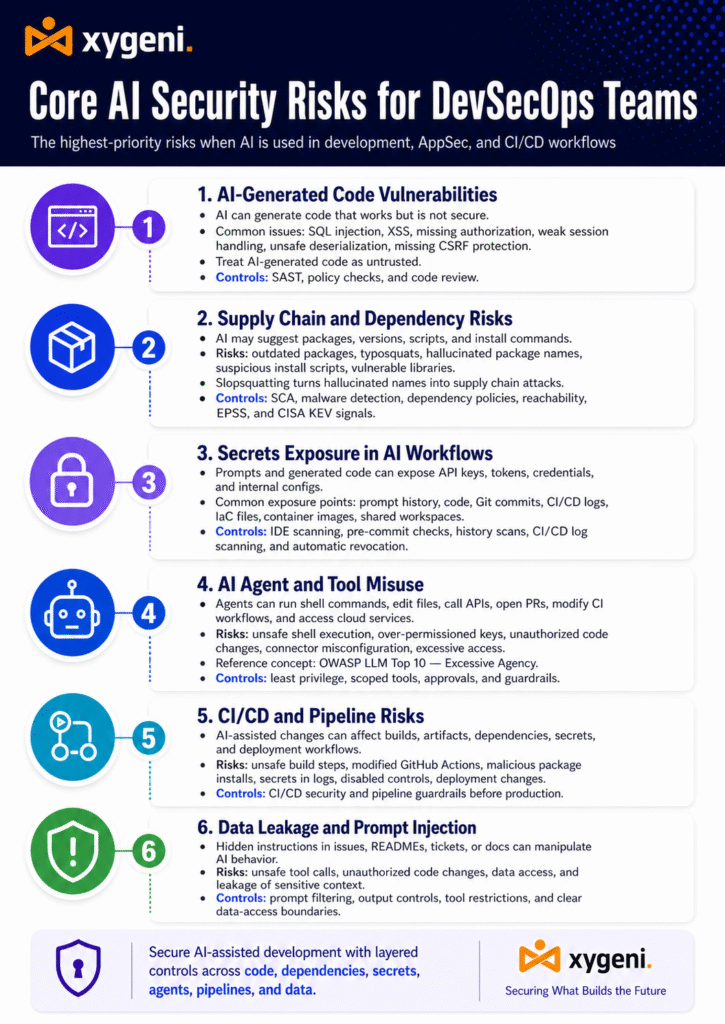
A seguir estão os riscos mais importantes quando a IA é usada no desenvolvimento, segurança de aplicativos (AppSec) e CI/CD workflows.
1. Vulnerabilidades de código gerado por IA
As ferramentas de programação com IA podem gerar código funcional, porém inseguro. Por exemplo, podem criar consultas SQL sem a parametrização adequada, ignorar a validação de entrada ou implementar lógica de autenticação fraca.
Isso ocorre porque muitos sistemas de IA geram padrões de código prováveis com base em dados de treinamento. No entanto, código provável nem sempre é código seguro. Na prática, o modelo pode reproduzir exemplos inseguros porque eles são comuns em repositórios públicos.
Exemplos comuns incluem:
- injeção SQL
- Cross-site scripting
- Verificações de autorização ausentes
- Gestão de sessão fraca
- desserialização insegura
- Ausência de proteção contra CSRF
Portanto, o código gerado por IA deve ser tratado como não confiável até que seja aprovado. SAST, verificações e revisões de políticas.
Sugestão de link interno: conecte esta seção à sua postagem em AI SAST.
2. Riscos da Cadeia de Suprimentos e da Dependência
As ferramentas de IA não apenas geram código. Elas também sugerem pacotes, versões, scripts e comandos de instalação. Isso cria um caminho direto das recomendações da IA para o risco na cadeia de suprimentos de software.
Por exemplo, uma ferramenta de IA pode sugerir:
- Um pacote desatualizado
- Uma dependência com erro tipográfico
- Um nome de pacote alucinado
- Um pacote com scripts de instalação suspeitos
- Uma biblioteca que é vulnerável, mas ainda assim amplamente utilizada.
Além disso, os atacantes podem explorar esse comportamento registrando nomes de pacotes que as ferramentas de IA provavelmente irão inventar. Esse risco é frequentemente chamado de "slopsquatting". Ele transforma a alucinação do modelo em um ataque à cadeia de suprimentos de pacotes.
Para reduzir esse risco, as equipes precisam SCA, detecção de malware, aplicação de políticas de dependência e análise de acessibilidade. Eles também devem usar sinais de explorabilidade, como EPSS e inteligência de exploração ativa do CISCatálogo de vulnerabilidades exploradas conhecidas.
3. Revelação de segredos em fluxos de trabalho de IA
A exposição de segredos é um dos riscos de segurança mais práticos da IA. Os desenvolvedores frequentemente inserem contexto em ferramentas de IA. Esse contexto pode incluir chaves de API, tokens, credenciais, URLs ou configurações internas.
Além disso, o código gerado por IA pode incluir marcadores que parecem reais ou, pior ainda, copiar segredos de volta para os arquivos de origem. pipeline scripts ou registros. Assim que os segredos entram no histórico do Git ou CI/CD registros, eles podem permanecer exploráveis muito tempo depois da data original. commit.
Os pontos de exposição comuns incluem:
- Histórico rápido
- Código gerado
- Git commits
- CI/CD toras
- IaC arquivos
- Imagens de contêiner
- Espaços de trabalho compartilhados
Por esse motivo, as equipes devem combinar a varredura em nível de IDE, pre-commit verificações, varreduras do histórico do repositório, CI/CD Análise de logs e revogação automática.
Sugestão de link interno: conecte esta seção ao seu produto de segurança de segredos ou conteúdo relacionado.
4. Uso indevido de agentes e ferramentas de IA
Agentic AI Introduz uma nova camada de risco porque os agentes não apenas sugerem ações, como também podem executá-las.
Um agente de IA pode executar comandos de shell, editar arquivos, chamar APIs, abrir pull requestsmodificar fluxos de trabalho de CI ou interagir com serviços em nuvem. Embora isso gere enormes ganhos de produtividade, também aumenta o raio de impacto dos erros.
Os principais riscos incluem:
- Execução de shell insegura
- Chaves de API com permissões excessivas
- Alterações de código não autorizadas
- Configuração incorreta do conector MCP ou API
- A ferramenta faz chamadas fora do escopo aprovado.
- Acesso ao ambiente além do que a tarefa exige
A categoria "excesso de acesso" do OWASP LLM Top 10 é especialmente relevante neste caso. Se um agente tiver acesso em excesso, uma instrução incorreta, uma injeção de código ou uma ferramenta comprometida podem se transformar em um incidente de segurança real.
5. CI/CD e Pipeline Riscos
O código gerado por IA eventualmente chega ao pipelineNesse ponto, o risco passa do código-fonte para as compilações, artefatos, segredos, dependências e fluxos de trabalho de implantação.
Por exemplo, uma mudança assistida por IA pode:
- Adicionar uma etapa de compilação insegura
- Modificar um fluxo de trabalho do GitHub Actions
- Extrair um pacote malicioso durante a instalação.
- Imprimir segredos nos registros de compilação
- Desativar um controle de segurança
- Alterar a lógica de implantação
Consequentemente, CI/CD A segurança torna-se essencial para a adoção da IA. Pipeline guardrails Deve-se bloquear padrões inseguros antes que cheguem à produção. Para obter mais informações, consulte nosso conteúdo sobre CI/CD segurança e software supply chain security.
6. Vazamento de Dados e Injeção Imediata
A injeção de informações de entrada é um dos riscos de segurança mais conhecidos em IA, mas frequentemente mal compreendido. Não se trata apenas de um problema de chatbots. Pode afetar qualquer fluxo de trabalho de IA que aceite entradas externas e as utilize para orientar ações.
Por exemplo, uma descrição de problema maliciosa, um arquivo README, um ticket de suporte ou uma página de documentação de dependência podem conter instruções ocultas. Se um agente de IA ler esse conteúdo e segui-lo, o atacante poderá influenciar chamadas de ferramentas, alterações de código ou acesso a dados.
O vazamento de dados pode ocorrer de maneiras semelhantes. O modelo pode revelar contexto sensível, resumir arquivos privados ou enviar dados confidenciais para serviços externos. Portanto, os sistemas de IA precisam de filtragem imediata, controles de saída, restrições de ferramentas e limites claros sobre quais dados eles podem acessar.
Riscos de segurança da IA em todo o mundo SDLC
Os riscos de segurança da IA surgem em diferentes estágios do ciclo de vida do software. A chave é proteger cada estágio, não apenas a aplicação final.
| SDLC Etapa | Risco de segurança da IA | Exemplo | Controle recomendado |
|---|---|---|---|
| IDE | Código inseguro gerado por IA | Um assistente de programação com IA sugere uma lógica de autenticação insegura. | Em tempo real SAST e feedback de codificação seguro. |
| Commit | Exposição de segredos | Um token aparece no código gerado ou commit história. | Detecção de segredos, pre-commit verificações e revogação automática. |
| Pull Request | Ignorar política | O código gerado altera as regras de controle de acesso sem revisão. | PR guardrails e aplicação de políticas. |
| Construir | Dependência maliciosa | Um pacote sugerido por IA apresenta comportamento de instalação suspeito. | SCA, detecção de malware e verificações de políticas de dependência. |
| CI/CD | Pipeline manipulação | Um agente modifica arquivos de fluxo de trabalho ou scripts de implantação. | CI/CD Verificações de segurança e detecção de anomalias. |
| Runtime | Injeção imediata ou vazamento de dados | A entrada externa faz com que um fluxo de trabalho de IA revele um contexto sensível. | Controles imediatos, restrições de acesso e monitoramento. |
Riscos de segurança da IA versus riscos tradicionais de cibersegurança
A cibersegurança tradicional ainda é importante. No entanto, a IA adiciona novos padrões de comportamento que exigem controles diferentes.
| Área | Risco tradicional de segurança cibernética | Risco de segurança da IA |
|---|---|---|
| Code | Vulnerabilidades escritas por humanos. | Padrões inseguros gerados por IA em maior velocidade. |
| Dependências | Pacotes vulneráveis conhecidos. | Pacotes sugeridos por IA que sejam alucinatórios, maliciosos ou inseguros. |
| Segredos | Credenciais acidentalmente committed por desenvolvedores. | Segredos copiados para prompts, código gerado ou registros. |
| Ferramentas | Uso indevido e manual de ferramentas de desenvolvimento. | Agentes autônomos que fazem uso indevido de ferramentas ou APIs. |
| Pipelines | Desconfigurado CI/CD workflows. | Alterações no fluxo de trabalho geradas pelo agente ou automação insegura. |
Exemplos reais de riscos de segurança da IA
O risco de segurança da IA não é teórico. Diversas estruturas públicas e iniciativas de pesquisa agora monitoram essas questões de forma mais formal.
O Repositório de Riscos de IA do MIT O catálogo inclui mais de 1,700 riscos de IA em diferentes causas e domínios. Enquanto isso, a OWASP fornece categorias práticas para riscos de aplicações de gerenciamento de longo prazo (LLM), incluindo injeção imediata, divulgação de informações sensíveis, vulnerabilidades na cadeia de suprimentos e agência excessiva.
Para equipes de DevSecOps, os exemplos mais relevantes geralmente aparecem na entrega de software:
- Ferramentas de IA sugerem código vulnerável
- Agentes de IA modificando arquivos de fluxo de trabalho
- Dependências geradas por IA introduzem exposição na cadeia de suprimentos
- Segredos vazando por meio de prompts, registros ou commits
- Fluxos de trabalho agentivos que chamam ferramentas fora do escopo aprovado
Resumindo, os riscos de segurança da IA tornam-se muito mais sérios quando os sistemas de IA podem acessar código, credenciais, pacotes, pipelines, ou infraestrutura.
Como mitigar os riscos de segurança da IA na prática
A melhor maneira de reduzir os riscos de segurança da IA é tratar o desenvolvimento assistido por IA como parte integrante do processo. SDLCIsso significa realizar varreduras precoces, validações frequentes e aplicar políticas nos locais onde os desenvolvedores realmente trabalham.
1. Analise o código gerado por IA no IDE.
Os desenvolvedores devem visualizar feedback de segurança enquanto escrevem ou aceitam código gerado por IA. Isso reduz a troca de contexto e ajuda a corrigir problemas antes que cheguem ao Git.
Uso:
- SAST no IDE
- Explicações de vulnerabilidades embutidas
- Sugestões de correção segura
- Remediação com base em políticas
Isso é especialmente importante para assistentes de codificação com IA, onde sugestões inseguras podem entrar rapidamente na base de código.
2. Validar as dependências antes da compilação
As dependências sugeridas por IA devem ser verificadas antes de serem instaladas ou distribuídas. Portanto, as equipes devem impor controles de dependência durante o desenvolvimento e CI/CD.
Uso:
- SCA
- Detecção de malware
- Detecção de typosquatting
- Pontuação EPSS
- Análise de acessibilidade
- Bloqueio baseado em políticas
Isso ajuda a priorizar os pacotes que representam risco real, e não apenas exposição teórica.
3. Detectar e revogar segredos automaticamente
A verificação de segredos deve abranger mais do que apenas o código-fonte. Fluxos de trabalho assistidos por IA podem expor credenciais em diversos locais.
Uso:
- Pre-commit exploração
- Verificação do histórico do repositório
- Pipeline verificação de logs
- IaC exploração
- Digitalização de imagem de contêiner
- Revogação automática
Como resultado, as equipes reduzem o tempo entre a exposição e o controle da infecção.
4. Aplicar Guardrails in CI/CD
Guardrails Deve-se decidir se uma alteração é suficientemente segura para prosseguir. A comunicação é útil, mas o bloqueio é necessário para riscos críticos.
Guardrails deve abranger:
- Novas vulnerabilidades críticas
- Segredos
- Dependências maliciosas
- Pacotes não fixados ou não confiáveis
- Alterações inseguras no fluxo de trabalho
- Desaparecido SBOMs
- Violações de política
Além disso, as equipes devem começar com o modo somente relatório quando necessário e, em seguida, passar para o modo de bloqueio à medida que a confiança aumentar.
5. Monitorar o comportamento da ferramenta agentiva
Sistemas de IA agéticos precisam de observabilidade. Se um agente pode editar arquivos, acionar builds ou chamar APIs, as equipes precisam saber o que ele fez, quando fez e se a ação era esperada.
Monitor:
- Chamadas de ferramentas
- Alterações no arquivo de fluxo de trabalho
- Atividade de escrita no repositório
- Destinos de rede
- Acesso secreto
- Pull request criação
- Pipeline desencadeia
Sem essa visibilidade, torna-se difícil confiar na autonomia do agente.
Onde a Xygeni ajuda a reduzir os riscos de segurança da IA
A Xygeni se concentra em proteger o desenvolvimento assistido por IA em toda a cadeia de entrega de software. Em vez de tratar o risco da IA como uma categoria separada, ela conecta código, dependências, segredos, pipelines e contexto empresarial.
Por exemplo:
- SAST Ajuda a detectar precocemente códigos inseguros gerados por IA.
- SCA Valida dependências e detecta pacotes maliciosos.
- Segurança de Segredos detecta credenciais expostas em repositórios e pipelines.
- Segurança de CI/CD Garante o cumprimento das políticas antes que mudanças inseguras sejam implementadas.
- Detecção de Anomalias Identifica comportamentos incomuns nos fluxos de trabalho de desenvolvimento e entrega.
- ASPM Correlaciona as descobertas em uma visão de risco única para que as equipes possam priorizar o que é importante.
Isso é importante porque os riscos de segurança da IA são, por natureza, multicamadas. Uma dependência vulnerável, um token exposto e uma alteração insegura no fluxo de trabalho podem parecer isolados em ferramentas pontuais. No entanto, juntos, podem representar um caminho de ataque muito maior.
Estruturas de Gestão de Riscos de Segurança de IA que Você Precisa Conhecer
Diversas estruturas ajudam as equipes a estruturar seu trabalho.
O Estrutura de gerenciamento de risco NIST AI Ajuda as organizações a mapear, mensurar, gerenciar e governar os riscos da IA. É útil para programas de liderança, conformidade e gestão de riscos.
O OWASP Top 10 para candidaturas a mestrado em Direito (LLM) É mais prático para equipes de segurança de aplicativos (AppSec) porque se relaciona diretamente a riscos técnicos, como injeção rápida, exposição de dados confidenciais, vulnerabilidades na cadeia de suprimentos e agência excessiva.
O Diretrizes do NCSC sobre IA e segurança cibernética É útil para líderes de segurança que precisam entender como a IA altera o risco cibernético organizacional.
Em conjunto, esses recursos demonstram um ponto claro: a segurança da IA deve ser gerenciada em todas as esferas de atuação: pessoas, processos, sistemas e fluxos de trabalho de entrega de software.
Lista de verificação: como reduzir os riscos de segurança da IA
Use esta lista de verificação como um ponto de partida prático.
| Área de Controle | O que fazer | Por que isso importa |
|---|---|---|
| Código gerado por IA | Execute SAST no IDE, PR e CI/CD pipeline. | Impede que código inseguro chegue à produção. |
| Dependências | Uso SCA, detecção de malware, EPSS e acessibilidade. | Bloqueia pacotes sugeridos por IA que sejam considerados de risco. |
| Segredos | Escanear commits, registros, histórico, IaC, e contêineres. | Reduz a exposição e o uso indevido de credenciais. |
| CI/CD | aplicar pipeline guardrails e portões de política. | Impede compilações e implantações inseguras. |
| Ferramentas de agentes | Monitore chamadas de ferramentas, acesso à API e alterações no fluxo de trabalho. | Limita a autonomia excessiva e o comportamento inesperado. |
| Gestão de riscos | Uso ASPM correlacionar as descobertas entre as camadas. | Ajuda as equipes a se concentrarem nos riscos reais dos negócios. |
Principais lições
- Os riscos de segurança da IA agora afetam código, dependências e segredos. pipelines e agentes.
- As ferramentas tradicionais de segurança de aplicativos ainda são necessárias, mas devem ser executadas mais cedo e com mais contexto.
- O código gerado por IA deve ser tratado como não confiável até que seja validado.
- Os fluxos de trabalho de agentes de IA precisam de guardrailspermissões e observabilidade.
- As equipes de DevSecOps precisam de visibilidade unificada em toda a organização. SDLC Para gerenciar o risco da IA de forma eficaz.
Perguntas frequentes: Riscos de segurança da IA
Quais são os riscos de segurança da IA?
Os riscos de segurança da IA são ameaças ou vulnerabilidades que surgem quando os sistemas de IA são construídos, integrados ou utilizados. Eles podem afetar modelos, dados, prompts, código, dependências, APIs e pipelines.
Quais são os maiores riscos de segurança da IA para equipes DevSecOps?
Os maiores riscos incluem código inseguro gerado por IA, dependências vulneráveis, exposição de segredos, injeção imediata, permissões excessivas do agente e insegurança. CI/CD automação.
Por que os riscos de segurança da IA são diferentes dos riscos tradicionais de segurança cibernética?
Os sistemas de IA podem gerar código, sugerir dependências, acionar ferramentas e agir de forma autônoma. Como resultado, os riscos surgem mais rapidamente e em mais camadas da organização. SDLC.
Como as equipes podem reduzir os riscos de segurança da IA?
As equipes podem reduzir riscos analisando o código gerado por IA, validando dependências, detectando segredos e aplicando políticas de segurança. CI/CD guardrails, monitorando o comportamento do agente e correlacionando as descobertas por meio de ASPM.
O código gerado por IA é seguro?
O código gerado por IA não é seguro por padrão. Ele deve ser revisado, analisado, testado e validado antes de entrar em produção.
Considerações finais: Os riscos de segurança da IA precisam ser analisados. SDLC-Controles de nível
A IA altera a velocidade e a natureza dos riscos de software. Ela ajuda as equipes a desenvolver mais rapidamente, mas também introduz novas formas de código inseguro, segredos expostos, dependências inseguras e automação arriscada entrarem na cadeia de entrega.
Portanto, a segurança da IA não pode ser tratada apenas com governança de modelos ou documentos de políticas. Ela precisa de controles práticos dentro da própria IA. SDLCFeedback sobre o IDE, SAST, SCA, detecção de segredos, CI/CD guardrails, detecção de anomalias e ASPMCorrelação de nível -
As equipes que gerenciarem bem os riscos de segurança da IA não serão as que bloquearão a adoção da IA. Serão elas que construirão a camada de segurança adequada ao seu redor.