Pourquoi les outils d'analyse statique de code sont essentiels en 2026
L'analyse statique du code n'est plus une option ; c'est une pratique fondamentale pour toute équipe développant rapidement des logiciels. Le même bug découvert en production peut coûter jusqu'à 10 000 dollars. Sans compter le temps de développement détourné des fonctionnalités, la dégradation de l'expérience utilisateur ou l'atteinte à la réputation en cas d'incident de sécurité, l'analyse statique du code comble cette lacune en analysant le code source avant sa mise en production.
Les enjeux sont plus importants en 2026. D'après les propres recherches de Xygeni, 60 % des applications contiennent des vulnérabilités dans leur code interne. Avec l'accélération du développement assisté par l'IA qui génère un volume de code toujours plus important, la fenêtre d'opportunité pour détecter les problèmes avant la mise en production est plus étroite que jamais. L'essor du DevSecOps, du codage assisté par l'IA et de la complexité croissante des systèmes rend cette situation encore plus critique. CI/CD pipelineDésormais, disposer du bon outil d'analyse statique n'est plus une option.
Cependant, tous les outils d'analyse statique de code n'offrent pas la même valeur ajoutée. Certains génèrent un grand nombre de faux positifs. D'autres passent complètement à côté de failles critiques exploitables. Et la plupart se limitent à la détection des vulnérabilités, ignorant les menaces de code malveillant qui arrivent désormais couramment via les dépendances open source et le code généré par l'IA.
Cet article compare les 4 meilleurs outils d'analyse statique de code pour 2026, évalués selon ce qui compte vraiment : la précision de la détection, les taux de faux positifs et la couverture des logiciels malveillants. CI/CD intégration et tarification.
Comparatif rapide : Les meilleurs outils d’analyse statique de code pour 2026
| Outil | Taux de vrais positifs | Taux de faux positifs | Détection de logiciels malveillants | Réparation automatique de l'IA | Prix | Idéal pour |
|---|---|---|---|---|---|---|
| Xygéni SAST | 100 % (Référence OWASP) | 16.7 % | Oui — natif | Oui — corrections de relations publiques contextuelles | À partir de 35 $/mois par contributeur (plateforme complète) | Les équipes DevSecOps qui ont besoin de précision, de détection de logiciels malveillants et d'une couverture complète de la plateforme |
| Code Snyk | 97.18 % | 34.55 % | Non | Suggestions de correction partielles | À partir de 125 $/mois (minimum 5 contributeurs), SAST seulement) | Des équipes privilégiant les développeurs sont déjà présentes dans l'écosystème Snyk. |
| SemgrepName | 87.06 % | 42.09 % | Non | Non | À partir de 100 $/mois par contributeur | Les équipes qui ont besoin d'une analyse rapide et personnalisable basée sur des règles |
| SonarQube | 50.36 % | Variable | Non | Non | À partir de 65 $/mois (SAST uniquement, paiement par lettre de crédit) | Des équipes se concentrent sur la qualité du code et la dette technique. |
Qu’est-ce qui distingue les meilleurs outils d’analyse de code statique ?
Tous les outils d'analyse statique de code n'offrent pas le même niveau de protection. Les plateformes les plus performantes en 2026 partagent les fonctionnalités suivantes :
Détection précise avec un faible taux de faux positifs
Les meilleurs outils privilégient les vulnérabilités réelles et exploitables plutôt que de générer du bruit. Un taux élevé de vrais positifs, combiné à un faible taux de faux positifs, permet aux développeurs de consacrer leur temps à corriger les problèmes réels, au lieu de courir après des alertes inutiles.
Remédiation basée sur l'IA
La détection sans correction crée des goulots d'étranglement. Recherchez des outils qui fournissent des suggestions de correction contextuelles directement dans pull requests, en remplaçant les schémas risqués par des alternatives sûres sans nécessiter de correction manuelle.
Détection des logiciels malveillants et de la chaîne d'approvisionnement
Les outils d'analyse statique de code traditionnels recherchent les vulnérabilités du code. Ils ne détectent pas les codes malveillants. Les meilleures plateformes vont plus loin et identifient les portes dérobées, les chevaux de Troie, les rançongiciels, l'exécution de code obscurcie et la falsification du registre système, aussi bien dans le code propriétaire que dans les dépendances open source.
CI/CD et intégration IDE
L'analyse statique du code doit être exécutée en continu, et non seulement avant la mise en production. Recherchez des intégrations natives avec GitHub Actions, GitLab CI, Jenkins, Azure DevOps et Bitbucket, ainsi que des plugins pour environnements de développement intégrés (IDE) qui affichent les résultats au fur et à mesure de l'écriture du code.
Priorisation basée sur l'exploitabilité
Le nombre brut de résultats génère du bruit, pas d'informations pertinentes. Les meilleurs outils filtrent les résultats selon leur accessibilité, leur exploitabilité et leur impact commercial, permettant ainsi aux équipes de se concentrer sur les points essentiels en priorité, et non sur les éléments ayant le score CVSS le plus élevé.
Validation des performances de référence OWASP
Le choix d'un outil d'analyse statique de code doit se fonder sur des résultats mesurables, et non sur les affirmations des fournisseurs. Le projet OWASP Benchmark fournit un exemple de ce type d'outil. standardCadre d'analyse indépendant et structuré permettant d'évaluer la précision de la détection par rapport aux vulnérabilités connues dans des cas de test réels. Demandez toujours des données de référence avant toute analyse. commitse connecter à un outil.
Meilleurs outils d'analyse de code statique
1. Xygéni SASTAnalyse statique de code conçue pour le DevSecOps

Aperçu : Xygéni SAST n'est pas un simple outil d'analyse statique de code. Il est conçu spécifiquement pour les équipes DevSecOps qui ont besoin d'une analyse préalable.cisDétection, correction automatisée et protection complète, sans ralentir le développement.
Là où la plupart des outils d'analyse statique de code se limitent à la détection des vulnérabilités, Xygeni va plus loin : il combine une analyse statique approfondie avec une détection intelligente des logiciels malveillants, des suggestions de correction basées sur l'IA et une priorisation selon l'accessibilité. Le résultat ? Un outil qui repère ce que les autres laissent passer, filtre les informations superflues et aide les développeurs à corriger les problèmes les plus importants, directement au sein de leurs flux de travail existants.
Xygéni SAST fait également partie de la plateforme tout-en-un Xygeni, ce qui signifie SAST Les résultats sont automatiquement corrélés avec SCA, détection de secrets, CI/CD sécurité, DAST et ASPM, offrant ainsi aux équipes une vue unifiée des risques sur l'ensemble du système SDLC.
Caractéristiques principales:
- Taux de vrais positifs de 100 % (référence OWASP) : Aucune détection manquée d'injection SQL et de script intersite (XSS). Aucun faux positif concernant le chiffrement et le hachage faibles.
- Faible taux de faux positifs (16.7 %) : Réduit la fatigue liée aux alertes et permet aux développeurs de se concentrer sur les problèmes exploitables plutôt que sur le bruit inutile.
- Correction automatique de l'IA : Génère des correctifs de code sécurisés et contextuels, livrés directement à pull requestsRemplace les schémas risqués par des alternatives sûres conformes aux meilleures pratiques linguistiques ; aucune correction manuelle n’est requise.
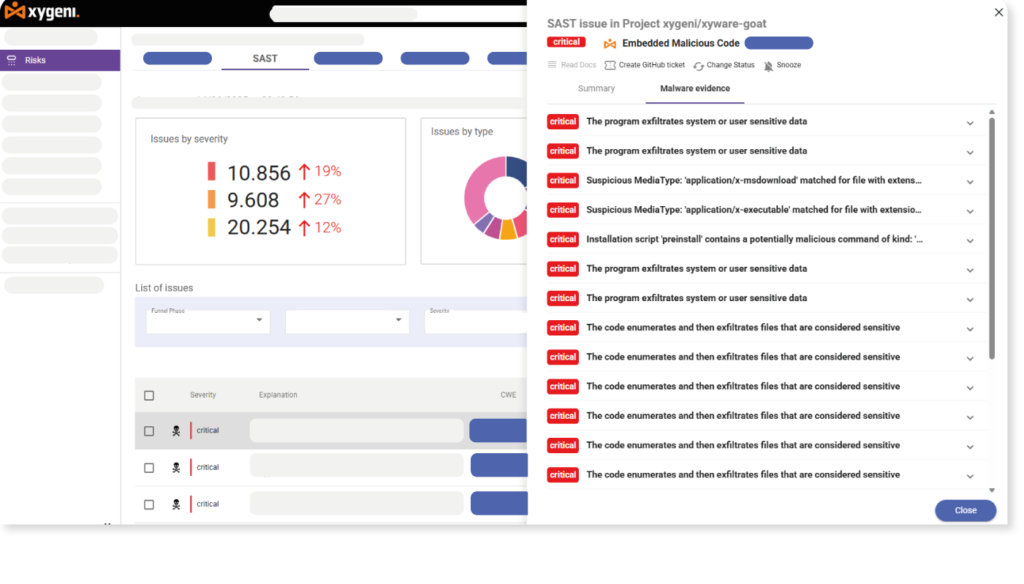
- Détection de logiciels malveillants : Détecte les portes dérobées, les chevaux de Troie, les vers, les rançongiciels, les logiciels espions, l'exécution de code obscurci et la falsification du registre système, aussi bien dans le code propriétaire que dans les dépendances open source. Une fonctionnalité dont la plupart des outils d'analyse statique de code sont totalement dépourvus.
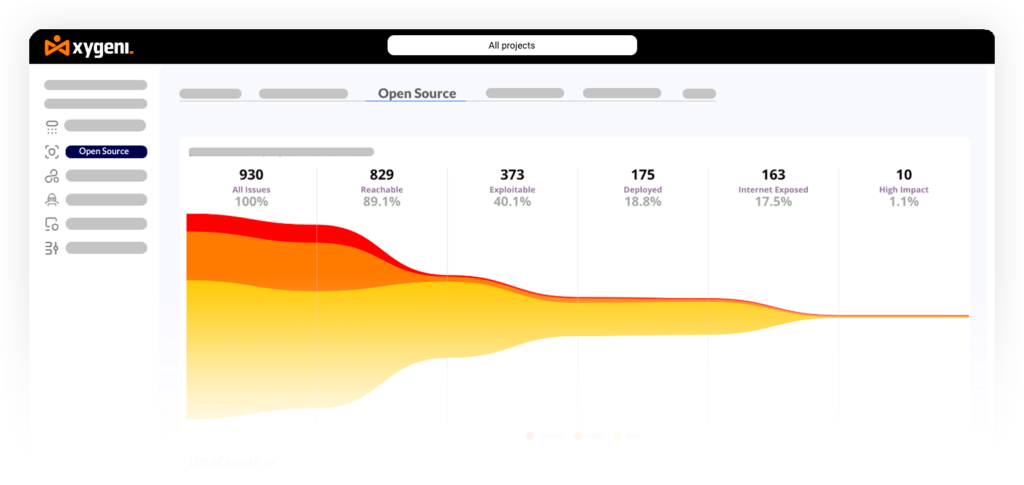
- Entonnoir de priorisation de l'exploitabilité : Filtre les résultats en fonction de leur accessibilité, de leur exploitabilité et de leur impact commercial afin que les équipes s'attaquent à ce qui est réellement dangereux, et pas seulement à ce qui existe.
- Intégration de l'EDI : Analysez le code tel qu'il est écrit. Consultez les détails du problème, sa gravité, ses métadonnées et les conseils de correction directement dans votre IDE, avant qu'une commit est fait.
- CI/CD Intégration: Prise en charge native de GitHub Actions, GitLab CI, Jenkins, Azure DevOps et Bitbucket, avec des contrôles de qualité bloquant les builds vulnérables.
- Couverture complète des vulnérabilités : Failles d'injection, XSS, erreurs de configuration, fuites d'informations, dépassements de tampon, authentification insuffisante et contrôle d'accès non sécurisé, dans le code propriétaire et le code généré par l'IA.
(I.e. Prix
Xygéni SAST est inclus dans la plateforme tout-en-un Xygeni à partir de 35 $/mois par contributeur. Cela inclut SAST, SCA, CI/CD Sécurité, détection de secrets, IaC Security, DAST et ASPM, sans limites cachées, sans frais par dépôt et sans restriction d'accès aux fonctionnalités.
En résumé : Xygéni SAST Cette solution est le choix idéal pour les équipes qui recherchent une détection fiable, une remédiation basée sur l'IA et une protection contre les logiciels malveillants sur une plateforme unique. Son taux de détection de 100 % sur le benchmark OWASP, son faible taux de faux positifs et sa protection native de la chaîne d'approvisionnement la distinguent de tous les autres outils de cette liste.
2. Snok Sast Outil
Aperçu : Snyk Code est connu pour être un outil rapide et facile à utiliser outil d'analyse de code statique Conçu pour les développeurs, il fournit des informations de sécurité en temps réel, à la fois dans les IDE et CI/CD pipelines, qui permet d'identifier les problèmes en amont sans perturber les flux de travail. La configuration est simple et s'intègre parfaitement aux environnements de développement modernes.
Cependant, malgré sa conception axée sur les développeurs, l'outil présente un taux de faux positifs relativement élevé. Il ne dispose pas non plus d'une fonction intégrée de détection des logiciels malveillants, ce qui impose aux équipes de sécurité une plus grande responsabilité de vérification manuelle des résultats.
Caractéristiques principales:
- Taux de vrais positifs de 97.18 % : Détecte avec précision la plupart des vulnérabilités lors analyse statique du code.
- CI/CD et intégration IDE : Fonctionne directement dans les outils de développement populaires pour une analyse continue.
Limites à considérer
- Taux de faux positifs de 34.55 % : Niveau sonore élevé susceptible de submerger les équipes de sécurité et de retarder les interventions.
- Aucune détection de logiciel malveillant : Impossible d'identifier le code malveillant dans les dépendances tierces ; des outils supplémentaires sont nécessaires.
- SAST est secondaire : Snyk a bâti sa réputation sur SCALe code Snyk ne correspond pas à la profondeur des applications dédiées SAST outils.
- Tarification fragmentée : SAST, SCA, le scan des conteneurs et IaC sont vendus séparément ; une couverture complète nécessite une sur mesure enterprise citation.
(I.e. Prix :
À partir de 125 $/mois pour un minimum de 5 contributeurs, SAST seulement. SCA, CI/CD Sécurité, détection de secrets, IaC SecurityL'analyse des conteneurs et le scan de conteneurs ne sont pas inclus et doivent être achetés séparément. Seuls 100 tests sont inclus ; les tests supplémentaires nécessitent des options coûteuses. Enterprise Un forfait est requis pour plus de 10 contributeurs.
En résumé : Snyk Code est un excellent choix pour les équipes de développeurs déjà présentes dans l'écosystème Snyk et qui souhaitent obtenir des résultats rapides et précis sans configuration complexe. Pour les équipes exigeant une plus grande précision, la détection de logiciels malveillants ou une plateforme AppSec unifiée, d'autres options de cette liste seront plus adaptées.
3. Semgrep Sast Outil
Aperçu : Semgrep est un outil d'analyse statique de code open source qui privilégie la flexibilité et la rapidité. Il permet aux équipes de sécurité et de développement de rédiger des règles personnalisées, adaptées à leur code et à leurs politiques spécifiques, sans nécessiter de compilation. Cela le rend idéal pour obtenir rapidement des retours d'information. CI/CD pipelineet les programmes de sécurité « shift-left » où l'application de politiques personnalisées est importante.
Semgrep se distingue par sa personnalisation et sa rapidité. Son point faible réside dans sa précision : avec un taux de vrais positifs de 87.06 % et un taux de faux positifs de 42.09 % sur le benchmark OWASP, il génère plus de bruit et passe à côté de plus de problèmes réels que les outils les mieux notés de cette liste. De plus, il ne propose aucune détection de logiciels malveillants.
Caractéristiques principales:
- Prise en charge des règles personnalisées : Les équipes peuvent rédiger et appliquer des règles de sécurité spécifiques à leurs applications, grâce à une syntaxe de règles simple et sans expertise en DSL.
- Analyses rapides sans compilation : Fournit un retour d'information rapide dans le cadre d'une analyse statique continue pipelines.
- Prise en charge linguistique étendue : Couvre un large éventail de langages et de frameworks.
- CI/CD Intégration: S'intègre à GitHub Actions, GitLab CI et autres pipeline outils.
- Noyau open source : Utilisation gratuite pour la numérisation de base ; les abonnements commerciaux ajoutent des règles professionnelles et des fonctionnalités d’équipe.
Limites à considérer
- Taux de vrais positifs de 87.06 % : Moins fiable que les principaux outils d'analyse statique de code pour détecter les problèmes critiques.
- Taux de faux positifs de 42.09 % : Le taux de faux positifs le plus élevé de cette liste peut être réduit par l'investissement dans des règles personnalisées, mais cela exige un effort continu et important.
- Aucune détection de logiciel malveillant : Impossible d'identifier un code malveillant dans les composants tiers.
- Pas de correction automatique par IA : La correction est manuelle ; les résultats nécessitent une enquête de la part des développeurs, sans guide de correction automatisé.
- Tarification par contributeur : Chaque contributeur a besoin d'une licence valable pour tous les produits ; il n'est pas possible de combiner différents niveaux de couverture.
(I.e. Prix :
À partir de 100 $/mois par contributeur pour l'ensemble des modules Code, Supply Chain et Secrets. Aucune flexibilité : l'achat de Semgrep Code requiert le même nombre de licences pour Supply Chain et Secrets. Les coûts sont proportionnels à la taille de l'équipe.
En résumé : Semgrep est parfaitement adapté aux équipes d'ingénierie de sécurité qui souhaitent créer des règles de détection personnalisées et peuvent investir dans leur optimisation. Pour les équipes qui ont besoin d'une précision élevée dès l'installation, d'une remédiation basée sur l'IA ou d'une protection contre les logiciels malveillants, il est préférable de l'utiliser en complément d'une plateforme plus complète.
4. Sonar Qube SAST Outil

Aperçu : SonarQube est l'une des plateformes de qualité de code les plus largement utilisées, offrant un soutien important pour la promotion d'un code propre. standards, en réduisant la dette technique et en s'intégrant aux technologies populaires CI/CD Il propose des outils de détection des points chauds de sécurité et d'analyse de vulnérabilités de base, mais son principal atout réside dans la qualité du code, et non dans l'analyse statique de niveau sécurité.
Sur le benchmark OWASP, SonarQube obtient un taux de vrais positifs de 50.36 %, ce qui signifie qu'il manque environ la moitié des vulnérabilités réelles. standardIl propose des cas de test prédéfinis. Il n'offre pas la détection de logiciels malveillants, la correction automatique par IA ni la priorisation basée sur l'exploitabilité. Pour les équipes ayant des exigences de sécurité élevées, il est idéal en complément d'une solution dédiée à la qualité du code. SAST un outil plutôt qu'une solution de sécurité autonome.
Fonctionnalités clés
- Analyse de la qualité du code : applique standards pour la lisibilité, la structure et la maintenabilité à long terme dans plus de 30 langages.
- CI/CD Intégration: Compatible avec Jenkins, GitLab, Azure DevOps, GitHub Actions et bien plus encore.
- Points d'accès de sécurité : Signale les zones de code potentiellement risquées, mais une vérification manuelle est nécessaire pour confirmer leur exploitabilité.
- Éditions Cloud et autogérées : Déploiement flexible pour les équipes avec on-premise exigences.
- Grand écosystème : Largement adopté, bénéficiant d'un fort soutien communautaire et d'une grande disponibilité de plugins.
Limites à considérer
- Taux de vrais positifs de 50.36 % : Détecte moins de la moitié des vulnérabilités réelles du benchmark OWASP, soit le score le plus bas de cette liste.
- Profondeur de sécurité limitée : Plus adapté à l'hygiène du code qu'à l'analyse approfondie des vulnérabilités ou à la sécurité de la chaîne d'approvisionnement.
- Aucune détection de logiciel malveillant : Ne détecte pas les comportements malveillants dans le code interne ou tiers.
- Pas de correction automatique par IA : Correction manuelle requise pour toutes les anomalies.
- Tarification au coût par ligne de code : Le tarif commence à partir de 100 000 lignes de code et augmente de 6 $ par tranche de 10 000 lignes de code ; les coûts augmentent considérablement pour les bases de code importantes.
(I.e. Prix :
À partir de 65 $/mois pour le forfait Équipe, SAST Uniquement. Modèle de paiement à la ligne de connexion (LoC) avec une limite stricte de 1.9 million de LoC. Aucune couverture de sécurité globale.
En résumé : SonarQube est le choix idéal pour les équipes qui privilégient la qualité du code, sa maintenabilité et la gestion de la dette technique. En tant qu'outil de sécurité autonome, sa faible précision selon le benchmark OWASP implique qu'il doit être associé à un système dédié. SAST Plateforme pour les équipes ayant de véritables exigences de sécurité.
Pourquoi Xygeni SAST Quel est le meilleur outil d'analyse statique de code pour 2026 ?
Chaque outil de cette liste a un cas d'utilisation précis. Snyk convient aux équipes déjà intégrées à l'écosystème Snyk et qui souhaitent obtenir rapidement des résultats destinés aux développeurs. Semgrep est destiné aux ingénieurs en sécurité qui ont besoin de règles personnalisées et d'analyses rapides. SonarQube excelle dans la gouvernance de la qualité du code et la gestion de la dette technique.
Mais aucun d'entre eux ne combine la précision de la détection, la protection contre les logiciels malveillants, la remédiation par IA et une couverture complète de la plateforme de cette manière Xygéni t.
Xygéni SAST est le seul outil de cette liste à atteindre un taux de vrais positifs de 100 % sur le benchmark OWASP, avec le taux de faux positifs le plus bas à 16.7 %. C'est le seul outil qui détecte les codes malveillants dans les composants internes et tiers. Et c'est le seul outil où SAST Les résultats sont intrinsèquement corrélés avec SCA, détection de secrets, CI/CD Sécurité, DAST et ASPM, afin que les équipes de sécurité aient une vision globale des risques, et non pas des résultats d'analyse isolés.
Pour les équipes qui prennent au sérieux le développement sécurisé dans le L'ère de l'IA (où le code généré par l'IA, les dépendances compromises et l'accélération du volume des menaces sont devenus la norme) Xygeni SAST est le choix le plus complet, précis et économique de cette liste.
Précision de détection inégalée - Taux de vrais positifs de 100 % - Référence OWASP prouvée
Questions fréquemment posées
Qu'est-ce que l'analyse de code statique ?
L'analyse statique du code, également connue sous le nom de SAST (Tests de sécurité statiques des applications) est le processus d'analyse du code source, du bytecode ou des binaires sans exécuter le programme afin d'identifier les vulnérabilités de sécurité, les erreurs de codage et les violations de politique avant le déploiement de l'application.
Quelle est la différence entre SAST et DAST ?
SAST L'analyse du code source avant déploiement permet de détecter les vulnérabilités dès la phase de codage. Les tests DAST, quant à eux, consistent à tester les applications en cours d'exécution depuis l'extérieur, en simulant des attaques réelles contre les services en production afin d'identifier les vulnérabilités d'exécution. La plupart des programmes DevSecOps matures utilisent ces deux approches, et des plateformes comme Xygeni les intègrent nativement.
Les outils d'analyse statique de code peuvent-ils détecter les logiciels malveillants ?
La plupart ne le peuvent pas. Traditionnel SAST Ces outils analysent les vulnérabilités du code ; ils ne détectent pas les codes intentionnellement malveillants. Xygeni SAST Il va plus loin en identifiant les portes dérobées, les chevaux de Troie, les ransomwares, l'exécution obfusquée et la falsification du registre système dans le code propriétaire et les dépendances open source, une capacité essentielle à mesure que les attaques contre la chaîne d'approvisionnement se développent.
Qu’est-ce que le benchmark OWASP et pourquoi est-il important ?
Le projet OWASP Benchmark est un projet indépendant, standardcadre stylisé qui mesure la précision SAST Ces outils détectent les vulnérabilités connues dans des cas de test réels. Il s'agit de la source indépendante la plus fiable pour comparer les outils d'analyse statique de code, et elle est bien plus digne de confiance que les arguments marketing des fournisseurs.
Dois-je utiliser l'analyse statique de code en parallèle ? SCA?
Oui. SAST détecte les vulnérabilités dans votre propre code. SCA identifie les risques liés à vos dépendances open source. Ensemble, ils couvrent les deux surfaces d'attaque. Les plateformes comme Xygeni intègrent les deux nativement (avec des résultats corrélés dans une vue unique des risques), éliminant ainsi le besoin de gérer des outils distincts. dashboards.