| If you need to... | Weiderliesen |
|---|---|
| Find vulnerabilities in your own code | Top SAST Tools |
| Check open-source dependencies for CVEs and licenses | Top 10 Tools fir d'Analyse vun der Softwarekompositioun |
| Test running apps and APIs like an attacker | Déi bescht Tools fir dynamesch Applikatiounssécherheetstester (DAST) |
| Find vulnerabilities across your apps and infrastructure | Top 10 Vulnerability Scanning Tools |
| Detect malicious packages | Top 5 Open-Source Malware Scanner |
| Generate and manage SBOMs | Top 6 SBOM Tools |
| Secure Terraform and Kubernetes templates | Top 7 IaC Tools |
| Secure your DevOps toolchain | Top 10 DevOps Sécherheetsinstrumenter |
| Secure AI models, agents and LLM apps | Top AI Security Tools |
| Run automated, AI-driven penetration tests | Top AI Pentesting Tools |
Each list compares tools on the same criteria: detection coverage, accuracy and false positives, fit with the developer workflow (IDE, pull requests, CI/CD), deployment options (SaaS, on-premises, air-gapped), integrations, and pricing transparency. We base our comparisons on vendor documentation, public pricing, and product testing where available, and we refresh each list for the new year and whenever the market changes.
Mir enthalen Xygeni in the categories where it competes, and we note this in each list so you can weigh our view accordingly.
Already shortlisting tools for 2027? See how Xygeni compares side by side with the platforms you’re evaluating.

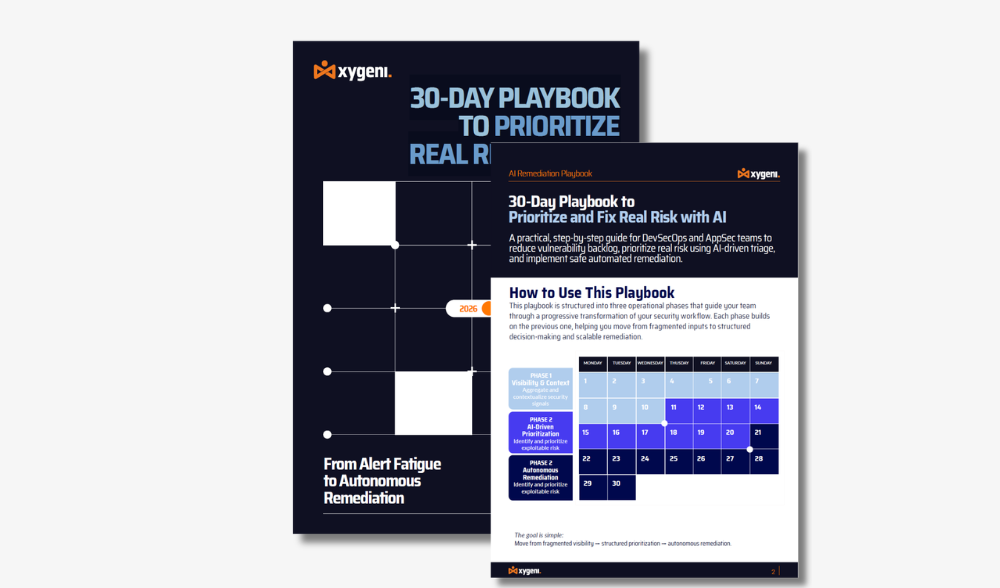
Dëst praktescht 30-Deeg-Spillbuch weist, wéi DevSecOps- an AppSec-Teams Kaméidi reduzéiere kënnen, richteg ausnotzbar Risiken prioritär behandelen an KI-gestëtzte Sanéierung sécher am ganze System aféiere kënnen. SDLCEntdeckt wéi Dir Resultater vereenegt kënnt SAST, SCA, Geheimnisser, IaC, an CI/CD, d'Prioriséierung vun de Schwachstelle mat kontextueller Risikoanalyse verbesseren an eng kontrolléiert Automatiséierung implementéieren, ouni u Visibilitéit oder Kontroll ze verléieren. Luet de Playbook erof a léiert, wéi Dir a just 30 Deeg vun enger reaktiver Triage op eng skalierbar, intelligent Sanéierung wiesselt.
Kuckt elo eise Webinar Vibe Coding Without Regret. KI transforméiert d'Aart a Weis wéi Software gebaut gëtt, mat Copiloten an KI-Agenten, déi en ëmmer méi groussen Undeel vum Produktiounscode generéieren. An dëser Sessioun gesitt Dir, wéi Dir KI-generéierte Code direkt an der IDE séchere kënnt, mat Echtzäit-Vulnerabilitéitserkennung, guardrails fir Copilot, an Erreechbarkeetsbaséiert Prioriséierung. Entdeckt wéi KI-gestëtzte Sanéierung Entwéckler hëlleft, Problemer effizient ze léisen a sécher, KI-gedriwwe Software ze bauen, ouni d'Kontroll ze verléieren. Kuckt et elo fir ze léieren, wéi Dir sécher, KI-gedriwwe Software vun Ufank un baut.
Three shifts are reshaping how teams choose security tools for 2027. First, AI coding assistants and agents now write and change a large share of production code, so security has to run where that code is written, not weeks later. Second, software supply chain attacks keep growing, from malicious packages to compromised CI/CD pipelines, and regulations like NIS2, DORA and the EU Cyber Resilience Act turn supply chain security into a compliance requirement. Third, AI is now part of the application itself, which adds a new attack surface: models, prompts, agents and MCP servers.
No single scanner covers all of it. That’s why teams combine several types of tools, and why choosing the right ones, and making them work together, matters as much as choosing the best one in each category.
Most software teams need SAST to find flaws in their own code, SCA to check open-source dependencies, secrets detection to stop leaked credentials and DAST to test running applications. In 2027, more teams also add malware detection for open-source packages, CI/CD security and, if they build with AI, AI security tools.
SAST analyzes your source code without running it, to find vulnerabilities such as SQL injection early. DAST tests the running application from the outside, the way an attacker would. SCA checks the open-source dependencies you import for known vulnerabilities, license issues and, in some tools, malicious packages.
Many teams start with separate tools, then struggle with duplicated alerts and no shared view of risk. An Application Security Posture Management (ASPM) platform brings findings from every scanner, including third-party tools you already use, into one prioritized view, so you can consolidate without ripping anything out.
We refresh each list for the new year and update it whenever vendors release major capabilities, change pricing or new tools enter the category. Each list shows the date of its last update.