Tout ingénieur en sécurité finit par poser la question suivante : Qu'est-ce qu'une fausse alerte positive ? et pourquoi c'est important en cybersécurité. fausse alerte positive Cela se produit lorsqu'un outil de sécurité signale une menace inexistante. De plus, en DevSecOps, les faux positifs peuvent ralentir le développement et engendrer une perte de temps, les équipes devant enquêter sur des problèmes qui s'avèrent finalement inoffensifs.
Par exemple, un scanner automatisé pourrait signaler une dépendance obsolète comme vulnérable alors que la fonction concernée n'est jamais exécutée. Ce scénario courant illustre pourquoi fausses alertes positives en cybersécurité Cela peut entraîner une lassitude face aux alertes et un ralentissement des mesures correctives. Par conséquent, minimiser le bruit est aussi important que détecter les risques réels.
Comprendre les fausses alertes en cybersécurité #
Les fausses alertes positives peuvent provenir de diverses sources, notamment des scanners statiques, de l'analyse de la composition logicielle (SCADes outils ou des bases de données de vulnérabilités peuvent s'avérer inutiles. Un exemple typique est celui d'une dépendance vulnérable signalée alors que la fonction concernée n'est jamais utilisée dans l'application. Bien que l'alerte soit techniquement exacte, elle est en pratique sans conséquence.
Selon le Glossaire du NISTUn faux positif est une erreur de détection où un comportement bénin est classé à tort comme une menace. Il en résulte des inefficacités opérationnelles, une saturation d'alertes et une perte de confiance dans les outils de sécurité.
Causes des fausses alertes positives #
Plusieurs facteurs contribuent aux faux positifs dans les environnements de sécurité modernes. Parmi ceux-ci :
Analyse de l'accessibilité manquante
Les vulnérabilités sont signalées sans qu'il soit possible de déterminer si le code concerné est exécuté.
Absence de notation d'exploitabilité
Toutes les vulnérabilités ne peuvent pas être exploitées dans un contexte spécifique, mais de nombreux outils les traitent de la même manière.
Logique de détection obsolète ou superficielle
Les outils utilisant des signatures basées sur des modèles sans contexte sont sujets à un sursignalement.
Aucune corrélation croisée
Lorsque les outils ne parviennent pas à corréler les résultats entre SAST, SCAet en cours d'exécution, le bruit augmente.
Environnements DevOps complexes
Des motifs inhabituels dans CI/CD peut être confondue avec une activité malveillante si elle n'est pas interprétée correctement.
De plus, bon nombre de ces alertes ne sont pas hiérarchisées en fonction de leur impact sur l'activité, ce qui rend difficile la distinction entre les problèmes urgents et les constatations non pertinentes.
Pourquoi la réduction des faux positifs est importante #
Réduire les fausses alertes ne se limite pas à améliorer la productivité. Il s'agit aussi de permettre une réponse plus rapide et plus fiable aux menaces. Dans les environnements à grande échelle, un volume élevé d'alertes peut masquer des problèmes critiques, retardant ainsi leur résolution et exposant les systèmes à des risques réels.
De plus, les équipes de développement négligent souvent les outils connus pour leurs résultats bruyants, ce qui conduit à ce que des failles de sécurité soient ignorées dans les flux de production.
Comment Xygeni minimise les fausses alertes positives #
Xygéni Application Security Posture Management (ASPM) La plateforme réduit les fausses alertes positives grâce à une approche multicouche basée sur l'analyse contextuelle, la corrélation et la priorisation dynamique.
Analyse d'accessibilité #
Xygeni détermine si une vulnérabilité est accessible. au sein du flux de code, basé sur analyse statique du contrôle et du flux de donnéesSi la fonction vulnérable est inaccessible par les chemins d'exécution connus, l'alerte est dépriorisée.
Notation d'exploitabilité #
Xygeni évalue chaque constatation pour sa réalité exploitabilitéIl ne s'agit pas seulement d'un risque théorique. Il prend en compte les conditions environnementales, les niveaux d'exposition et l'impact sur l'activité.
Entonnoirs de priorisation #
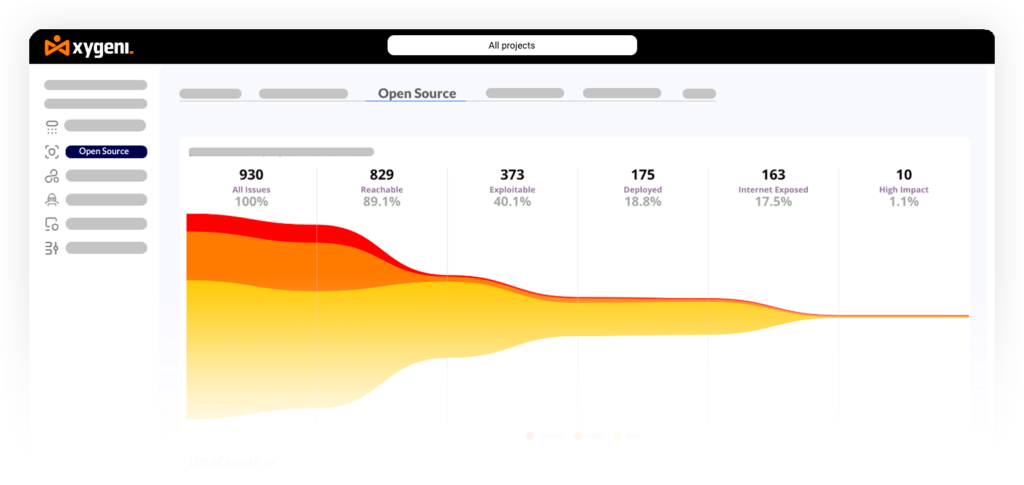
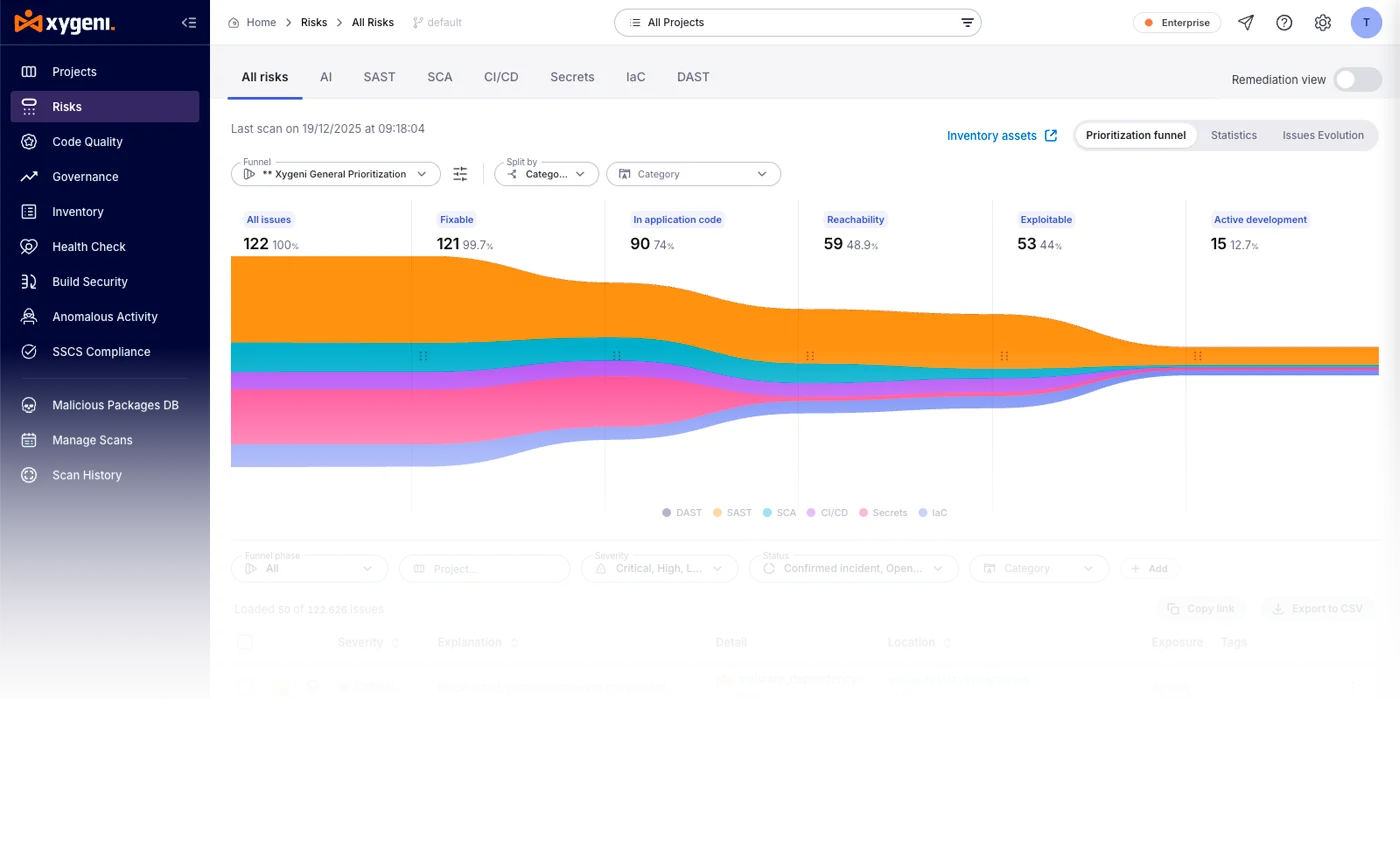
La plateforme propose des entonnoirs de priorisation avec jusqu'à huit étapes. Ces filtres prennent en compte des facteurs tels que la gravité, l'accessibilité, l'exploitabilité et la valeur de l'actif pour aider les équipes à trier efficacement les alertes.
De plus, les clients peuvent définir leurs propres règles pour refléter leurs politiques internes ou leurs besoins réglementaires, ce qui rend le processus très adaptable.
Test de performance OWASP : Preuve de précision et de faible bruit #
Xygéni SAST Le moteur a été validé indépendamment à l'aide de Référence OWASP, l'industrie-standard Suite de tests pour l'évaluation des outils de sécurité. Les résultats confirment l'avantage unique de Xygeni :
- Taux de vrais positifs : 100 pour cent
- Taux de faux positifs : 16.7 pour cent
- Note de référence : 83.3 pour cent
Ce score est nettement supérieur à celui de concurrents tels que Snyk, SonarQube, Semgrep et CodeQL. Par exemple, Snyk et Semgrep affichent des taux de faux positifs supérieurs à 30 %, ce qui accroît la saturation d'alertes et ralentit la résolution des problèmes.
Par conséquent, il est prouvé que Xygeni est à la fois précise et efficace, combinant une détection avancée avec une sortie conviviale pour les développeurs.
Pourquoi c'est important pour le DevSecOps #
Dans les environnements DevSecOps dynamiques, un grand nombre d'alertes peut paralyser les flux de développement. En réduisant les faux positifs grâce à des entonnoirs de visibilité, d'exploitabilité et de priorisation, Xygeni permet aux équipes de se concentrer sur des tâches de sécurité essentielles.
De plus, l’intégration avec CI/CD pipelines garantit que la correction peut être automatisée, suivie et alignée sur la vitesse de développement.
Questions fréquemment posées #
Un faux positif est-il la même chose qu'une fausse alarme ?
Oui. Un faux positif en sécurité signifie qu'un système signale à tort une menace alors qu'il n'y en a pas.
Xygeni peut-il éliminer tous les faux positifs ?
Bien qu'une élimination totale soit impossible, l'approche contextuelle de Xygeni les réduit considérablement en filtrant les résultats inaccessibles ou non exploitables.
Qu’est-ce que le benchmark OWASP et pourquoi est-il important ?
Il s'agit du cadre de test le plus fiable. SAST Les excellents résultats de Xygeni témoignent de sa capacité à détecter les menaces réelles tout en minimisant le bruit.
Découvrez comment Xygeni réduit le bruit et augmente la confiance. #
Xygeni vous aide à transformer votre flux de travail en sécurité applicative en convertissant les alertes en actions claires et prioritaires. Grâce à des critères de visibilité, d'exploitabilité et des processus de priorisation personnalisables, votre équipe peut se concentrer sur l'essentiel.
Démarrez votre essai gratuit ou demandez une démonstration dès aujourd'hui sur www.xygeni.io pour vivre une expérience de haute pré-cisLa sécurité ionique à grande échelle.