



Modern application security is no longer about isolated tools. Today, teams deal with scattered signals, endless alerts, and limited clarity about what is actually running in their environments. This challenge has pushed many organizations to rethink how an application control engine, an application client container, and Application Security Posture Management (ASPM) fit together to deliver real execution control.
ASPM provides a unified way to understand risk across code, pipelines, and runtime. However, posture alone is not enough. To act on that posture, teams need real execution control. This is where an application control engine becomes critical, and where traditional models such as the application client container begin to show their limits.
Why ASPM Is the Starting Point for Application Control
ASPM answers a fundamental question: what is my real security posture across all applications.
It does this by correlating signals from source code, dependencies, CI/CD pipelines, infrastructure, and execution behavior. As a result, teams gain visibility into what exists, how components relate, and where risk concentrates.
However, visibility without action quickly creates friction. Therefore, ASPM must connect posture to enforcement. In other words, once risk is understood, the platform must help decide what should be allowed to execute and what should not.
This is exactly where application control fits inside ASPM.
What ASPM Solves That Point Security Tools Cannot
Most security tools were built to answer narrow questions. Static scanners look at code. Dependency tools analyze libraries. Runtime solutions observe execution events. Each one works in isolation.
As defined by the NIST Risk Management Framework, effective security decisions require continuous context, not isolated controls. This limitation explains why point tools struggle to describe real application risk.
However, modern application risk does not exist in isolation. Instead, it emerges from the interaction between code changes, dependencies, pipelines, and runtime behavior. As a result, point tools often produce alerts without explaining real exposure.
This is where ASPM changes the model.
ASPM correlates signals across the entire application lifecycle. Rather than evaluating a single scan or event, it builds a continuous view of what exists, how components relate, and how risk evolves over time. Consequently, teams can understand not only what happened, but also why it happened and whether it actually matters.
Without ASPM, control mechanisms operate without context. A change may look dangerous in isolation while being completely expected. At the same time, a small modification may introduce real risk if it breaks established patterns. Therefore, posture becomes the foundation for meaningful control.
In short, ASPM turns scattered security data into structured insight. It replaces fragmented alerts with an understanding of application risk that control mechanisms can act on.
What Is an Application Control Engine
An application control engine is a mechanism that decides which applications, processes, or components are allowed to execute in an environment. Instead of reacting after execution, it focuses on preventing unwanted execution from the start, making the application control engine a key part of proactive security.
Traditionally, application control engines relied on static allowlists. If a binary or process was not explicitly approved, execution was blocked. At first, this approach reduced risk in stable and predictable systems.
However, modern software environments change constantly. Dependencies update automatically, builds are frequent, and workloads are short lived. Consequently, static rules lose relevance very quickly.
Unlike antivirus solutions, classic EDR tools, or firewalls that focus on known threats or network traffic, an application control engine operates at a different level. It decides whether execution should happen at all. Therefore, it plays a role in prevention rather than detection after the fact.
What Is an Application Client Container
An application client container provides a managed runtime environment for client applications. It handles concerns such as lifecycle management, configuration, and security context.
In simple terms, the container wraps the application and offers shared services so developers do not need to build them manually. This model became popular in enterprise environments where consistency and standardization were required.
Today, application client containers are still relevant in specific enterprise and legacy scenarios. However, they focus on how an application runs, not whether it should run. They assume the application and its components are already trusted, and they lack visibility into supply chain risk or unexpected changes.
Application Control Engine vs Application Client Container
Although the names sound similar, these approaches serve very different purposes.
| Aspect | Application Control Engine | Application Client Container |
|---|---|---|
| Primary purpose | Decide what can execute | Provide a managed runtime |
| Moment of control | Before and during execution | During execution |
| Visibility | Limited in legacy models | Runtime only |
| Enforcement | Policy based execution control | Platform level execution |
| Supply chain awareness | Often missing | Not designed for it |
In short, an application client container manages execution after teams assume trust. An application control engine decides whether execution deserves trust at all. Without posture context, however, many engines operate blindly and miss real risk.
Why Legacy Application Control Fails Without ASPM
Legacy application control engines targeted environments where software changed slowly. They assumed predictable execution paths and treated applications as fully understood.
Today, that model breaks down.
Dependencies enter projects automatically from public registries.
Teams push code changes multiple times per day.
Platforms run applications in ephemeral containers.
Attackers hide inside components teams already trust.
According to OWASP, modern supply chain attacks often abuse trusted components, which makes static execution control insufficient on its own. In this context, allowlists and fixed rules fail to capture how risk actually enters applications.
As a result, static allowlists lose relevance almost immediately. In addition, legacy control lacks posture awareness. It fails to explain why a change occurred or whether that change introduces real risk.
Therefore, application control without ASPM becomes either overly restrictive or dangerously permissive.
Modern Application Control Inside ASPM: From Posture to Enforcement
Modern application control works best as part of ASPM, not as a standalone mechanism.
Instead of relying only on static rules, teams base control decisions on posture signals such as:
- How teams built the application
- Which dependencies teams introduced or modified
- Whether behavior deviates from previous versions
- Whether execution patterns change unexpectedly
As a result, application control operates continuously. Rather than asking only “should this run,” systems ask “does this execution align with known posture and history.”
In this model, the application control engine acts as an enforcement layer driven by ASPM insight.
How Application Control Decisions Change with ASPM Context
Application control decisions change significantly when teams apply posture context.
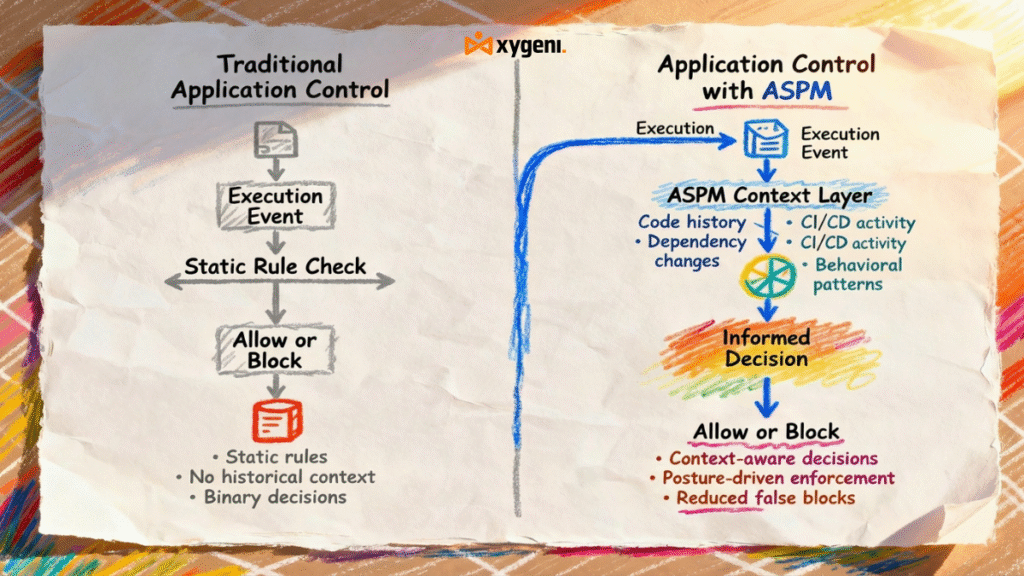
Without ASPM, application control engines rely on static rules. A binary passes or fails. A process matches a rule or does not. As a result, decisions remain binary and ignore intent.
With ASPM context, control becomes situational.
For example, teams allow a new dependency when it aligns with recent development activity. However, teams block the same dependency when it appears unexpectedly in a stable application. In this way, control adapts to context instead of enforcing fixed assumptions.
Similarly, execution behavior that looks normal in one application signals risk in another. ASPM provides historical and relational context, which helps control mechanisms distinguish between expected evolution and suspicious deviation.
Instead of asking “does this match a rule,” application control asks “does this make sense given what we know.” Consequently, enforcement becomes more accurate and less disruptive.
How Xygeni Connects ASPM, Application Control, and Enforcement
Xygeni approaches application control as a natural extension of ASPM.
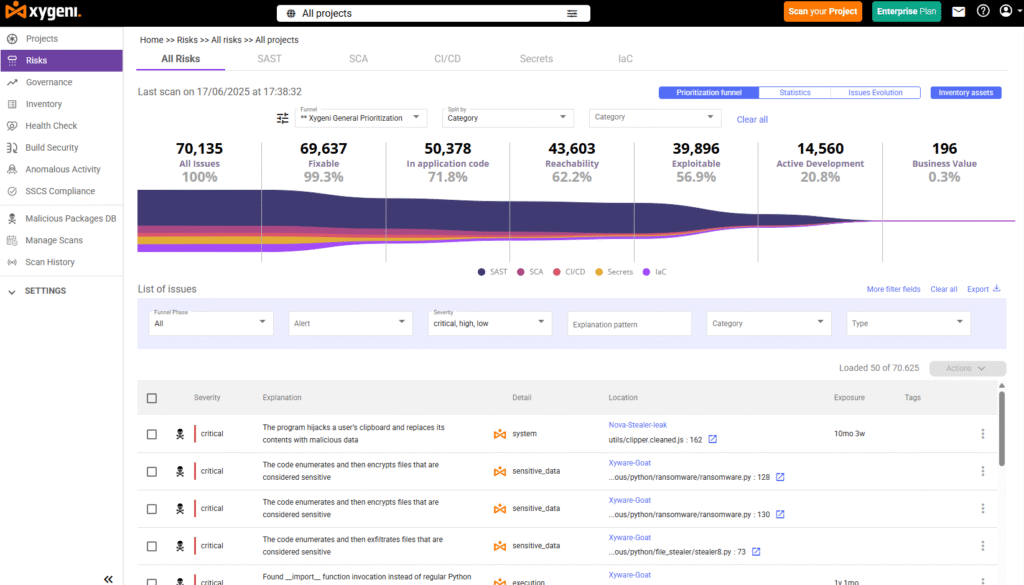
First, Xygeni builds posture by mapping applications, dependencies, pipelines, and execution signals. This creates a clear view of what exists and how components relate.
Next, Xygeni applies application control using that posture. Instead of static allowlists, decisions consider build context, dependency provenance, and behavioral history.
Importantly, this approach does not rely on heavy runtime agents. Application control logic is integrated directly into CI/CD pipelines and security workflows. As a result, enforcement happens early, consistently, and without performance impact.
Finally, posture, control, and enforcement form a closed loop:
- ASPM identifies real risk
- Application control decides what should execute
- Enforcement applies decisions automatically
In other words, Xygeni does not block blindly. It enforces because it understands the risk.
For example, a new dependency introduced during active development may be allowed if it aligns with recent build activity and historical patterns. However, the same dependency appearing unexpectedly in a stable service can be blocked automatically. In this way, application control decisions are driven by posture context rather than fixed assumptions.
Common Misconceptions About Application Control Engines
Many teams still think application control is only about blocking binaries. However, modern application control is broader.
Common misconceptions include:
- Application control replaces vulnerability scanning
- Static allowlists are enough
- Control only matters at runtime
In reality, effective application control depends on posture, context, and behavior over time. Without ASPM, control remains incomplete.
Final Thoughts
Application client containers help applications run consistently. Application control engines decide whether execution should happen at all. However, in modern environments, neither works in isolation.
ASPM provides the context. Application control provides the decision. Enforcement provides the action.
By connecting posture, control, and enforcement, platforms like Xygeni allow teams to control what executes, why it executes, and whether it should execute at all. In modern environments, controlling what runs before execution matters far more than scanning after execution, especially as software changes continuously.
About the Author
Written by Fátima Said, Content Marketing Manager specialized in Application Security at Xygeni Security.
Fátima creates developer-friendly, research-based content on AppSec, ASPM, and DevSecOps. She translates complex technical concepts into clear, actionable insights that connect cybersecurity innovation with business impact.