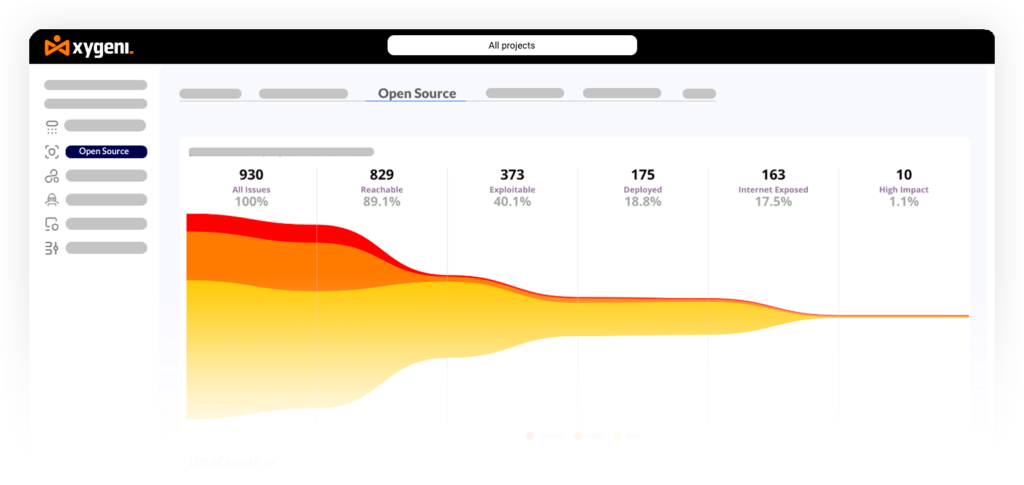
Most AppSec platforms cover the same four things: static analysis, dependency scanning, secrets and IaC. What separates them in 2026 is what happens after detection: whether findings are ranked by real exploitability rather than raw CVSS, whether fixes arrive as pull requests, and whether the platform sees the AI assets now entering your SDLC at all.
Xygeni is our pick for teams that want the full lifecycle in one platform without per-seat pricing. Snyk suits developer-led teams wanting fast setup, Veracode and Fortify suit regulated enterprises with deep static analysis needs, Cycode suits centralized governance, and Checkmarx suits large orgs with dedicated AppSec teams.
The rankings below explain the trade-off behind each.
The best application security tools protect your code, CI/CD pipelines, and dependencies before attackers get in. In this 2026 guide, we compare the top AppSec platforms and highlight what each is best for, so you can choose the right tool for your workflow without drowning in noise.
Today’s AppSec tools do more than scan. They plug into your IDE, Git workflows, and CI/CD pipelines to catch real risks early and help fix them before they hit production. From SAST and SCA to secrets detection, IaC scanning, and CI/CD monitoring, the best platforms reduce alert fatigue with smarter prioritization across the entire SDLC.
In 2026, the best application security tools must also address AI-introduced risk. With 40% of AI-generated code containing security vulnerabilities, and LLMs now being weaponized to plant malware inside autonomous agents, AppSec platforms that don’t cover AI assets, MCP servers, and AI coding assistants are leaving a critical gap unaddressed.
In this guide, we break down the must-have features in modern application security tools and compare the top platforms for 2026.
Best Application Security Tools (2026)
How we ranked
- Coverage across the SDLC (SAST, SCA, secrets, IaC, CI/CD, AI security)
- Prioritization signals (reachability, exploitability, EPSS, attack path context)
- AI security coverage (AI-SPM, MCP server protection, LLM risk scoring)
- Remediation workflow (PR-based fixes, automation, developer UX)
- Scalability and operability (setup, integration depth, noise control
Quick comparison table
Quick comparison of the best application security tools by coverage, prioritization, and what each platform is best for.
| Tool | Coverage | AI Security | Exploitability & Prioritization | AutoFix | CI/CD Security | Compliance | Best For |
|---|---|---|---|---|---|---|---|
| Xygeni | SAST, SCA, Secrets, IaC, CI/CD, AI-SPM, AI Risk | ✅ AI-SPM, AI risk scoring, Shield — full AI-era SDLC coverage | ✅ EPSS + Reachability + attack path context | ✅ AI AutoFix + remediation workflows | ✅ Pipeline + repo protections | NIS2, DORA, EU AI Act, NIST AI RMF, ISO/IEC 42001 | Teams that need all-in-one AppSec with AI security, real prioritization, and no per-seat pricing |
| Snyk | SAST, SCA, IaC, Secrets (modular) | ❌ No | ⚠️ Limited (less context-driven) | ⚠️ Partial (depends on product) | ⚠️ Basic (mostly integrations) | SOC 2, ISO 27001 | Dev teams that want fast setup and broad scanning coverage |
| Jit | SAST, SCA, IaC, Secrets, CI/CD checks | ❌ No | ❌ No reachability/EPSS by default | ❌ Limited (more manual remediation) | ⚠️ Posture checks only | SOC 2, ISO 27001 | Teams that want modular AppSec checks plugged into Git workflows |
| Veracode | SAST, SCA | ❌ No | ❌ Limited (less exploitability context) | ⚠️ Partial (Veracode Fix) | ❌ No dedicated CI/CD security | PCI DSS, HIPAA, SOC 2 | Enterprises focused on traditional SAST/SCA with compliance reporting |
| Cycode | SAST, SCA, IaC, Secrets, CI/CD | ❌ No | ❌ No EPSS/reachability prioritization | ❌ No PR-based AutoFix | ✅ Governance + monitoring | SOC 2, ISO 27001, GDPR | Security teams prioritizing centralized code-to-cloud visibility |
| Fortify (OpenText) | SAST, SCA | ❌ No | ❌ Limited (severity-based only) | ⚠️ Partial (workflows vary) | ❌ No dedicated CI/CD security | PCI DSS, HIPAA, NIST | Highly regulated orgs needing deep static analysis coverage |
| Checkmarx | SAST, SCA, IaC, Secrets | ❌ No | ❌ No EPSS/reachability by default | ❌ Limited (less automated) | ⚠️ Partial (depends on setup) | PCI DSS, HIPAA, SOC 2 | Large orgs with dedicated AppSec teams and heavy customization needs |
1. Xygeni Application Security Tools
Best Application Security Tools for DevSecOps
Best for: Teams that need full SDLC coverage (from classical AppSec to AI security) in a single platform with no per-seat pricing and no tool sprawl.
Xygeni’s All-in-One AppSec Platform is the most complete application security solution available in 2026. Built for modern DevSecOps teams, it combines SAST, SCA, Secrets Detection, IaC scanning, CI/CD Security, and, uniquely, a full AI Security layer, all in one platform with no tool sprawl and no per-seat pricing.
Unlike traditional application security tools that focus only on detection, Xygeni delivers real-time protection, automated fixes, and AI-powered AutoFix, helping teams catch issues early and ship safely without slowing developers down.
Key Features:
- SAST: Advanced static application security testing with custom rules and deep IDE and PR integration. Detects unsafe code patterns and malware through static analysis. AI-powered AutoFix suggests or creates secure code patches automatically, helping teams write safer code faster.
- SCA: Goes beyond basic vulnerability detection using reachability analysis and EPSS-based prioritization. Scans both direct and transitive dependencies, ranks threats by exploitability, and blocks malware hidden in open-source packages. Enforces license compliance and creates pull requests automatically for quick remediation.
- Secrets Detection: Catches hardcoded secrets before they reach production. Scans Git commits, branches, and history in real time, with pre-commit blocking, live alerts, and full traceability for sensitive data such as API keys and tokens.
- IaC Security: Scans Terraform, Helm, and Kubernetes files for misconfigurations like excessive permissions or missing encryption. Issues are caught and fixed early via native CI/CD integration.
- CI/CD Security: Monitors DevOps pipelines for active threats — suspicious Git activity, rogue scripts, and privilege misuse. Anomaly detection keeps environments safe even from novel threats.
- AI Security (2026): Beyond traditional AppSec, Xygeni now includes AI-SPM, a live inventory of every AI asset in your SDLC (models, datasets, agents, MCP servers, AI coding assistants) with an audit-ready AI-BOM. Its Shield endpoint agent blocks malicious dependencies using MEW (Malware Early Warning) verdicts before signatures exist, and enforces approved-model and approved-MCP allowlists on every developer machine. Risk scoring covers the OWASP Top 10 for LLM Applications, Agentic Apps (2026), and MCP servers.
Why Choose Xygeni?
- Exclusive Early Malware Detection: The only AppSec platform offering real-time, behavior-based malware scanning across open-source components and CI/CD workflows, before signatures exist.
- Full AI Security Layer: AI-SPM, AI risk scoring, and Shield endpoint enforcement cover the attack surface that every other tool on this list leaves unaddressed.
- Smarter Prioritization: Reachability analysis, EPSS scores, and business context mean you fix what matters first, not what scores highest on a raw severity scale.
- Developer-Centric Experience: Native CI/CD integrations, pull request scanning, and AutoFix suggestions tailored to your environment.
- Proactive Supply Chain Defense: Detects and blocks supply chain attacks (typosquatting, dependency confusion, zero-days) before they reach production.
- Extend, Don’t Replace: Xygeni’s AI applies to findings from your existing SAST, SCA, and third-party scanners, so you get better signal without ripping out incumbent tools.
Compliance: NIS2, DORA, EU AI Act, NIST AI RMF, ISO/IEC 42001. EU-hosted, with on-premises and air-gapped deployment options.
Recognition: Named Hot Company in Application Security Posture Management 2026 and Hot Company in GenAI Application Security 2026 by the Global InfoSec Awards (Cyber Defense Magazine).
Pricing: Starts at $33/month for the complete all-in-one platform, SAST, SCA, CI/CD Security, Secrets Detection, IaC Security, and Container Scanning included. Unlimited repositories, unlimited contributors, no per-seat pricing, no surprises.
2. Snyk Application Security Tools
Application Security Tools for Developer Teams
AppSec coverage: SAST, SCA, IaC Security, Secrets Detection, CI/CD Security
Best for: Dev teams that want fast setup and broad scanning coverage across the core AppSec stack.
Snyk offers a developer-focused suite of application security tools designed to surface vulnerabilities early in the SDLC. It covers static code analysis, open-source risk scanning, IaC scanning, and secrets detection. While popular for ease of use and CI/CD integration, teams often face limitations around alert management, prioritization, and tool fragmentation at scale.
Key Features:
- SAST (Snyk Code): Static analysis within IDEs and CI pipelines, though lacks deeper prioritization signals or customizable rules for advanced use cases.
- SCA (Snyk Open Source): Detects vulnerabilities in third-party components and suggests fixes, but does not evaluate reachability or exploitability.
- IaC Security: Identifies configuration issues in Terraform and Kubernetes files, with minimal support for complex multi-cloud environments.
- Secrets Detection: Relies on third-party integrations such as Nightfall or GitGuardian, adding setup steps and fragmenting visibility.
- CI/CD Security: Basic pipeline monitoring; real-time anomaly detection and insider threat protections are limited.
Limitations:
- No AI security coverage
- High alert noise due to lack of reachability filtering or EPSS scoring
- No built-in malware scanning or package integrity checks
- Fragmented tooling — secrets, IaC, and SCA handled separately
- Modular pricing: each feature requires a separate license
Pricing: Team plan includes 200 tests/month; full coverage requires separate purchases per product. No pricing transparency, custom quote required for enterprise use.
3. Jit Application Security Tools
Modular Application Security Tools for Git-Native Teams
AppSec coverage: SAST, SCA, IaC Security, Secrets Detection, CI/CD Security
Best for: Teams that want modular AppSec checks plugged directly into Git workflows with minimal friction.
Jit provides a modular set of application security tools that integrate into development pipelines with low setup overhead. It covers core AppSec testing across SAST, SCA, IaC, secrets detection, and CI/CD posture checks. Teams may find themselves managing security more manually due to limited remediation depth and prioritization.
Key Features:
- SAST: Git-based static analysis feedback; lacks advanced insights like malware detection or runtime context.
- SCA: Scans for known CVEs but offers no reachability scoring or exploitability filtering.
- IaC Security: Checks common misconfigurations; requires tuning for enterprise-grade environments.
- Secrets Detection: Real-time scanning but lacks pre-commit enforcement or Git history analysis.
- CI/CD Security: Flags pipeline risks like weak MFA or branch protection gaps; no runtime anomaly detection.
Limitations:
- No AI security coverage
- No exploitability-based prioritization (no EPSS, no reachability)
- No PR-based AutoFix — remediation is largely manual
- Custom pricing required for full automation and advanced controls
Pricing: Custom pricing required for full feature access. Per-seat pricing and annual billing can create scaling challenges for growing teams.
4. Veracode Application Security Tools

Enterprise SAST and SCA
AppSec coverage: SAST, SCA
Best for: Enterprises focused on traditional static analysis and SCA with strong compliance reporting requirements.
Veracode is an established enterprise-grade platform for application security testing. However, it omits several capabilities now considered baseline in modern AppSec: IaC scanning, secrets detection, CI/CD pipeline security, and AI security coverage. Security teams often need to supplement Veracode with additional tools to achieve complete protection.
Key Features:
- SAST: Deep static code analysis across supported languages with CI/CD workflow integration.
- SCA: Identifies known vulnerabilities and licensing issues in third-party and open-source components.
- Veracode Fix: AI-powered remediation engine that suggests secure code patches.
- Policy Management & Compliance Reporting: Audit-ready compliance dashboards with custom policy enforcement.
Limitations:
- No IaC or CI/CD security; cannot scan Terraform, Helm, or Kubernetes
- No secrets detection
- No AI security coverage
- No EPSS or reachability metrics, flat CVE lists without exploitability context
- No malware or supply chain threat detection
- Limited IDE and pull request integration
Pricing: Median contract value $18,633/year based on customer purchase data. No all-in-one plan, SCA must be bundled separately. All plans require custom quotes.
5.Cycode Application Security Tools

Code-to-Cloud Visibility Platform
AppSec coverage: SAST, SCA, IaC Security, Secrets Detection, CI/CD Security
Best for: Security teams prioritizing centralized governance and code-to-cloud visibility across the SDLC.
Cycode delivers a broad platform aimed at unifying visibility and control across the software development lifecycle. Despite its extensive feature set, it lacks modern risk-based prioritization and automation capabilities that development teams increasingly rely on for speed and signal quality.
Key Features:
- SAST: Detects flaws and insecure functions with CI/CD and developer environment integration.
- SCA: Scans direct and transitive dependencies for CVEs and licensing risks.
- IaC Security: Audits Terraform, Helm, and Kubernetes for misconfigurations before deployment.
- Secrets Detection: Flags hardcoded API keys and credentials in code, Git history, and pipelines.
- CI/CD Security: Monitors pipelines for risky behaviors, drift, and unauthorized changes.
Limitations:
- No AI security coverage
- No exploitability-based prioritization — no reachability analysis or EPSS scoring
- Significant tuning required for complex environments
- No PR-based AutoFix — remediation is manual
- Opaque, modular pricing likely to escalate with team size
Pricing: Custom quotes required. Modular feature licensing likely adds cost as coverage expands.
6. Fortify by OpenText Application Security Tools

Enterprise Static Analysis
AppSec coverage: SAST, SCA
Best for: Highly regulated enterprises with static development practices needing deep language coverage and compliance support.
Fortify by OpenText delivers traditional enterprise-grade application security testing focused on SAST and SCA. It is well-known for broad language support and regulatory compliance alignment. However, it lacks secrets detection, IaC security, CI/CD pipeline protection, and any AI security coverage — capabilities now considered baseline in modern DevSecOps environments.
Key Features:
- SAST (Static Code Analyzer): Supports 25+ languages with custom rule tuning and build system integration.
- SCA: Evaluates open-source dependencies for known vulnerabilities and licensing issues.
Limitations:
- No secrets detection or IaC security
- No CI/CD pipeline monitoring
- No AI security coverage
- No exploitability-based prioritization — teams receive flat CVE lists
- Slow feedback loops, especially with Fortify on Demand (FoD)
Pricing: Custom quotes only. Enterprise licensing geared toward large organizations, often bundled with consulting and audit services.
7. Checkmarx Application Security Tools

Broad AppSec Coverage for Large Enterprises
AppSec coverage: SAST, SCA, IaC, Secrets Detection
Best for: Large organizations with dedicated AppSec teams that need broad language coverage and heavy customization.
Checkmarx delivers a broad set of application security testing tools with strong language coverage and enterprise compliance capabilities. However, the platform requires significant configuration effort, is largely modular, and lacks the modern prioritization and automation features that fast-moving DevSecOps teams need.
Key Features:
- SAST: Scans 25+ languages for logic flaws, insecure patterns, and embedded secrets.
- SCA: Evaluates open-source dependencies and third-party packages for CVEs and license risks.
- IaC Security: Checks Terraform and Kubernetes configuration templates for misconfigurations.
- Secrets Detection: Flags exposed credentials in codebases and version histories.
Limitations:
- No AI security coverage
- Long scan durations delay developer feedback
- High learning curve — setup requires AppSec expertise
- Disjointed interfaces across SAST, SCA, and IaC modules
- No AutoFix or PR-based remediation — fixes are largely manual
- No risk-based prioritization — no EPSS scores or reachability analysis
- Secrets detection lacks pre-commit scanning or Git hooks
- Costly at scale — modular pricing escalates quickly
Pricing: Enterprise-level pricing; reported deployments range from $75,000 to $150,000/year. No all-in-one plan — full coverage requires bundling multiple modules.
Essential Features to Consider in Application Security Tools
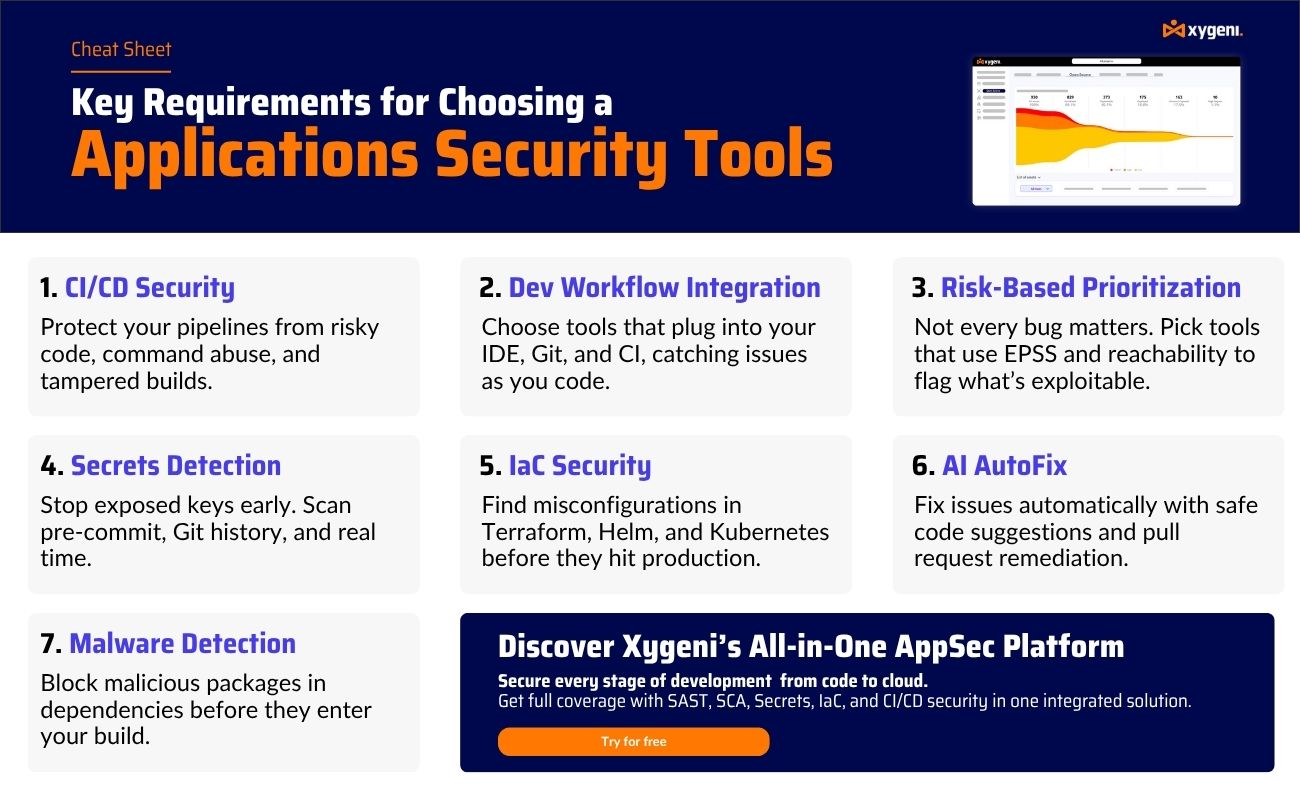
Choosing the right application security tools isn’t about ticking boxes, it’s about finding solutions that reduce real risk, support how developers work, and handle threats as they happen. The best AppSec tools share these essential capabilities:
1. CI/CD Security and Pipeline Protection
Attacks now target GitOps flows and automation, not just production. Your application security testing tools must monitor CI/CD pipelines for anomalies, risky commands, and tampered builds, tracking changes across branches, commits, and contributors in real time.
2. Integration Across the SDLC
Security is more effective when it’s part of the development rhythm. Choose tools that integrate into your IDE, Git workflows, and CI pipelines so issues are caught during coding, not after release.
3. Prioritization That Matches Exploitability
It’s not enough to detect every vulnerability. Tools that apply reachability analysis and EPSS scoring help you prioritize based on what could actually be exploited — saving time and cutting unnecessary alert volume.
4. Secrets Detection from the Start
Hardcoded secrets remain among the most common and damaging risks. Effective AppSec tools detect secrets before code is pushed, via pre-commit hooks, Git history scanning, and real-time alerts.
5. Infrastructure as Code (IaC) Security
IaC misconfigurations are frequently missed. Your platform should scan Terraform, Kubernetes, and Helm templates directly in the development process, highlighting risky permissions or missing controls early.
6. AI-Powered AutoFix
Tools with AI-powered AutoFix provide pull request remediation and safe code suggestions, helping teams build securely without changing how they work.
7. Malware and Dependency Threat Detection
Attackers increasingly hide malware in dependencies. Look for platforms that scan public registries, detect malicious patterns, and block suspicious packages before they reach your builds — ideally before signatures exist.
8. AI Security Coverage
In 2026, the best application security tools must also secure the AI in your SDLC. This means inventorying AI assets (models, agents, MCP servers), scoring their risk against OWASP LLM and MCP Top 10, and enforcing policy at the developer endpoint. Currently, only Xygeni provides this as part of its core platform.
AI Changed the Game. Your Application Security Tools Should Too.
Modern development teams can no longer rely on outdated security practices. Today’s application security tools must secure the entire lifecycle (from the first commit to production) without slowing developers down.
Not all AppSec tools are created equal. Some detect issues but flood teams with noise. Others miss what is truly risky. And in 2026, most still have no answer for AI-introduced risk, the fastest-growing attack surface in the SDLC.
This is where Xygeni makes a clear difference. It brings together SAST, SCA, Secrets Detection, IaC Security, CI/CD monitoring, and the only built-in AI Security layer in the market, in one integrated platform. It not only finds vulnerabilities but shows what is exploitable, how to fix it fast, and blocks threats at the developer endpoint before they ever reach production.
With AI-powered AutoFix, reachability analysis, EPSS-based scoring, and full AI-era SDLC coverage, Xygeni is the best application security tool for teams that need complete protection in 2026, without the tool sprawl, per-seat pricing, or alert fatigue of legacy platforms.
Disclaimer: Pricing is indicative and based on publicly available information. For accurate and up-to-date quotes, please contact the vendor directly.
FAQs
What are application security tools?
Application security tools are platforms that identify, prioritize, and help remediate security vulnerabilities across code, dependencies, infrastructure, and CI/CD pipelines, integrated directly into the software development lifecycle to catch issues before they reach production.
What is the best application security tool in 2026?
For teams that need full SDLC coverage with real prioritization, Xygeni is the most complete option, combining SAST, SCA, Secrets Detection, IaC, CI/CD Security, and AI Security in one platform with no per-seat pricing. For developer-focused teams wanting fast setup, Snyk is a widely used alternative.
Do application security tools cover AI-generated code?
Most traditional tools do not. Xygeni is currently the only platform that combines classical AppSec scanning with dedicated AI Security, covering AI-generated code risks, MCP server vulnerabilities, prompt injection, and AI asset inventory through AI-SPM.
How much do application security tools cost?
Pricing models vary more than the capabilities do. Most enterprise platforms use custom quotes with modular licensing, so the sticker price covers one module and full coverage means bundling several. Per-seat pricing is common and becomes the dominant cost as a team grows, which is why the real question is not the list price but what happens to it when you add twenty developers. Xygeni starts at $33/month for the full platform with unlimited repositories and contributors. Enterprise platforms in this category typically run from five figures annually into six for large deployments.
What is the difference between SAST and SCA?
SAST analyzes code your team wrote, looking for insecure patterns such as injection flaws, unsafe deserialization or hardcoded logic errors. SCA analyzes code your team imported, checking open-source dependencies for known vulnerabilities, licence conflicts and, increasingly, malicious packages. They answer different questions and neither substitutes for the other. In practice most of a modern application is dependencies, so SCA usually surfaces more findings while SAST surfaces the ones nobody else could have found for you.
Do I need a separate tool for AI security?
Not necessarily, and there is a good argument against it. AI risk in the SDLC is not a separate domain so much as a new set of assets inside the one you already have: models, agents, MCP servers, prompts and AI coding assistants all live in your repositories alongside everything else. Running them through a separate tool produces a second queue with its own severity scale, which is exactly the fragmentation AppSec teams spent the last five years escaping. The more useful question is whether your existing platform can see those assets at all, and whether their findings land in the same prioritized list as your code and dependency findings.