

Generative AI no longer lives in labs or side projects. Today, teams deploy LLM-powered features, copilots, and autonomous agents directly into CI/CD pipelines, cloud platforms, and production workflows. As a result, generative AI security and gen AI security have become real DevOps concerns, not theoretical ones. To address this shift, OWASP elevated the OWASP GenAI Security Project to flagship status, setting a clear direction for teams that build, deploy, and operate AI-powered systems.
This post explains what the OWASP GenAI Security Project covers, why gen AI security matters for DevOps teams, and how this initiative connects directly to modern pipelines and automation.
What Is the OWASP GenAI Security Project
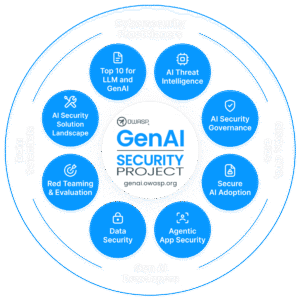
The OWASP GenAI Security Project is an open initiative focused on identifying and mitigating risks introduced by generative AI systems. Instead of limiting the scope to models or prompts, the project looks at how AI behaves once teams integrate it into software delivery.
In practice, the project covers:
- LLM-powered applications
- Autonomous and semi-autonomous agents
- Tool-connected models interacting with APIs and pipelines
- Multi-agent systems coordinating actions
In other words, the initiative focuses on how AI changes the security model when software stops acting passively and starts taking action.
Why Generative AI Security Matters for DevOps Teams
From a DevOps perspective, generative AI changes the blast radius of mistakes. Traditional automation already controls builds and deployments. However, once teams add AI on top of that automation, the system gains decision-making power.
For example, teams often grant AI agents access to:
- Source code repositories
- CI/CD runners
- Cloud APIs and credentials
- Deployment and configuration tools
At that point, AI becomes part of the control plane. Because of this, weak gen AI security controls can lead to fast and silent failures.
For example, a prompt injection can trigger unsafe pipeline actions. Likewise, an over-privileged agent can modify infrastructure without exploiting a classic vulnerability. Therefore, DevOps teams need guidance that goes beyond securing the model itself.
From LLM Risks to Agentic Security Threats
One of the most important contributions of the OWASP GenAI Security Project is its focus on agentic behavior. Traditional LLM risks often stop at bad output. However, agentic systems introduce new failure modes.
For instance, agents can:
- Plan multi-step workflows
- Call tools automatically
- Persist memory across sessions
- Interact with other agents
As a result, OWASP introduced the OWASP Top 10 for Agentic Applications, published as part of the GenAI Security Project. This list highlights risks such as:
- Goal hijacking and instruction manipulation
- Tool misuse and over-privileged execution
- Identity and permission abuse
- Agentic supply chain compromise
- Unexpected code or command execution
Notably, these risks map directly to DevOps workflows like CI jobs, IaC automation, and cloud orchestration.
Where GenAI Security Breaks Traditional Pipeline Controls
For DevOps teams, one key insight stands out. Generative AI security issues often bypass traditional security controls.
For example, a malicious prompt can trigger a legitimate pipeline step. Similarly, an agent can misuse trusted credentials without exploiting a vulnerability. In addition, a poisoned tool definition can redirect actions without raising alerts.
Because everything looks authorized, classic controls often miss these failures. Therefore, the OWASP GenAI Security Project emphasizes:
- Least privilege for agents and tools
- Clear separation between planning and execution
- Strong provenance and attestation
- Continuous monitoring of agent actions
How DevOps Teams Should Use the OWASP GenAI Security Project
DevOps teams can apply this initiative directly by turning guidance into controls.
First, teams should threat model AI-enabled pipelines and treat agents as non-human identities. Next, teams should review agent permissions and remove broad API access. In addition, teams should secure the AI supply chain by pinning models, prompts, tools, and descriptors.
Moreover, teams should log agent actions clearly and track why an agent executed a specific step. Finally, teams should map the OWASP Top 10 for Agentic Applications to real pipeline controls and guardrails.
By following this approach, teams move from experimentation to secure by design generative AI deployments.
| GenAI Security Risk | What It Means in DevOps | Recommended Control |
|---|---|---|
| Prompt Injection | Untrusted input influences agent decisions or pipeline actions | Input validation, strict prompt boundaries, separation of planning and execution |
| Over-Privileged Agents | AI agents access cloud APIs, repos, or CI runners with excessive permissions | Least privilege, scoped tokens, short-lived credentials |
| Tool Misuse | Agents invoke CI, IaC, or deployment tools in unsafe ways | Explicit tool allowlists, policy-based execution controls |
| Agent Goal Hijacking | Attackers manipulate agent objectives through prompts or context | Goal validation, human approval for sensitive actions |
| AI Supply Chain Risks | Compromised models, prompts, or tool descriptors enter pipelines | Pin versions, verify provenance, validate artifacts |
| Lack of Agent Observability | Teams cannot track why or how an agent executed actions | Detailed logging, audit trails, and behavior monitoring |
How Xygeni Helps DevOps Teams Apply the OWASP GenAI Security Project
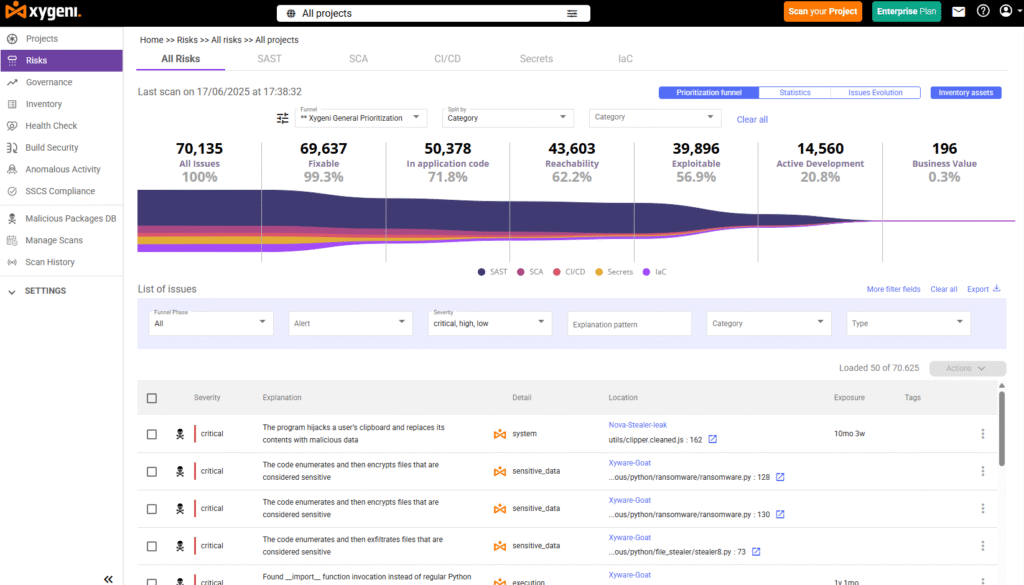
The OWASP GenAI Security Project provides a solid framework, but DevOps teams still need practical controls to apply those ideas inside real pipelines. This is where Xygeni fits naturally.
Xygeni focuses on securing automation, pipelines, and software supply chains before anything reaches production. As a result, teams can apply gen AI security principles at the exact stage where AI agents, scripts, and tools actually operate.
First, Xygeni helps teams control over-privileged automation. Many GenAI risks start when agents or workflows inherit excessive permissions. Xygeni analyzes pipelines, IaC, and configuration early, so teams can spot risky access patterns and reduce blast radius before any AI-driven action runs.
In addition, Xygeni strengthens supply chain integrity, which plays a central role in generative AI security. AI agents often rely on external tools, scripts, models, or dependencies. Xygeni validates these inputs continuously, preventing compromised artifacts or unsafe automation logic from silently propagating through the pipeline.
Xygeni also improves observability of automated behavior. Instead of treating AI-driven actions as opaque, teams gain clear visibility into what runs, when it runs, and why it runs. Consequently, DevOps engineers can trace automation decisions and detect execution paths that match known GenAI threat patterns.
Moreover, Xygeni enforces guardrails at build time rather than after deployment. By scanning code, configuration, and automation logic before execution, Xygeni blocks unsafe agent behavior before it reaches runtime. This approach aligns closely with OWASP guidance that prioritizes prevention over detection.
Finally, Xygeni integrates directly into existing CI/CD workflows. Teams do not need separate tools for AI security. Instead, generative AI security becomes part of the same DevSecOps controls already used to protect code, dependencies, and infrastructure.
In short, Xygeni helps DevOps teams move from GenAI security theory to day-to-day enforcement, without slowing delivery or adding operational friction.
Final Thoughts on the OWASP GenAI Security Project
The OWASP GenAI Security Project sends a clear message. Generative AI security is now part of software delivery.
AI agents already write code, deploy infrastructure, rotate secrets, and remediate issues. If teams treat them as simple tools, they will miss the new attack paths that autonomy introduces.
By adopting the OWASP GenAI Security Project early, DevOps teams gain a shared language, a practical threat model, and a roadmap to secure agent-driven automation. As a result, teams stay in control as software starts to act on its own.
About the Author
Written by Fátima Said, Content Marketing Manager specialized in Application Security at Xygeni Security.
Fátima creates developer-friendly, research-based content on AppSec, ASPM, and DevSecOps. She translates complex technical concepts into clear, actionable insights that connect cybersecurity innovation with business impact.