

AI remediation is becoming a critical topic in DevSecOps because the real problem is no longer detection. Today, most teams already have scanners for code, dependencies, secrets, infrastructure, and CI/CD pipelines. However, detection alone does not reduce risk.
The hard part is deciding:
- What to fix first
- How to fix it safely
- Which issues can wait
- How to avoid slowing delivery
Security teams are not short on alerts. Instead, they are short on time, context, and reliable ways to act on what actually matters.
That is exactly where AI remediation creates value.
What Is AI Remediation in DevSecOps?
AI remediation refers to the use of machine learning and contextual analysis to improve how teams prioritize, validate, and automate security fixes.
In other words, it is not just about generating patches. Rather, it is about improving remediation decisions across the software development lifecycle.
Traditional remediation workflows usually follow this pattern:
- Detect
- Triage
- Assign
- Fix
- Verify
In theory, that sounds simple. However, modern environments rarely behave that neatly.
Findings arrive simultaneously from:
- SAST tools (code vulnerabilities)
- SCA tools (dependency risks)
- Secret scanners
- IaC checks
- CI/CD security controls
As a result, backlogs grow faster than teams can process them. Developers become overloaded. Meanwhile, security teams keep returning to the same question:
What deserves attention right now?
Why Traditional Remediation Workflows Stop Scaling
Most remediation workflows break down for three reasons.
First, they depend too heavily on manual triage.
Second, they rely too much on severity-only ranking.
Third, they treat remediation as a volume problem instead of a decision-quality problem.
Severity is not risk. A high CVSS score does not automatically mean urgent business impact. Conversely, a medium-severity issue in a critical service may require immediate action.
Consequently, teams do not just struggle with volume. They struggle with confidence.
They ask:
- Which issues can safely wait?
- Which remediation path is low risk?
- Will this dependency update introduce breaking changes?
- Which fixes are safe candidates for automation?
This ambiguity slows everything down.
Therefore, AI remediation matters not because teams need another feature, but because they need help reducing uncertainty inside real remediation workflows.
The scaling challenge is structural. According to Gartner (2024), by 2026, organizations that prioritize security automation and AI augmentation will reduce incident response times by up to 50% compared to those relying primarily on manual processes.
This projection reinforces a critical reality: detection tools are multiplying faster than human remediation capacity. Consequently, organizations that fail to modernize remediation workflows risk accumulating unresolved vulnerabilities and security debt.
AI remediation is not about replacing engineers. Instead, it is about scaling decision quality in environments where manual triage no longer keeps pace with software delivery.
| Dimension | Traditional Remediation (Manual) | AI-Driven Remediation |
|---|---|---|
| Prioritization Model | Primarily based on CVSS severity (Low / Medium / High / Critical). | Based on contextual risk, exploitability, business impact, and real usage. |
| Triage Process | High volume of manual review and false positives. | Automated correlation of findings with noise reduction. |
| Action Output | Generic ticket: “Fix this vulnerability.” | Context-aware recommendation or validated pull request. |
| Remediation Speed | Weeks or months of accumulated security debt. | Hours or days for high-risk, exploitable vulnerabilities. |
| Confidence in Fixes | Uncertainty about regressions, breaking changes, or side effects. | Pre-change impact analysis and safer fix validation. |
| Scalability | Limited by human triage and review capacity. | Scales through intelligent automation and dynamic prioritization. |
Where AI-Driven Remediation Creates Real Value
Not every remediation problem requires AI. However, there are specific areas where AI-driven remediation can significantly improve outcomes.
1. Reducing Remediation Noise
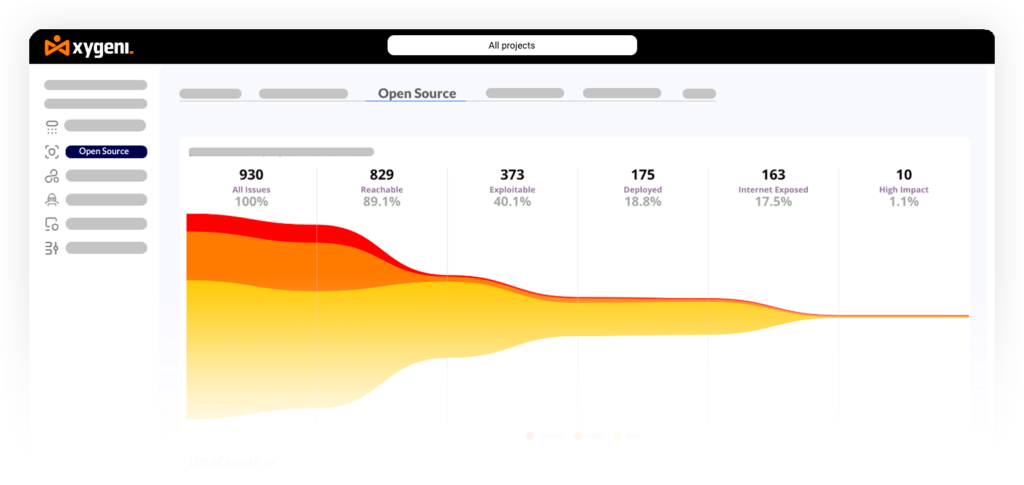
Many DevSecOps teams are overwhelmed by sheer volume. AI remediation can improve how findings are grouped, correlated, and ranked.
As a result, teams spend less time sorting alerts and more time addressing real risk.
Importantly, remediation does not fail only when teams miss critical issues. It also fails when they spend too much time on the wrong ones.
2. Improving Risk-Based Prioritization
A strong AI remediation approach moves beyond severity-only thinking.
Instead of asking, “Is this vulnerability critical?” the better question is:
“Is this vulnerability relevant, reachable, and risky in this context?”
Contextual remediation considers:
- Runtime exposure
- Application criticality
- Dependency reachability
- Business impact
- Existing compensating controls
Therefore, AI remediation helps teams focus on what actually reduces risk, not just what looks severe on paper.
3. Supporting Safer Automated Fixes
One of the biggest blockers in remediation automation is trust.
Teams hesitate to apply automated patches because they fear:
- Breaking production
- Introducing regressions
- Creating new vulnerabilities
AI-driven remediation can analyze change impact, dependency relationships, and potential breaking changes before recommending or applying a fix.
Consequently, automation becomes safer and more predictable.
4. Reducing Manual Work in Repetitive Flows
Some remediation tasks are repetitive and low risk. For example:
- Updating non-critical dependencies
- Rotating exposed secrets
- Applying standard configuration fixes
AI remediation can identify these predictable patterns and streamline them.
However, this does not mean automating everything. Instead, it means automating the right fixes while keeping human review for high-impact decisions.
In modern DevSecOps environments, ambiguity is often more dangerous than volume.
How to Implement AI Remediation Without Adding More Noise
Implementing AI remediation gradually is essential. Otherwise, teams simply add another layer of complexity.
A practical rollout usually follows four phases:
Phase 1: Identify Friction Points
First, analyze where remediation slows down today. Look at real workflow bottlenecks, not just roadmap assumptions.
Phase 2: Improve Decision Quality
Before scaling automation, ensure that prioritization decisions improve. If teams still lack context, automation will only accelerate the wrong fixes.
Phase 3: Automate Low-Risk Workflows
Start with repetitive, predictable tasks. Measure results. Keep the review loop tight.
Phase 4: Expand With Confidence
Only after trust grows should automation expand into higher-impact areas.
Ultimately, the goal is not to automate everything. Rather, it is to make remediation scalable without sacrificing safety.
If you want a practical way to assess where your team stands, download the AI-Driven Remediation & Risk Prioritization Checklist. It helps teams evaluate remediation maturity and spot the highest-impact gaps to address next.
What Good AI Remediation Looks Like in Practice
Effective AI remediation does not feel flashy. Instead, it feels practical.
It helps teams:
- Focus faster
- Defend remediation decisions
- Reduce back-and-forth between security and development
- Avoid fixing the wrong issue first
- Balance speed with safety
In mature environments, AI remediation leads to:
- Less manual sorting
- Better prioritization
- Fewer low-value interruptions
- Higher confidence in fix recommendations
- More consistency across teams
The best implementations are the ones developers do not experience as “AI features.” They experience them as a better workflow.
That is the real benchmark.
Common Mistakes in AI Remediation
Even with good intentions, teams often fall into predictable traps.
Treating AI Remediation as Auto-Fix Only
Auto-fix is just one component. Without contextual prioritization, automation alone will not reduce meaningful risk.
Trying to Automate Everything Too Early
Some fixes are safe to automate. Others require careful validation. Therefore, starting narrow is usually more effective.
Ignoring Developer Workflow
If AI remediation outputs are disconnected from IDEs, pull requests, or CI/CD pipelines, adoption will suffer.
Optimizing for Ticket Closure Instead of Risk Reduction
Closing more tickets does not automatically mean reducing more risk. Decision quality matters more than volume.
Why AI Remediation Matters Now
Modern software environments are fundamentally different from those of just a few years ago. Applications ship faster, dependency trees are more layered, and CI/CD pipelines introduce additional complexity with every release. At the same time, security findings are distributed across multiple tools, dashboards, and workflows.
As a result, remediation pressure continues to grow. Teams can no longer rely on processes where every vulnerability requires the same amount of manual effort, regardless of urgency or business impact. However, they also cannot afford blind automation that introduces instability or new risk.
This is precisely where AI remediation becomes relevant. It is not about doing more with fewer people. Rather, it is about improving decision quality in environments where noise already overwhelms human capacity.
Importantly, the consequences of poor remediation are measurable. According to the IBM Cost of a Data Breach Report 2024, the global average cost of a data breach reached $4.88 million, the highest ever recorded. Moreover, organizations that extensively used AI and automation reduced breach costs by an average of $2.22 million compared to those that did not.
In other words, delayed or misaligned remediation is not just an operational inefficiency. It directly increases financial exposure and business risk.
Therefore, strengthening remediation decisions is no longer optional. It is a concrete, measurable form of risk reduction.
Assess Your AI Remediation Maturity
If your remediation workflow still depends heavily on manual triage and severity-only ranking, it may not scale.
To help teams evaluate their current approach, we created the AI-Driven Remediation & Risk Prioritization Checklist.
This resource helps you:
- Identify remediation bottlenecks
- Evaluate prioritization quality
- Spot low-risk automation opportunities
- Strengthen DevSecOps alignment
Download the free checklist and use it to identify the highest-impact improvements in your remediation workflow.
Final Thoughts on AI Remediation in DevSecOps
AI remediation should not be implemented as a shortcut. Instead, it should improve how teams decide what to fix, when to fix it, and how to fix it safely.
That means:
- Better prioritization
- Better focus
- Better alignment between security and development
- More confidence in automated fixes
If implemented thoughtfully, AI remediation becomes more than another security feature.
It becomes a practical way to reduce friction, improve decision quality, and scale risk reduction across modern DevSecOps environments.
About the Author
Fátima Said specializes in developer-first content for AppSec, DevSecOps, and software supply chain security. She turns complex security signals into clear, actionable guidance that helps teams prioritize faster, reduce noise, and ship safer code.