





Autofix in AppSec is the process of automatically detecting and remediating vulnerabilities directly in the development workflow without manual intervention. For modern software teams, that sounds like the obvious next step. Backlogs keep growing, release cycles keep shrinking, and few organizations can afford to funnel every SAST finding, dependency issue, secret leak, or IaC misconfiguration into a fully manual remediation queue.
However, there is a catch. Teams want to remediate vulnerabilities faster, but they do not want automation that quietly introduces regressions, breaks dependencies, or creates instability in CI/CD. That tension is now one of the central problems in application security. OWASP explicitly treats CI/CD as a security domain with its own major risk categories, while NIST’s Secure Software Development Framework makes clear that secure development practices need to be integrated into the SDLC rather than bolted on at the end.
That is why autofix is not just a product feature. It is an operating model. Done badly, it creates noise, risk, and broken builds. Done well, it closes the gap between detection and remediation, reduces time to fix, and helps security fit the speed of DevOps. In this guide, we will look at what autofix really means in AppSec, where it fails, what safe automated remediation should look like, and how to implement it in a way that developers will actually trust.
What Is Autofix in AppSec?
At a basic level, autofix means software does more than identify a security issue. It proposes, generates, or applies a remediation. In other words, the tool moves from “here is the problem” to “here is the fix.”
That sounds simple, but in practice it covers several very different workflows.
In SAST, autofix typically means generating code-level changes for vulnerabilities such as SQL injection, cross-site scripting, unsafe deserialization patterns, weak input validation, or insecure authentication logic. In SCA, it usually means recommending or applying dependency upgrades, pinning safer versions, or creating pull requests that move packages to patched releases. In Secrets Security, autofix can mean revoking and rotating credentials, not just flagging them. In IaC, it can mean rewriting insecure Terraform, Kubernetes, or cloud configuration patterns into safer defaults.
The important distinction is this: autofix is not the same thing as a hint. Many security tools can suggest a generic remediation. Fewer can generate a developer-ready change. Fewer still can run that remediation through the actual delivery workflow, validate it, and present it to the developer as a reviewable change in source control.
That difference matters because modern engineering teams do not operate in PDFs and tickets. They operate in pull requests, policies, checks, and pipelines.
Why Traditional Remediation Does Not Scale
The case for autofix starts with a painful reality: traditional remediation processes do not scale to modern software delivery.
Most organizations already have enough scanning. They do not have enough resolution. Static analysis, dependency scanning, secret detection, and infrastructure checks generate findings continuously. Meanwhile, engineering teams are under pressure to ship features, keep lead time low, and avoid destabilizing production.
The result is a gap between discovery and action.
First, there is simple alert volume. The more mature an AppSec program becomes, the more findings it tends to produce. That does not always improve security. In many environments, it simply creates backlog. Xygeni’s product materials position this as a noise and prioritization problem, and that framing aligns with the broader industry reality: prioritization, not detection alone, is where many programs struggle.
Second, manual remediation is slow by design. A developer has to read the issue, interpret the scanner output, reproduce the problem if necessary, design a fix, implement it, run tests, open a pull request, and wait for review. That may be acceptable for one critical issue. It is not acceptable for hundreds of medium-severity findings, recurring dependency upgrades, or repeated secret leaks across multiple repositories.
Third, security and engineering are often optimizing for different outcomes. Security wants risk reduced. Engineering wants change introduced safely and predictably. That difference is manageable when the flow of findings is small. It becomes damaging when teams are flooded with issues and no mechanism exists to turn validated findings into safe, low-friction fixes.
This is exactly where automation starts to look necessary. And yet, necessity alone does not make automation safe.
The Problem With Naive Autofix
Not all autofix is good autofix. In fact, many of the objections developers have to security automation are not objections to automation itself. They are objections to bad automation.
A naive autofix engine typically has one of four problems.
The first is that it treats every issue as equally fixable. A scanner sees a vulnerable dependency and simply proposes the next patched version. A code engine sees an unsafe pattern and swaps in a canned replacement. That may work for some straightforward cases. It fails quickly in real systems, where the codebase, the architecture, the runtime, and the dependency graph all matter.
The second is that it ignores execution context. A fix that looks correct in isolation may be irrelevant, insufficient, or risky when applied to real code paths. This is one reason exploitability signals matter so much. FIRST’s EPSS exists precisely because severity alone is not a reliable indicator of whether a vulnerability is likely to be exploited in the near term. EPSS provides a daily probability estimate of exploitation activity for CVEs, which helps teams focus limited remediation capacity on what is more likely to be attacked.
The third is that naive autofix ignores change risk. This is especially dangerous in SCA. A dependency upgrade may eliminate a CVE and still introduce API incompatibilities, removed methods, renamed classes, altered contracts, or subtle runtime behavior changes.
The fourth is over-automation. When a tool opens a flood of low-value pull requests, many of which fail tests or create merge friction, developers learn to ignore it. That is not remediation acceleration. That is remediation spam.
The right question, then, is not whether teams should automate remediation. The right question is what kind of automation reduces risk without increasing operational pain.
Breaking Changes Are the Real Trust Problem
When developers say they do not trust autofix, they often mean one very specific thing: they do not trust it not to break something.
That trust problem is most visible in dependency remediation.
A vulnerable package may have a patched version available, but that does not mean the upgrade is safe. The patched release may remove a method your application uses. It may rename an API. It may tighten a type contract. It may modify behavior in a way that passes unit tests but causes production regressions. In many teams, the actual cost of remediation is not applying the patch. It is investigating the blast radius.
Consider a simple example in Java. A codebase depends on a library where a common method exists in version 1.x but is removed in version 2.x.
					// Before upgrade
MyService service = new MyService();
service.foo();
After the upgrade, foo() no longer exists. The vulnerability may be gone, but the build is broken.
That is why “just update to the fixed version” is not an engineering strategy. It is a gamble.
OWASP’s CI/CD guidance is relevant here because modern delivery pipelines are both acceleration mechanisms and attack surfaces. Security controls that create unstable changes or uncontrolled pipeline behavior solve one problem by creating another. CI/CD protections need flow control, validation, and policy enforcement, not just rapid change injection.
Safe autofix has to respect that reality. It has to understand not only whether a vulnerability is fixable, but whether the fix can be introduced without breaking the software lifecycle it is meant to protect.
What Safe Autofix Should Look Like
Safe autofix is not “automatic change generation.” Safe autofix is controlled automated remediation.
That means five things.
First, fixes must be context-aware. A secure suggestion that ignores the surrounding code, framework conventions, data flow, or dependency behavior is not good enough. The fix has to fit the application, not just the vulnerability class.
Second, fixes must be risk-aware. This is where remediation risk analysis matters. A good autofix system should be able to answer a basic engineering question before proposing a change: what is the likelihood this remediation will introduce breaking changes?
Third, fixes must be prioritized. The best autofix programs do not try to fix everything at once. They align remediation to exploitability, reachability, and operational impact. This matches how mature AppSec programs are evolving more broadly. CISA’s Known Exploited Vulnerabilities Catalog exists precisely to help organizations incorporate evidence of exploitation into remediation decisions, not just severity scoring.
Fourth, autofix must run inside real delivery workflows. If the remediation engine cannot work through pull requests, checks, policies, and tests, it is not aligned with how modern teams deliver software.
Fifth, developers must remain in control. Developer-approved changes are not a weakness of autofix. They are the mechanism that makes automation trustworthy in production engineering environments.
Put differently, safe remediation requires control, not just automation.
Naive Autofix vs Safe Autofix
Below is the practical difference between automation that creates work and automation that removes it.
| Aspect | Naive Autofix | Safe Autofix |
|---|---|---|
| Fix Strategy | Applies generic fixes or upgrades as soon as a vulnerability is detected | Generates context-aware fixes based on code, dependency behavior, and workflow validation |
| Dependency Updates | Recommends the next patched version without change impact analysis | Evaluates upgrade paths and checks for breaking changes before suggesting remediation |
| Prioritization | Acts on severity alone | Combines severity with exploitability, reachability, and operational impact |
| Pipeline Safety | May open PRs that fail builds or tests | Validates fixes through CI/CD checks and review gates |
| Developer Role | Developers clean up automation fallout | Developers review safe, ready-to-merge remediation proposals |
| Outcome | More noise, more regressions, lower trust | Faster remediation, fewer regressions, higher adoption |
If you want one takeaway from this table, it is this: the quality of autofix is determined by the quality of its context and controls.
How Autofix Works in a Modern DevSecOps Pipeline
In a mature environment, autofix is not a single action. It is a structured remediation workflow integrated into CI/CD.
Instead of manual, disconnected fixes, modern pipelines follow a continuous flow:
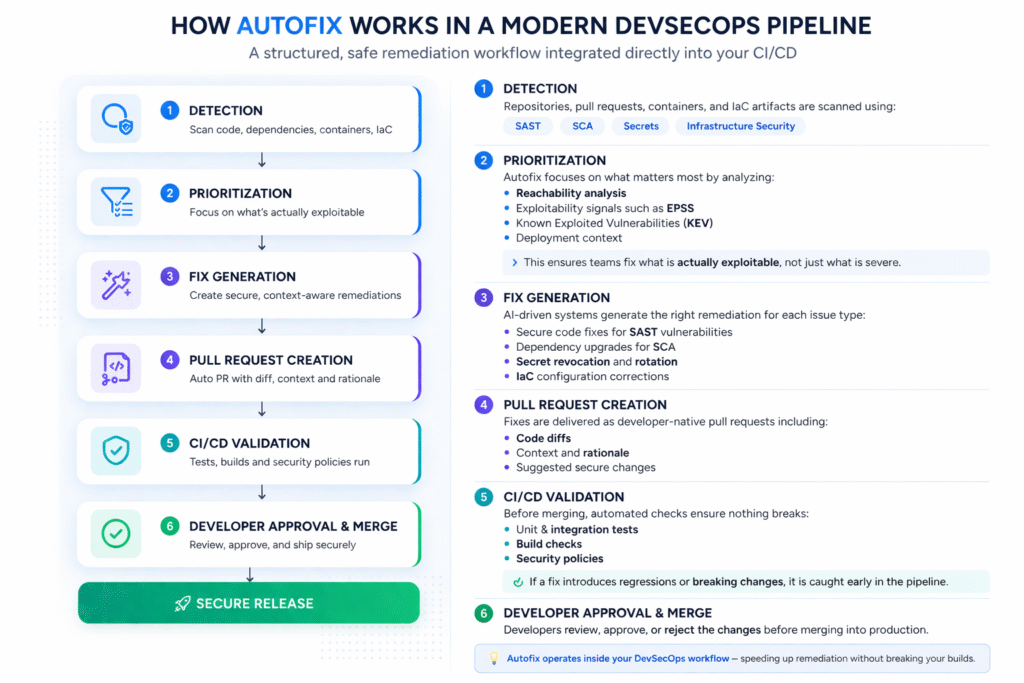
How Autofix Works in a Modern DevSecOps Pipeline
In a mature environment, autofix is not a single action. It is a structured remediation workflow integrated into CI/CD.
Instead of manual, disconnected fixes, modern pipelines follow a continuous flow:
Step-by-step autofix workflow
- Detection
Repositories, pull requests, containers, or IaC artifacts are scanned using SAST, SCA, Secrets, or infrastructure checks. - Prioritization
Not all vulnerabilities are treated equally. Autofix systems prioritize using:- Reachability analysis
- Exploitability signals such as EPSS
- Known exploited vulnerabilities (KEV)
- Deployment context
- Fix Generation
The system generates remediation actions based on the issue type:- Code fixes for SAST vulnerabilities
- Dependency upgrades for SCA
- Secret revocation and rotation
- IaC configuration corrections
- Pull Request Creation
Fixes are packaged into developer-native workflows, typically as pull requests with:- Code diffs
- Context and rationale
- Suggested changes
- Validation in CI/CD
Before merging, fixes are validated automatically through:- Unit and integration tests
- Build checks
- Security policies
- Developer Approval and Merge
Developers review, approve, or reject the changes before merging into productio
As a result, autofix does not bypass the development lifecycle. It operates inside it.
It integrates seamlessly with platforms like GitHub, GitLab, and Azure DevOps, ensuring that vulnerability remediation becomes part of the delivery workflow, not a separate process.
Autofix for Different Vulnerability Classes
One of the most common mistakes in the autofix conversation is treating all fixes as though they behave the same way. They do not.
Autofix for SAST
Code-level autofix is where many people first encounter the concept. A scanner finds a SQL injection, reflected XSS sink, or insecure validation pattern and proposes a secure replacement. This is often the most intuitive form of autofix because the fix is visible in source code and can be reviewed like any other change.
Xygeni’s product materials position AI AutoFix in this space as context-aware remediation that generates developer-ready fixes and pull requests for issues such as XSS and SQL injection. The underlying message is important even beyond the product claim: good SAST autofix must be code-aware, not just rule-aware.
Autofix for SCA
Dependency autofix is arguably more important operationally because vulnerable packages appear constantly and manual dependency upkeep does not scale. But it is also where trust is hardest to earn, because dependency updates are exactly where breaking changes become most painful.
A credible SCA autofix capability therefore has to do more than find a patched version. It has to evaluate upgrade safety, blast radius, and compatibility.
Autofix for Secrets
Secrets remediation is less about code rewriting and more about containment. If a live secret is exposed, the ideal response is not a ticket asking someone to rotate it next week. The ideal response is immediate revocation, replacement, and clear tracking. That is why autofix in secrets security often looks different from code autofix. The value is speed and certainty.
Autofix for IaC
Infrastructure misconfigurations are often highly repetitive. That makes them strong candidates for automation. If teams can standardize safe patterns for Terraform, Kubernetes, ARM, or CloudFormation, then autofix can enforce those patterns much earlier in the pipeline. NIST’s SSDF emphasis on integrating secure practices into each SDLC implementation fits directly here: security is strongest when it is embedded in the workflow, not deferred to later stages.
How to Avoid Breaking Builds With Autofix
This is the core promise behind the topic, and it deserves direct treatment.
To avoid breaking builds with autofix, teams need to validate remediation the same way they validate any other production-bound change. That means:
- analyze dependency and code impact before applying the change
- validate the fix in CI/CD with tests and policies
- limit automated scope where blast radius is high
- require developer review for material changes
- use staged introduction for high-impact upgrades
This is why remediation risk analysis is so valuable. It changes the question from “is there a fix?” to “is this the safest viable fix?” That is a much better engineering question.
It is also where many automation programs fail. They optimize for throughput and ignore change safety. Developers notice that immediately.
By contrast, a trusted autofix system respects the same change-management discipline that strong engineering teams already apply to feature development: review, test, validate, merge.
Best Practices for Implementing Autofix
If you are building or maturing an autofix program, the goal should be adoption, not novelty. Teams will use autofix when it consistently saves time without creating cleanup work.
Start with policy. Decide which issue classes are safe to automate first. SAST patterns with well-understood rewrites, dependency updates inside defined version ranges, or secret revocation workflows are often good early candidates.
Then narrow the scope. Do not try to automate everything in one release. Focus first on the issues that are both common and high-confidence. That is usually a better trust-building strategy than rolling out broad but noisy remediation.
Integrate remediation into existing developer workflows. If your engineering teams live in pull requests and branch protections, autofix should too.
Measure outcomes. The right metrics are not just “number of fixes generated.” They are merge rate, regression rate, time saved, false positive reduction, and time to remediation.
Finally, keep a human approval layer where it matters. Safe autofix does not eliminate developer judgment. It elevates it by removing repetitive work and concentrating attention on higher-value review.
From Detection to Remediation: Closing the Loop
One of the biggest weaknesses in legacy AppSec tooling is that the process ends too early. A finding appears. A ticket is created. Then the system waits.
That is not a closed loop. That is a handoff.
A modern AppSec program needs to be able to go from detection to prioritization to remediation with as little manual orchestration as possible. That is the real promise of autofix. It does not merely make remediation faster. It changes where remediation happens, how it is introduced, and who has to do the repetitive work.
This is also why the topic matters commercially, not just technically. Buyers no longer want only detection quality. They want measurable reduction in backlog and faster movement from issue discovery to issue resolution.
How Xygeni Enables Safe Autofix
Xygeni’s materials position its autofix capability around three themes: context, automation, and delivery integration.
On the code side, Xygeni AI SAST AutoFix generates developer-ready fixes, replacing risky patterns with secure alternatives and delivering those fixes through pull requests instead of abstract recommendations. It instantly remediates vulnerabilities such as XSS or SQL Injection and applies secure coding best practices directly in the developer workflow.
However, autofix in Xygeni goes beyond SAST. It also includes Secrets Autofix, which detects leaked credentials and revokes them automatically using prebuilt playbooks across platforms like AWS, GCP, or GitLab. This enables immediate containment, eliminating manual response delays and reducing the risk of credential abuse.
On the dependency side, Xygeni’s SCA Autofix enables bulk auto-remediation by generating fixes for vulnerable dependencies and applying them at scale. Teams can trigger automated patching, create pull requests with upgraded versions, and integrate remediation directly into CI/CD pipelines without disrupting delivery.
Additionally, these capabilities extend to Infrastructure as Code (IaC) and pipeline configurations, ensuring that misconfigurations and risky infrastructure patterns are also remediated as part of the same automated workflow.
That is the strategic point. Safe autofix does not operate in isolation. It spans code (SAST), dependencies (SCA), secrets, and infrastructure (IaC), ensuring consistent remediation across the entire software supply chain. Moreover, it works best when combined with exploitability-based prioritization, dependency graph analysis, and CI/CD validation, so fixes are not only automated, but also safe, relevant, and production-ready.
Quick Answer: How Do You Safely Remediate Vulnerabilities With Autofix?
To safely remediate vulnerabilities with autofix, teams need context-aware fixes, exploitability-based prioritization, remediation risk analysis, CI/CD validation, and developer approval before merge.
That is the short answer.
Anything less than that may still be automation, but it is not the kind of automation developers will trust in production.
FAQ
What is autofix in AppSec?
Autofix in AppSec is the automated generation and delivery of remediation changes for security issues such as code flaws, vulnerable dependencies, exposed secrets, or infrastructure misconfigurations.
Can autofix break builds?
Yes. Autofix can break builds when dependency upgrades introduce incompatible changes, when fixes ignore application context, or when changes are applied without validation.
How do you remediate vulnerabilities automatically without creating regressions?
Use autofix inside a controlled workflow: prioritize by exploitability and reachability, analyze remediation risk, validate changes in CI/CD, and keep a developer approval step.
What makes safe autofix different from naive autofix?
Safe autofix is context-aware, risk-aware, and pipeline-aware. Naive autofix simply proposes or applies changes without understanding compatibility, runtime impact, or engineering workflow.
Is AI autofix reliable?
It can be, but reliability depends on validation and governance. Gartner explicitly recommends that organizations using AI-based code security assistants continue to use traditional AST and code review as balancing controls, because AI optimizers can overcorrect or miss issues related to performance, reliability, and code quality.
Final Takeaway
Autofix is no longer a novelty in AppSec. It is becoming a practical requirement for teams that need to reduce backlog without expanding headcount or slowing delivery.
The real challenge is not whether to automate remediation. It is whether that automation respects how software is actually built and shipped.
If your autofix strategy ignores context, prioritization, and validation, it will create more friction than value. If it is designed around developer workflows, remediation risk, and CI/CD control points, it can materially improve both security outcomes and engineering speed.
That is the standard worth aiming for.

About the Author
Co-Founder & CTO
Fátima Said specializes in developer-first content for AppSec, DevSecOps, and software supply chain security. She turns complex security signals into clear, actionable guidance that helps teams prioritize faster, reduce noise, and ship safer code.