

In practice, security risk does not stop at code. While this may be true, static analysis finds issues early, it cannot confirm which vulnerabilities remain exploitable once an application is live. For that reason, DAST and ASPM must work together to connect runtime behavior with code-level findings and determine real exposure in producti
In other words, without runtime context, AppSec teams prioritize vulnerabilities based on assumptions rather than evidence. As a result, backlogs grow, false positives accumulate, and critical issues blend in with low-impact findings. This is where combining DAST with ASPM changes the equation, because runtime signals validate reachability, exposure, and exploitability under real-world conditions.
Why DAST Alone Is Not Enough
DAST simulates real-world attacks against live applications. As a result, it detects issues that static tools cannot see prior to deployment.
However, DAST tools typically generate large alert volumes without sufficient context.
Consequently, teams face:
- Flat vulnerability lists
- Limited prioritization
- Missing correlation with code and dependencies
In contrast, ASPM provides the structure needed to interpret these findings.
DAST reveals runtime vulnerabilities, but without correlation and prioritization, its findings still create noise and slow remediation.
DAST Ingestion in ASPM: From Runtime Signals to Actionable Risk

In order to close this gap, Xygeni ingests DAST outputs directly into its ASPM engine.
This includes results from tools such as OWASP ZAP, Acunetix 360, and other XML-based scanners.
After that, Xygeni correlates runtime findings with static signals and asset context.
What Xygeni Does
- Ingests DAST findings into ASPM
- Correlates runtime data with SAST, SCA, and configuration context
- Enriches issues with exposure and asset metadata
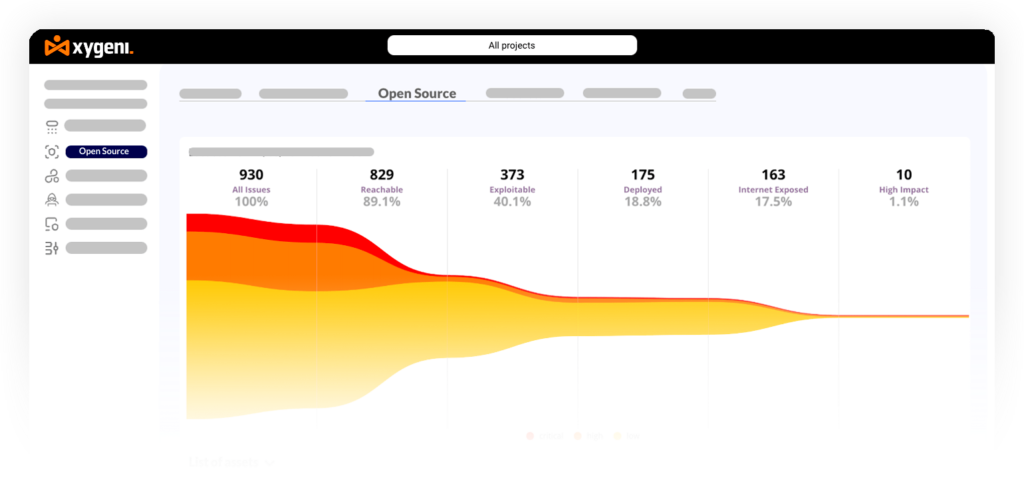
- Passes all findings through a multi-stage prioritization funnel
As can be seen, DAST becomes one signal among many, not an isolated output.
The DAST Prioritization Funnel: Runtime-Aware Filtering
Rather than treating all findings equally, Xygeni applies a progressive funnel:
All Issues → Internet Exposed → Unauthenticated → Business Value
At each stage, findings are filtered based on:
- External exposure
- Authentication requirements
- Runtime reachability
- Business relevance
As a result, low-impact or unreachable issues are removed early.
Why This Matters for DevSecOps Teams
Real-world exposure validation
DAST confirms exploitability on live systems. Therefore, teams stop fixing vulnerabilities that never materialize in production.
Signal over noise
Internal-only endpoints and authenticated paths drop out early. Consequently, backlogs remain actionable instead of overwhelming.
Faster, smarter remediation
Engineers triage based on runtime exposure and impact. In this way, fix cycles shorten and remediation accuracy improves.
Unified view: code → run → risk
By correlating static and dynamic signals, ASPM removes blind spots. In the final analysis, security decisions become data-driven and defensible.
DAST + ASPM in Continuous Delivery Environments
Modern applications change continuously. Given that, security decisions must reflect current runtime behavior, not assumptions made earlier in the SDLC.
By embedding DAST inside ASPM:
- Security aligns with real application behavior
- DevOps maintains release velocity
- Security debt decreases over time
In short, runtime-aware prioritization keeps security relevant as systems evolve.
To Conclude
DAST shows what can be attacked.
ASPM explains what truly matters.
Taken together, DAST and ASPM close the gap between code and runtime exposure, delivering accurate prioritization, reduced noise, and confident remediation for modern DevSecOps teams.