TL;DR
"Vulnerability management" describes two different products, and most comparisons put them in the same table. One patches the operating systems and third-party applications on your endpoints and cloud workloads. The other finds and fixes flaws in the software your teams build, across code, dependencies, pipelines and containers. Both are called vulnerability management tools. Buying the wrong one is the most common and most expensive mistake in this category.
Discovery was never the bottleneck. Deciding what to fix is. Any scanner will hand you thousands of findings. What determines whether the backlog shrinks is prioritisation that accounts for reachability, exploitability, EPSS and business context rather than CVSS severity alone, because severity on its own marks far more as critical than any team can work.
Remediation is where the hours actually go. A finding that arrives with a validated fix, and with an assessment of what the upgrade will break, gets resolved. A finding that arrives as a ticket gets triaged, deferred and inherited by whoever joins next.
The short version of the list: Xygeni for application and software supply chain vulnerability management with ASPM, risk-based prioritisation and AI remediation in one platform. Wiz for cloud posture and workloads. Aqua for containers and Kubernetes. Snyk for developer-first dependency and code scanning. Sonatype and Mend for open source governance and licence compliance. Heimdal for patching endpoints and third-party applications. Read the section below on the two markets before the rankings, because it determines which half of this list is even relevant to you.
Vulnerability management tools identify, prioritise, remediate and continuously monitor security weaknesses across the assets an organisation owns. They split into two families: infrastructure and endpoint tools that scan and patch operating systems, third-party software and cloud workloads, and application security tools that find and fix flaws in software your teams build, including source code, open source dependencies, containers, infrastructure as code and CI/CD pipelines. Which family you need depends on whether your risk sits in what you run or in what you build.
What Are Vulnerability Management Tools?
Vulnerability management tools help organizations identify, prioritize, remediate, and continuously monitor security vulnerabilities across applications, infrastructure, cloud environments, open-source dependencies, containers, and CI/CD pipelines. Modern vulnerability management tools go beyond vulnerability discovery by incorporating risk-based prioritization, Application Security Posture Management (ASPM), automated remediation, and DevSecOps integrations.
As software ecosystems become increasingly complex, organizations need vulnerability management tools that not only find vulnerabilities but also help teams understand which risks matter most and how to remediate them efficiently.
Open-source software has become a critical part of modern application development, helping organizations accelerate innovation and reduce development costs. However, the growing reliance on open-source components also increases exposure to vulnerabilities, software supply chain risks, and compliance challenges. Effective vulnerability management tools help organizations continuously identify, prioritize, and remediate these risks while maintaining secure development practices across the software development lifecycle (SDLC).
Industry analysts increasingly recognize that vulnerability management requires more than vulnerability scanning alone. Modern AppSec programs increasingly combine vulnerability management, ASPM, software supply chain security, risk-based prioritization, and automated remediation to help teams manage growing volumes of security findings.
This guide compares the top vulnerability management tools for 2026, highlighting their detection capabilities, prioritization features, remediation workflows, integrations, and ideal use cases, so you can choose the right solution for your organization’s security and DevSecOps requirements.
Vulnerability Management Tools List
| Tool | Coverage | AI Remediation | ASPM / Prioritization | Best For |
|---|---|---|---|---|
| Xygeni | Code, OSS, CI/CD, IaC, containers & software supply chains | AI AutoFix + Risk Analysis | Native ASPM & risk prioritization | DevSecOps teams seeking end-to-end vulnerability management |
| Wiz | Cloud environments & infrastructure | Limited | CSPM/CNAPP prioritization | Cloud-native organizations |
| Aqua | Containers, Kubernetes & cloud workloads | No | Moderate | Kubernetes-focused teams |
| Snyk | Code, dependencies, containers & IaC | Partial | Limited | Developer-first security programs |
| Sonatype | Open source dependencies & SCA | No | Policy-based prioritization | SCA-focused organizations |
| Mend | Open source dependencies & compliance | Partial | Moderate | Enterprise SCA programs |
| Heimdal | OS & third-party app vulnerabilities across endpoints | Partial | CVE/CVSS-based patch prioritization, AI-assisted triage | Infrastructure & endpoint vulnerability management |
Key Capabilities of Modern Vulnerability Management Tools
If you are looking for complete vulnerability management software for your team, here you will find some of the most important features you must take into account:
- Continuous Vulnerability Discovery: continuously identifies vulnerabilities across applications, open-source dependencies, containers, infrastructure, and CI/CD pipelines.
- Risk-Based Prioritization: uses exploitability, reachability, EPSS intelligence, severity, and business context to focus teams on the vulnerabilities that matter most.
- AI-Powered Remediation: accelerates vulnerability resolution through automated fix generation, remediation guidance, and change-risk analysis.
- ASPM & Centralized Visibility: consolidates findings from multiple security tools into a unified risk view and improves governance across the SDLC.
- Software Supply Chain Security: helps organizations manage risks across dependencies, build systems, package registries, and delivery pipelines.
- DevSecOps & CI/CD Integration: embeds vulnerability management directly into developer workflows and deployment pipelines to reduce remediation time.
Top 6 Open Source Vulnerability Management Tools to Take into Account in 2026
Overview: Xygeni is an AI-powered vulnerability management platform that combines vulnerability detection, ASPM, software supply chain security, AI-powered remediation, and DevSecOps automation in a single solution.
Unlike traditional vulnerability management tools that focus primarily on vulnerability discovery, Xygeni helps organizations identify, prioritize, govern, and remediate risk across source code, open-source dependencies, CI/CD pipelines, cloud infrastructure, and software supply chains.
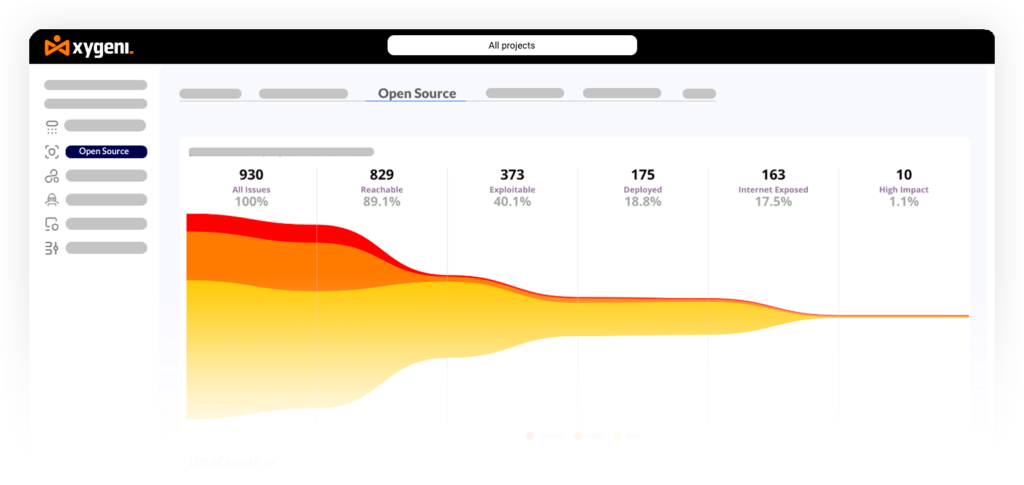
Its risk-based prioritization funnel combines exploitability, reachability analysis, EPSS intelligence, severity, and business context to help teams focus on the vulnerabilities that matter most while reducing alert fatigue. By correlating technical findings with real-world risk indicators, Xygeni enables security and DevSecOps teams to prioritize remediation efforts more effectively and accelerate risk reduction across the SDLC.
Key Features of Xygeni’s Vulnerability Management Software:
- Unified Vulnerability Management: consolidates vulnerabilities across code, open-source dependencies, CI/CD pipelines, IaC, containers, and software supply chains into a single platform.
- ASPM & Risk Prioritization: correlates findings and prioritizes vulnerabilities using exploitability, reachability, EPSS intelligence, severity, and business context.
- AI AutoFix & Remediation Risk Analysis: generates secure fixes and evaluates potential breaking changes before deployment.
- Continuous Vulnerability Detection: continuously monitors development environments and software assets to identify new risks as they emerge.
- Software Supply Chain Security: helps identify vulnerabilities and risks across dependencies, packages, build pipelines, and delivery workflows.
- Developer & CI/CD Integrations: integrates directly with GitHub, GitLab, Bitbucket, Azure DevOps, Jenkins, and developer workflows.
Best suited for: DevSecOps teams seeking end-to-end vulnerability management with ASPM, risk-based prioritization, AI-powered remediation, and software supply chain security.
Looking for a smarter way to prioritize, remediate, and manage vulnerabilities across the SDLC? Discover how Xygeni helps security and DevSecOps teams focus on the risks that matter most.

Overview: Wiz integrates across multiple cloud environments to provide extensive visibility and control.
Best suited for: Organizations prioritizing cloud infrastructure visibility, cloud risk management, and multi-cloud security operations.
Key Features:
- Cloud Risk Assessment: this open source vulnerability management tool offers evaluations of cloud configurations and workloads that can help to identify security gaps and suggest optimizations.
- Continuous Monitoring: it keeps surveillance over cloud environments to detect and alert on security anomalies in real-time.
- Anomaly Detection: Wiz uses algorithms to identify unusual patterns and potential threats. With this, the tool helps to prevent breaches before they occur.
Overview: Aqua’s primary focus is on securing applications across its entire software lifecycle.
Best suited for: Teams running containerized, Kubernetes-based, and cloud-native application environments.
Key Features:
- Container Security: this vulnerability management software provides comprehensive security solutions for containerized environments.
- Serverless Function Protection: it also safeguards serverless functions against vulnerabilities and misconfigurations, and makes sure that they operate within secure parameters.
- Automated Compliance Checks: the tool helps with compliance and automatically enforces security policies and conducts audits.
Overview: Snyk is a user-friendly tool whose features are tailored specifically for developer-first vulnerability management.
Best suited for: Developer-first organizations focused on securing code, open-source dependencies, and developer workflows.
Key Features:
- Open-source Tracking: the tool monitors open-source libraries used in projects to identify and track vulnerabilities.
- Code Analysis: it performs static analysis of source code to detect security flaws and suggest fixes.
- Dependency Scanning: also, the tool examines project dependencies for known vulnerabilities and offers updates or patches to mitigate risks.
Overview: Sonatype delivers precise intelligence about open-source vulnerabilities and remediation guidance.
Best suited for: Organizations focused on open-source governance, software composition analysis (SCA), and dependency risk management.
Key Features:
- Component Lifecycle Management: the tool manages the lifecycle of software components to ensure they remain secure throughout their usage.
- Policy Enforcement: it automates the enforcement of security policies to maintain compliance and manage risk.
- Software Composition Analysis (SCA Security): analyzes software compositions to identify vulnerabilities within open-source components.
Overview: Mend offers comprehensive solutions for securing open-source software throughout the DevSecOps pipeline.
Best suited for: Enterprise teams managing open-source security, license compliance, and vulnerability remediation at scale.
Key Features:
- License Compliance: this vulnerability management software ensures that software licenses are managed and adhered to, reducing legal and security risks.
- Effective Vulnerability Remediation: it also provides mechanisms for rapid remediation of identified vulnerabilities within open-source software.
Integration with Other - Development Tools: it works seamlessly with widely used development tools to enhance the workflow without disrupting existing processes.
Open source vulnerability management enables security managers and DevSecOps teams to make informed decisions about which tools best suit their needs.

Overview: Heimdal secures the infrastructure layer, patching the operating systems and third-party apps that code ultimately runs on, as part of a broader unified cybersecurity platform spanning endpoint, network, and identity security.
Best suited for: Organizations needing continuous CVE and CVSS-based vulnerability tracking and patching across their endpoint estate.
Key Features:
- Cross-Platform Vulnerability Tracking: monitors Windows, macOS, and Linux endpoints for CVE and CVSS-classified vulnerabilities across 350+ third-party apps.
- Sandbox-Tested Patch Deployment: tests and deploys every patch within four hours of release over encrypted channels.
- AI Wingman Triage: a multi-agent layer that helps teams prioritize vulnerability signals faster.
Watch our non-gated SafeDev Talk Episode on Endless Vulnerabilities & Smarter Defenses to learn more about how vulnerability management tools can help you scale effectively!
Are Vulnerability Management Tools a Necessity?
Organizations increasingly rely on vulnerability management tools because vulnerability discovery alone is no longer enough. Modern software environments generate thousands of security findings across applications, cloud infrastructure, open-source dependencies, and software supply chains. Without prioritization and remediation workflows, security teams struggle to focus on the risks that matter most.
Modern vulnerability management is no longer just about finding vulnerabilities, it is about understanding which vulnerabilities matter, prioritizing remediation efforts, and continuously reducing risk across the software development lifecycle. However, by choosing a sophisticated tool such as Xygeni, your organization is not only going to address vulnerabilities effectively but also it is going to be able to enhance its overall security posture. It is the right choice for those seeking to optimize their DevSecOps environments. If your organization is looking to elevate its security strategies, considering Xygeni could be the pivotal step toward achieving enhanced security, compliance, and operational efficiency.
Also, take a look at our latest blogpost on “Why Every Organization Needs a Vulnerability Management Tool?”
Final Thoughts on Vulnerability Management Tools
Vulnerability management tools have evolved far beyond vulnerability scanning. The most effective platforms help organizations discover, prioritize, govern, and remediate risk across applications, infrastructure, software supply chains, and modern DevSecOps environments.
As vulnerability volumes continue to increase, organizations increasingly need capabilities such as ASPM, AI-powered remediation, risk-based prioritization, and software supply chain security to focus on the vulnerabilities that matter most.
Xygeni brings these capabilities together in a unified platform, combining vulnerability management, software supply chain security, ASPM, risk-based prioritization, and automated remediation to help teams secure the entire SDLC.

FAQ’s
What is the difference between vulnerability scanning and vulnerability management?
Vulnerability scanning identifies security flaws. Vulnerability management includes discovery, prioritization, remediation, verification, and continuous monitoring. Modern vulnerability management tools help organizations manage the entire lifecycle of vulnerabilities rather than simply detecting them.
Which vulnerability management tools support DevSecOps?
Modern vulnerability management tools such as Xygeni, Snyk, Mend, Aqua, and Wiz integrate with source code repositories, CI/CD pipelines, and developer workflows. These integrations help teams identify, prioritize, and remediate vulnerabilities earlier in the software development lifecycle.
What vulnerability management tools provide AI-powered remediation?
Some modern vulnerability management platforms include AI-powered remediation capabilities that help developers resolve vulnerabilities faster. Xygeni provides AI AutoFix and Remediation Risk Analysis, while other platforms offer varying levels of automated fix recommendations and remediation guidance.
What is ASPM in vulnerability management?
Application Security Posture Management (ASPM) helps organizations consolidate findings from multiple security tools, prioritize vulnerabilities based on exploitability and business impact, and improve remediation workflows. ASPM enables security and DevSecOps teams to focus on the vulnerabilities that pose the greatest risk to production environments.
How do vulnerability management tools prioritize risk?
Modern vulnerability management tools prioritize vulnerabilities using factors such as CVSS severity, exploitability, reachability analysis, EPSS intelligence, business criticality, asset exposure, and proximity to production. This helps organizations focus remediation efforts on the vulnerabilities most likely to be exploited and reduce the time spent investigating low-risk findings.
How much do vulnerability management tools cost?
Application security platforms commonly start in the low tens of dollars per month for small teams and move to negotiated annual contracts at enterprise scale. Endpoint and cloud tools are usually priced per asset or per endpoint. Almost no vendor in this category publishes enterprise pricing, so budget for a scoping conversation and compare on what is included rather than on headline rates.
Do we need both infrastructure and application vulnerability management?
Most organisations that build software do. Infrastructure tooling patches what you run, application tooling fixes what you write, and neither produces the other’s output. The exception is a team that ships very little of its own code, where infrastructure coverage alone can be enough.
What is the difference between vulnerability management and ASPM?
Vulnerability management is the process: find, prioritise, fix, verify, monitor. ASPM is the layer that makes it work at scale across application security tools, correlating findings from multiple scanners, removing duplicates, adding context such as reachability and business criticality, and tracking whether risk is actually going down.