TL;DR
A malicious package has no CVE while it is being used against you. That is the whole problem with CVE-based scanning in the supply chain. In August 2026, the CHAINDROP campaign put malicious code into more than 400 npm packages across 1,700 versions, with over 1.3 billion combined monthly downloads and no CVE assigned during active exploitation. A scanner that waits for a database entry sees a clean dependency tree throughout.
Behavioural and ML-based detection is the only approach that fires in time. Analysing what a package actually does at publication and at install time catches the class of attack that matters, whether that is credential harvesting in an install script, obfuscated payloads or a compromised maintainer account. Every tool on this list does some version of this, and they differ mainly in how much of the lifecycle they see.
Detection without enforcement is a notification. The question that separates these tools is what happens after the verdict: does the package get blocked before it reaches disk, quarantined, or simply reported in a dashboard someone reads on Monday. Ask for the enforcement point, not the detection claim.
The short version of the list: Xygeni for teams that want malware detection across code, dependencies, pipelines, IaC and artifacts in one platform, with Malware Early Warning, package quarantine and a dependency firewall. ReversingLabs for pre-release validation of compiled binaries. Socket for developer-first behavioural analysis of npm and PyPI. Aikido for zero-day package detection inside a broader developer AppSec platform. Veracode where a compliance-driven programme is already standardised on it. Our detections are published weekly and openly in the Malicious Code Digest, so you can check the claim rather than take it.
An open source malware scanner detects intentionally malicious code in open source packages and in your own SDLC, rather than known vulnerabilities in catalogued components. The five compared here are Xygeni, ReversingLabs, Socket, Aikido and Veracode, and they differ on two axes: how detection works (behavioural, ML-assisted, binary inspection or threat database) and how much of the lifecycle they cover (dependencies only, post-build artifacts, or the full pipeline including source code, IaC and CI/CD).
Open-source malware scanners help organizations identify malicious packages, compromised dependencies, backdoors, trojans, and software supply chain attacks before they reach production environments. As software supply chain attacks continue to increase, organizations need security tools that can detect malicious behavior even when no CVE exists.
Traditional vulnerability scanners check dependencies against known vulnerability databases. While effective for catalogued flaws, they often miss newly published malicious packages and zero-day supply chain attacks. This guide compares the top open source malware scanners for 2026, evaluating malware detection techniques, software supply chain security capabilities, CI/CD integrations, and ideal use cases.
Industry analysts increasingly recognize that software supply chain security requires more than vulnerability management alone. Modern AppSec programs increasingly combine malware detection, software composition analysis (SCA), Application Security Posture Management (ASPM), and software supply chain security controls to identify both known vulnerabilities and intentionally malicious components.
How we evaluated these scanners?
Each tool was assessed against the same six criteria, using publicly documented capabilities and vendor documentation as of September 2026: detection technique, lifecycle coverage, enforcement capability, ecosystem support, developer workflow integration, and pricing transparency. Where a vendor has acquired detection technology, the assessment reflects the current product rather than the historical one. Pricing figures are the publicly available ones at the time of review, and enterprise pricing is negotiated per scope.
Top 5 Open Source Malware Scanners in 2026
Comparative Table: Open Source Malware Scanners
| Tool | Detection Approach | SDLC Coverage | CI/CD Integration | Best For |
|---|---|---|---|---|
| Xygeni | ML-assisted malware detection, behavioral analysis, AI Security & AI-SPM | Source code, dependencies, CI/CD, IaC, containers, software supply chain & AI workflows | Native malware firewall, pipeline guardrails, and policy enforcement | Organizations seeking SDLC-wide malware protection and software supply chain security |
| ReversingLabs | Binary-level deep inspection with threat intelligence | Post-build: binaries, containers, artifacts | Artifact repository integration | Large enterprises needing pre-release binary validation |
| Socket | Behavioral package analysis at install time | Dependencies only: npm and PyPI primary | GitHub PR integration | Developer-focused teams monitoring open source dependency behavior |
| Aikido | AI-powered static analysis of package code patterns | Dependencies, containers, IaC; limited SDLC | IDE plugins and CI/CD gates | Developer teams wanting zero-day package detection with broad AppSec |
| Veracode | Static and dynamic analysis with SCA | Application code and dependencies | CI/CD pipeline integration | Regulated enterprises with compliance-driven AppSec programs |
1. Xygeni: Open Source Malware Scanner
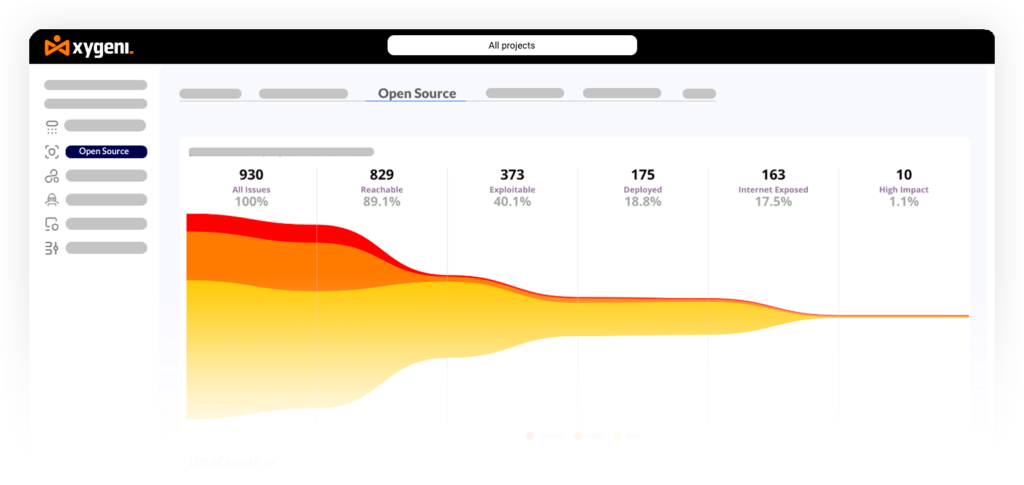
Overview: Xygeni is the only tool in this comparison that covers malware detection across every layer of the software development lifecycle simultaneously: application source code, open source dependencies, CI/CD pipelines, IaC files, build artifacts, and containers. Where other tools specialize in one stage, Xygeni defends the entire pipeline from a single platform.
Unlike traditional open source malware scanners that focus only on package analysis, Xygeni combines malware detection, software supply chain security, AI Security Posture Management (AI-SPM), CI/CD security, and application security testing in a single platform. This allows organizations to identify malicious packages, compromised build pipelines, AI-related risks, and software supply chain threats across the entire SDLC.
Its malware detection goes beyond pattern matching and CVE lookups. Xygeni uses a proprietary ML-assisted engine to detect unknown malware, including zero-day threats that have no public CVE. It analyzes newly published packages across npm, PyPI, Maven, and other registries in real time, providing an Early Warning system that flags suspicious packages and places them in quarantine before they enter the SDLC. Publisher and Criticality Analysis evaluates package reliability through maintainer reputation history and cross-platform criticality scores, catching risks that behavioral analysis alone may miss.
For proprietary code, Xygeni inspects source files for backdoors, trojans, and hidden threats including CWE-506 (Embedded Malicious Code) patterns, ensuring the codebase itself remains trustworthy alongside the dependencies it pulls in. The Malware Dependency Firewall acts as a proactive guardrail, blocking malicious packages from reaching applications before developers even interact with them. You can learn more about AI-powered malware detection in the software supply chain and how malicious code can cause damage for additional context.
Key Features:
- Proprietary ML-assisted engine detecting unknown malware beyond CVE-based threat databases
- Real-time monitoring of npm, PyPI, Maven, and other registries, analyzing newly published and updated packages daily
- Early Warning system with package quarantine, flagging suspicious components before they enter development workflows
- Publisher and Criticality Analysis evaluating maintainer reputation, history, and cross-platform criticality scores
- Malware Dependency Firewall proactively blocking malicious packages from reaching applications
- Detection of backdoors, trojans, and hidden threats in application source code aligned to CWE-506 and related patterns
- Pipeline and CI/CD security detecting reverse shell commands, malicious providers, and malware downloads in pipeline definitions and IaC files
- Actionable malware insights with commit details, developer information, timestamps, and complete audit trails
- Historical Package Lookup providing access to malware records of open source packages, including those removed from registries, for incident response and governance
- Continuous real-time threat monitoring with alerts for emerging risks across the software supply chain
- Native CI/CD integration with GitHub Actions, GitLab CI, Jenkins, Bitbucket Pipelines, and Azure DevOps
- Part of a unified platform covering SAST, SCA, DAST, IaC Security, Secrets Detection, CI/CD Security, ASPM, Build Security, and Anomaly Detection
Best for: DevSecOps teams that need comprehensive malware protection across every stage of the SDLC, not just dependency scanning, as part of a unified AppSec platform.
Pricing: Starts at $33/month for the complete all-in-one platform. Includes malware detection across SCA, SAST, CI/CD Security, Secrets Detection, IaC Security, and Container Scanning. Unlimited repositories and contributors with no per-seat pricing.
2. ReversingLabs: Open Source Malware Scanner

Overview: ReversingLabs is a specialized malware analysis platform focused on post-build security for compiled software artifacts. Its core product, Spectra Assure, applies AI-powered binary inspection combined with one of the largest file reputation databases globally, covering billions of files. This makes it a strong last line of defense before software release, particularly for teams that distribute compiled software to customers or integrate third-party binaries they cannot inspect at source level.
ReversingLabs does not scan earlier SDLC stages. It focuses exclusively on what has already been built, making it a complementary tool rather than a primary malware scanner for teams that need shift-left protection. Its value is highest in regulated industries and software vendors where pre-release binary validation is a compliance requirement. For context on build security and artifact integrity, that link covers related concepts.
Key Features:
- Binary-level malware scanning using proprietary unpacking and static analysis on compiled artifacts
- Threat intelligence database covering billions of files for rapid malicious component identification
- Integration with artifact repositories including JFrog Artifactory and Sonatype Nexus
- Quarantine of compromised or tampered artifacts to block threats before release
- Third-party software validation without requiring access to source code
Cons:
- Does not scan source code, open source dependencies, IaC files, or pipeline behavior; coverage is limited to post-build artifacts
- No developer-focused features such as IDE integration or real-time PR feedback
- Complex setup and enterprise-level pricing requiring sales engagement; better suited to large SOC teams than agile DevOps environments
Pricing: Enterprise pricing based on artifact volume and selected features. No public plans available; contact sales for a quote.
3. Socket: Open Source Malware Scanner
Overview: Socket is a developer-focused malware detection tool that analyzes open source package behavior rather than checking against CVE databases. Instead of waiting for a vulnerability to be catalogued, Socket inspects what a package actually does: whether it accesses the network unexpectedly, reads environment variables, modifies the filesystem, or uses patterns associated with credential theft and data exfiltration. This behavioral approach catches supply chain attacks with no CVE, which is the class of threat that traditional scanners miss. For context on real-world supply chain attacks using this type of vector, see the Shai-Hulud npm supply chain attack analysis.
Socket is focused on npm and PyPI primarily, with partial support for other ecosystems still developing. It does not scan proprietary code, CI/CD pipelines, containers, or IaC files, so teams need to complement it with broader SDLC security tooling for full coverage.
Key Features:
- Behavioral package analysis detecting suspicious activity at install time, independent of CVE databases
- Detection of install hooks, unusual API usage, network calls, and signs of data exfiltration in open source packages
- GitHub integration with real-time PR scanning and blocking of risky packages before merge
- Live malware feed providing continuous updates on emerging threats across open source registries
- Enterprise Dependency Firewall with customizable blocking policies for organization-wide protection
- Developer-friendly interface with CLI, web dashboard, and Slack notifications
Cons:
- Coverage limited to third-party dependencies; does not scan proprietary code, CI/CD pipelines, containers, or IaC files
- Primary ecosystem support for JavaScript and Python; Java, Ruby, and others partially supported or in development
- Automated blocking and organizational controls require paid plans
- Not a full AppSec platform; requires additional tooling for SDLC-wide malware coverage
Pricing: Free tier available for open source projects. Paid team and organization plans available on request with per-user pricing.
4. Aikido: Open Source Malware Scanner
Overview: Aikido Security is a unified application security platform that includes a zero-day open source malware scanner focused on npm and PyPI registries. Rather than relying solely on known vulnerabilities, its AI-powered static analysis detects malicious packages early by flagging obfuscated code, suspicious install scripts, and patterns associated with credential theft and data exfiltration. It extends scanning beyond packages to container images and IaC files, making it broader in SDLC coverage than Socket while remaining more limited than full-stack platforms.
Aikido integrates into developer workflows through IDE plugins and CI/CD pipeline gates, providing timely feedback on risky package imports without requiring significant workflow changes. For teams looking for a developer-centric AppSec platform that combines malware detection with broader vulnerability and secrets scanning, it offers a practical consolidated entry point.
Key Features:
- Zero-day malware scanner analyzing newly published packages on npm and PyPI in real time, before CVEs are assigned
- AI-powered static analysis detecting obfuscated code, malicious install scripts, and data exfiltration patterns
- IDE plugin and PR integration blocking suspicious packages as part of everyday development workflow
- Container image and IaC layer scanning extending coverage beyond package dependencies
- Live malware intelligence feed for continuous registry threat monitoring
Cons:
- Primarily focused on open source packages; does not scan custom source code or CI/CD pipeline behavior for malware
- No automated prioritization funnel; alerts require manual triage, which can slow incident response
- Ecosystem support beyond JavaScript and Python is still maturing
- Advanced policy automation and team-wide controls available only in paid plans
Pricing: Starts at approximately $300/month for 10 users under the Basic plan. Per-user pricing increases with team size. Custom enterprise plans available for larger deployments.
5. Veracode: Open Source Malware Scanner
Overview: Veracode is an enterprise application security platform that combines static analysis, dynamic testing, and software composition analysis. While it is not primarily positioned as a malware scanner, its SCA capabilities detect malicious or compromised open source components alongside known vulnerabilities, making it relevant for teams that need a compliance-driven AppSec program that includes supply chain risk management. Its strength is in regulated industries where audit trails, policy enforcement, and integration with enterprise governance workflows are non-negotiable requirements.
Veracode’s malware detection is limited compared to behavioral scanners like Socket or Xygeni. It focuses on known threats catalogued in threat databases rather than real-time behavioral analysis of package activity. For teams whose primary security program is built around Veracode’s broader platform, its SCA layer provides a reasonable baseline for open source risk management within that ecosystem. For context on application security testing best practices, that link covers the broader testing landscape.
Key Features:
- SCA scanning detecting vulnerabilities and license risks in open source components
- Static analysis (SAST) for proprietary code vulnerability detection
- Dynamic analysis (DAST) for runtime vulnerability testing of deployed applications
- Policy enforcement and compliance reporting aligned to PCI-DSS, HIPAA, and NIST standards
- Integration with CI/CD pipelines and enterprise development tools
Cons:
- No real-time behavioral malware detection; relies on known threat databases rather than zero-day behavioral analysis
- No proactive package quarantine or early warning system for newly published malicious packages
- Platform-focused design can limit integration flexibility outside the Veracode ecosystem
- High cost with median contract values around $18,633/year; no transparent self-serve pricing
Pricing: Median contract value approximately $18,633/year based on customer purchase data. No transparent self-serve pricing available; custom quotes required.
Watch our non-gated SafeDev Talk Episode on the Evolution of Malware Attacks to know more about them and the need for proactive strategies to protect your software supply chains!
Key Features to Look for in Open Source Malware Scanners
With the tools compared, these are the criteria that matter most for selecting effective malware scanning coverage:
Behavioral detection beyond CVEs. CVE databases only cover known vulnerabilities in catalogued packages. The most dangerous supply chain attacks use packages that are malicious from the moment of publication, with no assigned CVE. Scanners that only check CVE databases cannot detect these threats. Behavioral analysis, examining what a package actually does at install time, is the only approach that catches zero-day supply chain attacks.
Registry monitoring with early warning. The window between a malicious package being published and being detected is the most dangerous period. Tools that continuously monitor registries and flag suspicious packages before they appear in CVE lists provide meaningfully earlier protection than those that wait for database updates.
SDLC coverage depth. There is a practical difference between a tool that scans dependencies and a tool that also inspects proprietary code, pipeline definitions, IaC files, and build artifacts. Malware can hide in any of these layers. Understanding which stages each tool covers prevents false confidence in partial coverage. See indicators of compromise in CI/CD pipelines for context on pipeline-specific threats.
Publisher and maintainer reputation analysis. A package with a clean behavioral profile can still come from a compromised or malicious maintainer account. Tools that evaluate publisher reputation, maintainer history, and cross-platform criticality scores provide an additional signal layer that behavioral analysis alone cannot supply.
Historical package lookup. Malicious packages are often removed from registries quickly after detection, but teams may have already pulled them into their builds. Tools that maintain historical records of detected malware, including removed packages, enable incident response and retroactive auditing.
CI/CD enforcement capability. Detection without enforcement means finding malware after it has already entered the pipeline. Tools that can block malicious packages from being pulled, quarantine suspicious components, or fail pipeline builds when threats are detected convert detection into a real security gate.
How to Choose the Right Open Source Malware Scanner
If you need full SDLC malware coverage in a single platform: Xygeni is the only tool here that covers source code, dependencies, pipelines, IaC, and artifacts simultaneously, with a proprietary ML engine for unknown malware, an Early Warning system, and a Malware Dependency Firewall as proactive protection.
If your primary need is pre-release binary validation: ReversingLabs is the strongest option for teams that need to validate compiled artifacts before distribution, particularly when source code is not available for third-party components.
If you want developer-first behavioral analysis of npm and PyPI packages: Socket provides the most accessible behavioral scanner for JavaScript and Python dependency ecosystems, with good GitHub integration for developer workflows.
If you want a broader AppSec platform with zero-day package detection: Aikido combines malware scanning with vulnerability management, secrets detection, and container security in a developer-friendly platform, though its malware coverage is narrower than Xygeni in terms of SDLC depth.
If your program is compliance-driven and built around enterprise governance: Veracode provides the audit trails, policy enforcement, and compliance reporting needed in regulated industries, with SCA coverage as part of a broader AppSec platform.
Final Thoughts
Open source malware scanning is a distinct discipline from CVE-based vulnerability management. Most breaches via supply chain attacks exploit packages that have no CVE at the time of the attack. Choosing a scanner that only checks known vulnerability databases leaves the most dangerous attack class entirely undetected.
The five tools reviewed here offer meaningfully different approaches. For teams that need the broadest coverage, combining behavioral analysis, ML-based unknown malware detection, real-time registry monitoring, and SDLC-wide protection in a single platform, Xygeni provides the most comprehensive approach in 2026.
For organizations seeking comprehensive software supply chain security, malware detection alone is not enough. The most effective platforms combine malware detection, dependency analysis, CI/CD security, AI Security, software supply chain protection, and risk prioritization. Xygeni brings these capabilities together in a single platform, helping teams identify, block, prioritize, and remediate threats across the entire software development lifecycle.
FAQ
What is an open-source malware scanner?
An open source malware scanner analyzes open source packages, dependencies, and code for malicious behavior, hidden threats, and supply chain attacks. Unlike traditional vulnerability scanners that check against CVE databases, malware scanners use behavioral analysis, static inspection, and threat intelligence to detect threats that have no public CVE, which is how most supply chain attacks operate.
What is the difference between a malware scanner and a vulnerability scanner?
A vulnerability scanner checks software components against known CVE databases to identify publicly disclosed security flaws. A malware scanner analyzes code and package behavior to detect malicious intent, including backdoors, trojans, obfuscated logic, and supply chain attack patterns that may have no CVE. The two approaches are complementary: vulnerability scanning covers known flaws, malware scanning covers intentional threats.
What is the difference between software composition analysis (SCA) and malware scanning?
Software Composition Analysis (SCA) identifies known vulnerabilities, license risks, and compliance issues in open source dependencies by comparing components against vulnerability databases such as the NVD. Malware scanning focuses on detecting intentionally malicious code, including backdoors, trojans, credential stealers, obfuscated scripts, and software supply chain attacks that may not have an assigned CVE.
The two approaches address different risks. SCA helps organizations manage known vulnerabilities, while malware scanning helps identify malicious packages before they are catalogued in public databases. Modern software supply chain security programs typically use both technologies together to protect against known flaws and emerging threats.
Why do most supply chain attacks bypass CVE-based scanners?
Supply chain attacks typically use newly published malicious packages, compromised maintainer accounts, or typosquatting techniques to inject malicious code into popular registries. These packages are malicious from the moment of publication and have no assigned CVE because they have not been catalogued in any public database yet. CVE-based scanners have no signal to match against, so they pass the package as clean. Behavioral scanners analyze what the package actually does, detecting malicious activity regardless of CVE status.
Which open source malware scanner covers the most SDLC stages?
Xygeni covers the broadest range of SDLC stages in a single platform: application source code, open source dependencies, CI/CD pipeline definitions, IaC files, build artifacts, and containers. It uses a proprietary ML-assisted engine for unknown malware detection, combined with real-time registry monitoring and a Malware Dependency Firewall for proactive blocking. Other tools in this comparison cover one or two stages but not the full pipeline.
Can open source malware scanners detect zero-day threats?
Yes, but only tools that use behavioral analysis or ML-based detection engines can do so. CVE-based scanners cannot detect zero-day threats because no CVE has been published for the malicious package yet. Xygeni’s ML-assisted engine, Socket’s behavioral analysis, and Aikido’s AI-powered static analysis can all detect malicious behavior in packages before a CVE exists, which is the critical window when most supply chain attacks are active.
How do open source malware scanners detect malicious packages?
Open source malware scanners use behavioral analysis, static code inspection, machine learning, threat intelligence, and reputation analysis to identify malicious packages. Unlike CVE-based tools, they analyze what software actually does rather than relying solely on known vulnerabilities.
Are there free open source malware scanners?
Yes. OpenSSF Package Analysis, GuardDog, YARA and ClamAV are open source and free to run. They provide detection primitives rather than a managed capability: no registry-wide monitoring, no publisher reputation, no historical lookup for removed packages, and no enforcement point that blocks an install before it happens.
Can a malware scanner block a package before it installs?
Some can. This is the difference between detection and enforcement, and it is worth asking about specifically, because a scanner that reports after the install script has already run has not protected the machine. Enforcement can sit in the pull request, in the pipeline, in a registry proxy, or at the developer endpoint before the package reaches disk.
Do AI coding agents change the malware risk in dependencies?
Yes, in one specific way. An agent resolves and installs packages without a human choosing them, so an approved-library policy that assumed human selection no longer applies. Research presented at USENIX Security 2025 found that 19.7% of packages recommended by language models do not exist, and attackers register the names that recur.