


Choosing the right SDLC tools drives efficiency, security, and collaboration in software development. Whether your team follows Agile, DevSecOps, or Waterfall SDLC methodologies, these tools streamline workflows and accelerate productivity, and in 2026, that toolset increasingly includes AI coding assistants and autonomous agents alongside the version control, CI/CD, and infrastructure tools teams have relied on for years.
However, without built-in security, even the most commonly used SDLC tools can expose your projects to vulnerabilities, whether that’s a secret committed to Git, a misconfigured pipeline, or a hallucinated package an AI assistant just suggested installing. For this reason, integrating security solutions becomes essential to protect your development process at every stage, not just the traditional ones.
Let’s explore the key SDLC tools teams rely on today and discover how Xygeni fortifies each one with robust security measures.
SDLC Tools for Security
Version Control Tools
Version control tools like Git help teams track code changes, collaborate seamlessly, and manage project versions efficiently. These tools simplify tasks like branching, merging, and rolling back changes, making it easier to manage complex development workflows.
However, these tools can introduce security risks. Developers sometimes commit sensitive information such as API keys, tokens, or passwords by accident. For example, in 2022, Uber suffered a significant breach when an exposed credential in a private repository allowed attackers to access critical systems.
To prevent such incidents, Xygeni’s Secrets Security scans for sensitive information in real time during commits. When it detects secrets, it blocks the commit immediately and alerts the developer to remove the exposed data. This proactive approach ensures sensitive information stays out of your code history and reduces the risk of credential leaks and unauthorized access.
CI/CD Pipeline Tools
CI/CD tools like Jenkins automate building, testing, and deploying code. These tools speed up development and help deliver software updates reliably. Consequently, they rank among the most commonly used SDLC tools in modern development.
Yet, CI/CD pipelines often become targets for attackers. In 2021, Codecov fell victim to a supply chain attack due to a compromised CI/CD pipeline. Malicious actors injected code that exposed credentials, affecting thousands of users.
To combat these threats, Xygeni’s CI/CD Protection continuously monitors pipelines for vulnerabilities and misconfigurations. Xygeni scans each step, flags security issues, and blocks insecure deployments before they reach production. As a result, your CI/CD process remains secure, and only compliant, vulnerability-free code goes live.
Infrastructure as Code (IaC) Tools
Infrastructure as Code (IaC) tools like Terraform and CloudFormation let developers manage infrastructure using code. These tools improve consistency, scalability, and automation, making them essential for teams following DevSecOps and other automation-driven SDLC methodologies.
However, misconfigurations in IaC templates can lead to severe vulnerabilities. For example, in 2019, a major data breach at Capital One occurred because of a misconfigured AWS S3 bucket. This error exposed the data of over 100 million customers.
Xygeni’s IaC Security scans IaC templates before deployment to detect misconfigurations such as open ports, unencrypted databases, or overly permissive access controls. By catching these issues early, Xygeni helps teams fix vulnerabilities before they impact production environments. Consequently, your infrastructure remains secure and compliant.
Open Source Security Tools
Open-source libraries accelerate development and reduce costs. As a result, they form the backbone of many modern applications, making open-source management tools some of the most commonly used SDLC tools. For instance, up to 90% of an application’s code may rely on open-source components.
Nevertheless, these dependencies introduce security risks. In 2021, the Log4j vulnerability affected millions of applications worldwide, highlighting the dangers of using vulnerable open-source code. Attackers exploited this flaw to gain control over servers and steal sensitive data.
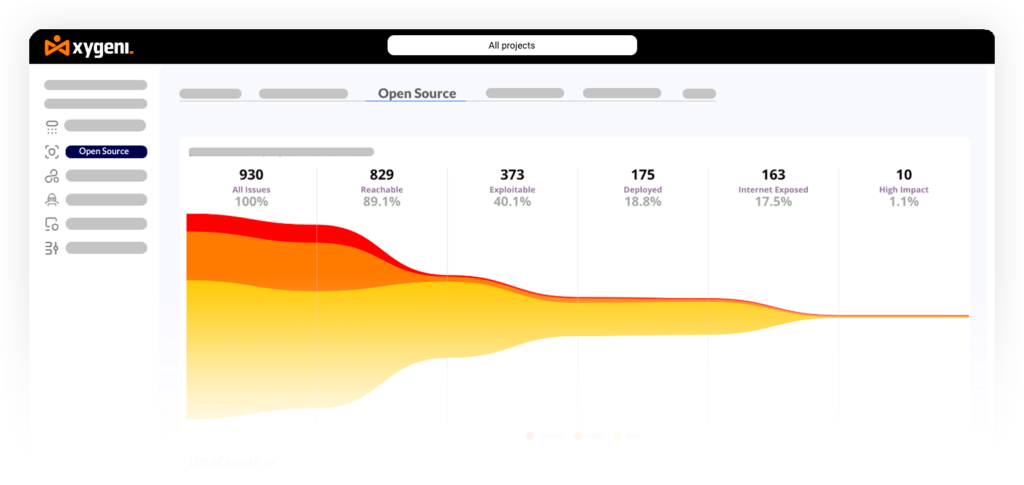
Xygeni’s Open Source Security solution addresses these challenges. It continuously scans dependencies for vulnerabilities and malware, monitors public registries for compromised packages, and blocks risky components before they enter your codebase. Additionally, Xygeni automates license compliance, helping you avoid legal pitfalls. This way, your applications benefit from open-source innovation without sacrificing security.
AI Coding Tools and Agents
AI coding assistants and autonomous agents have become some of the most widely adopted SDLC tools in modern development, generating code, suggesting dependencies, and in some workflows, installing packages with minimal human review. That speed comes with a new category of risk: AI assistants can hallucinate package names that attackers then register with malware, and agents connected through MCP servers can introduce integrations nobody on the security team has reviewed.
Xygeni’s AI Inventory maps every AI model, agent, and MCP connection running across the SDLC, and AI Triage applies AI-driven analysis to the resulting security findings, producing a verdict, urgency, and remediation complexity for each one, so AI-generated code and AI-introduced dependencies get the same scrutiny as anything else in your pipeline.
Why Security Enhancements for SDLC Tools Matter
Relying on the most commonly used SDLC tools enhances efficiency, but these tools can also introduce security risks. Without integrated security, vulnerabilities can slip through undetected. Therefore, enhancing these tools with Xygeni’s solutions ensures:
- Secrets Stay Protected: Xygeni blocks sensitive data from entering version control systems.
- Deployments Remain Secure: CI/CD pipelines only deliver secure and compliant code.
- Infrastructure Stays Resilient: IaC templates are free of misconfigurations and vulnerabilities.
- Dependencies Stay Safe: Open-source libraries remain secure and compliant with licensing standards.
- AI-Introduced Risk Stays Visible: AI coding assistants and agents are inventoried and triaged like any other part of the SDLC, not left as a blind spot.
By securing these SDLC tools, your team can focus on development without worrying about hidden threats.
How Xygeni Supports Different SDLC Methodologies
Xygeni’s security solutions adapt to various SDLC methodologies:
- Agile and DevSecOps: Xygeni integrates security checks directly into Agile sprints and CI/CD workflows. Findings are automatically triaged through AI Triage, producing a verdict, urgency, and remediation complexity for each issue, so teams catch what’s genuinely exploitable early without manually reviewing every alert or slowing down the sprint.
- Waterfall: Xygeni enforces security standards at each phase of the Waterfall model. From version control to deployment, Xygeni helps teams stay compliant and secure throughout the process, with each phase gate backed by the same scanning and prioritization used across Agile workflows.
By incorporating Xygeni’s solutions, your team can align security with your preferred methodology, ensuring both efficiency and protection.
Fortify Your SDLC Tools with Xygeni
The most commonly used SDLC tools drive modern software development, from version control and CI/CD pipelines to the AI coding assistants and agents now embedded in daily workflows. However, integrating robust security measures is essential for protecting your code, infrastructure, dependencies, and the AI layer increasingly woven through all three.
Xygeni enhances these tools by blocking secrets, securing CI/CD pipelines, managing IaC templates, protecting open-source libraries, and inventorying and triaging the AI models, agents, and MCP connections running across your SDLC. As a result, your development lifecycle becomes more secure, efficient, and compliant, no matter how much of it is now written or touched by AI. Ready to Secure Your SDLC Tools?

FAQ
What are the most commonly used SDLC tools?
The most common categories are version control tools (like Git), CI/CD pipeline tools (like Jenkins), Infrastructure as Code tools (like Terraform), open-source dependency management tools, and, increasingly, AI coding assistants and agents.
Do SDLC methodologies like Agile and Waterfall need different security tools?
The underlying security controls, secrets detection, CI/CD monitoring, IaC scanning, dependency security, largely stay the same. What changes is when and how often they run: Agile and DevSecOps environments need continuous, automated checks integrated into sprints and pipelines, while Waterfall methodologies apply the same controls at each defined phase.
Are AI coding assistants considered SDLC tools that need securing?
Yes. AI coding assistants, autonomous agents, and MCP connections now operate across the SDLC the same way version control or CI/CD tools do, and they introduce their own risks, such as hallucinated package names and unreviewed integrations, that traditional SDLC tooling wasn’t built to catch.