
Ask a security leader how many AI tools are touching company data right now, and you’ll get a confident number. It will be wrong, and not because anyone is hiding anything. Most shadow AI leaves nothing to find: no install, no license, no line item. A browser tab and a personal login are enough. That gap between the AI your policy covers and the AI your organization actually runs is what drives shadow AI risk, and it has grown from an IT footnote into one of the fastest-moving categories in AppSec. This guide covers how to detect and eliminate shadow AI in practice, with the detection signals and governance steps that hold up once the audit is over.
Shadow AI risk in one paragraph
Shadow AI is any AI tool, model, agent, or API call operating inside your organization without security or IT review. It’s the direct successor to shadow IT, but harder to catch: shadow IT usually left a procurement record or a network signature that a CASB could match against. Shadow AI often leaves neither. An employee pastes a contract into a chatbot signed in with a personal account, or a developer wires an API key from a model provider straight into a script, and none of it touches a vendor inventory. Two independently reported figures show how much shadow AI risk has already accumulated: 80% of workers use AI tools their organization hasn’t approved, according to Unseen Security’s 2026 State of Shadow AI report, and 86% of organizations say they lack visibility into how data actually flows to and from the AI tools already in use.
Why shadow AI risk outgrew shadow IT
Three shifts explain why shadow AI risk moved faster than the governance built to catch shadow IT, and none of them are reversible.
- AI stopped needing an install. The tools that defined shadow IT (unsanctioned SaaS, rogue browser extensions) left evidence in an asset inventory. An AI assistant opened in a browser tab, or a model API called with a personal card, leaves nothing for endpoint monitoring or procurement to flag.
- AI moved inside the tools you already approved. Copilot-style features now ship embedded in platforms already on the allowlist. The platform got reviewed. The AI capability quietly turned on inside it, but it usually didn’t.
- The volume moved from human-triggered to machine-scale. Zscaler’s ThreatLabz team analyzed 536.5 billion AI and machine learning transactions across its cloud and recorded a 3,464.6% year-over-year increase in enterprise AI/ML traffic. That scale of change is exactly why a shadow AI risk assessment done a year ago is already out of date, and why point-in-time audits keep losing to a problem that compounds monthly.
Where shadow AI actually hides
Security teams that go looking for shadow AI risk with shadow-IT tools usually come back with an incomplete list, because the hiding spots are different:
- Browser-based tools with no endpoint footprint. The AI runs entirely in a tab. No agent to detect, nothing to install.
- AI features embedded in sanctioned platforms. The platform was reviewed. The AI feature that shipped inside it later usually wasn’t.
- Personally expensed API usage. A developer puts a model API on a personal card and calls it directly from code. It never reaches procurement, so it never reaches the inventory.
- Unreviewed agent instructions and skill files. Agentic coding tools increasingly follow instructions written directly into a repository (skill files, agent rules), and those files can wire an agent to a model, dataset, or MCP server nobody signed off on.
How to Detect and Eliminate Shadow AI
Knowing how to detect and eliminate shadow AI means treating it as two separate problems that have to run together: finding what’s already there and making sure it doesn’t come back unmanaged.
Detect it: three signals that work together
No single scan finds all of the shadow AI risk, because each hiding spot above leaves a different trace.
- Network and proxy logs. Your firewall, proxy, and DNS logs already record outbound calls to AI provider endpoints, whether or not the tool was approved. High-frequency API calls from a single host, large outbound payloads, or off-hours automated traffic to a model endpoint are the patterns worth pulling on.
- Identity and access signals. Network logs tell you a tool is in use; your identity provider tells you who’s behind it and how much access they handed over. Watch for OAuth grants to unreviewed AI applications, sign-ins to AI tools with personal rather than corporate accounts, and service-account API activity nobody can explain.
- Asset and code-level discovery. This is the layer standard shadow-IT tooling misses, and it’s specific to how AI shows up in software: models, datasets, inference endpoints, agents, MCP servers, and AI coding tools referenced directly in repositories, pipelines, and skill files, not just in browser traffic. Without this layer, you can see that a model API was called; you can’t see which agent called it, from which pipeline, or what it’s connected to, which is exactly where shadow AI risk turns into a supply chain incident rather than a policy violation.
Eliminate it: four steps that make it stick
Detection tells you what’s already running. Turning that into something durable takes four steps, run as a loop rather than a one-time audit, since shadow AI risk changes faster than any annual review can track.
- Build one inventory, not three. Traditional assets (repos, pipelines, containers) and AI assets (models, datasets, agents, MCP servers, coding tools) need to live in the same view, with the relationships between them mapped. An AI tool that looks harmless on its own can be a real exposure once you see what dataset feeds it and what endpoint it talks to.
- Classify before you write policy. A rule banning “sensitive data in AI tools” means nothing if nobody can tell which data counts. Know where regulated and confidential data lives, and let that classification decide which AI use cases are fine and which never leave the building.
- Give teams a faster approved path, not a longer ban list. People reach for shadow AI because the sanctioned option is slower than the tab already open in front of them. A governed catalog of approved models and agents, with credentials abstracted away from developers, removes the reason to go around the policy.
- Enforce where the risk actually acts: the install and the call. Blocking a model in a document doesn’t stop an agent from installing it. Enforcement needs to sit at the point where a package gets installed or an API gets called, so a blocked action fails automatically instead of depending on someone remembering the rule.
What shadow AI risk means for AppSec, not just IT
Most shadow AI guidance treats this purely as a data-loss-prevention problem, and DLP is a legitimate piece of it. But a growing share of shadow AI risk doesn’t show up in a browser at all: it shows up as a hallucinated package an agent tried to install, an MCP server nobody vetted, or a coding assistant with standing access to a repository it was never scoped to touch. That’s not shadow IT with an AI label on it. It’s a new category of software supply chain risk, and it needs the same discipline AppSec already applies to any other dependency: know what’s there, verify it, and automate the verification instead of hoping every developer remembers to check.
Stop governing AI from a spreadsheet
The gap isn’t effort; it’s visibility: most teams are missing a single place where AI assets, code, and pipelines show up together, which is exactly the distance between “we have a shadow AI policy” and “we can actually enforce it.”
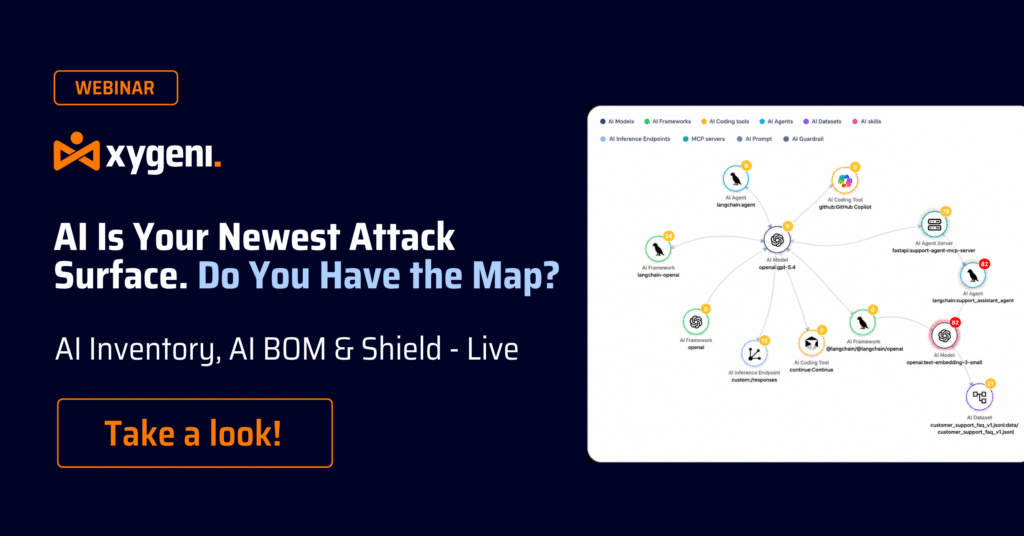
That’s the problem Xygeni AI Security is built around. AI Inventory continuously and automatically discovers every AI asset across your repositories, pipelines, and developer environments: models, frameworks, datasets, inference endpoints, agents, MCP servers, and AI coding tools like Copilot, Cursor, or Claude Code, mapped as a relationship graph with an AI-BOM generated on every scan. DevAI runs as an active guardrail in the same environments, validating skill files and agent instructions and blocking malicious installs before an agent acts, no prompt required. And because CoreAI applies the same AI-driven correlation and governance to findings from your existing scanners as it does to Xygeni’s own, shadow AI risk doesn’t disappear into yet another disconnected tool: it lands in the same risk view as everything else in your SDLC.
Start free. Sign up with GitHub, GitLab, or Google and get visibility into up to 25 repositories and 50 AI scans a month at no cost, no credit card required.

FAQ
What is shadow AI risk, in plain terms?
Shadow AI risk is the exposure created by AI tools, models, agents, or API calls running inside an organization without security review. Because most of it leaves no install and no procurement record, the risk compounds quietly until someone goes looking for it deliberately.
How do you detect and eliminate shadow AI in practice?
Detection runs on three signals working together (network and proxy logs, identity and access signals, and code/pipeline-level asset discovery), and elimination is a four-step loop: build one unified inventory, classify data before writing policy, give teams a faster approved path, and enforce at the point of install or API call rather than in a document.
Is shadow AI the same as shadow IT?
Related, not identical. Shadow IT usually left a trail (an install, a license, a network signature). Shadow AI often leaves none of that: a browser tab and a personal login are enough, and AI features now ship embedded inside platforms already approved.
Can a CASB or DLP tool catch shadow AI risk on its own?
Only partially. Those tools were built to catch unsanctioned software with a footprint. A model called directly from code, or an AI feature turned on inside an approved platform, generates none of the signals a CASB is tuned to flag. Managing shadow AI risk fully requires identity, network, and code/pipeline-level visibility together.
Where does shadow AI most commonly show up in software development specifically?
Beyond browser-based chatbots, it shows up as API keys hardcoded into source code, open-source models pulled into a project without a security scan, and agent skill files or MCP server connections added to a repository without review, exactly the layer that generic shadow-IT tooling doesn’t inspect.