
TL;DR
AI pentesting tools are not one category. They are four product shapes solving four different problems. Autonomous exposure validation proves attack paths across infrastructure. Agentic web and API offense attacks your applications. Continuous runtime testing runs on every build in the pipeline. AI application red teaming attacks the models and agents you ship. Comparing them as if they were interchangeable is the fastest way to waste a budget.
Agentic pentesting is the shift underneath all four. A copilot suggests a step and a human runs it. An agent runs the command, reads the output, decides what to do next, and loops. That difference is why agentic pentesting reaches findings a fixed script never will, and why the honest version of the 2026 model is a division of labour: agents own breadth and continuous coverage, humans own judgment and the signature a regulator requires.
Autonomy is not what separates vendors. Evidence is. Ask whether a finding carries the request, the response and the payload used. Ask what happens to a claimed exploit that turns out not to be real, because agentic systems hallucinate. Ask where the tool runs, since internal applications and regulated estates rule out anything cloud-only. Then ask whether findings correlate with what you already scan, or arrive in a fourth console nobody triages.
What a serious evaluation comes down to: evidence on every finding, triage over that evidence rather than a severity label, testing that runs inside your own infrastructure including air-gapped, authenticated coverage behind a login, a scanner that fails a build instead of filing a report, and correlation into one risk model with the findings you already manage. Xygeni covers those across code, pipeline and runtime, including findings ingested from the tools you are not replacing.
Why Annual Pentesting Stopped Working?
A traditional penetration test is a two-week photograph of a system that changes daily. It costs five figures, covers a fraction of the estate, and by the time the report arrives, the application has moved on.
Nothing about that was ever ideal. What changed is the gap widening at both ends. Code ships faster because AI writes more of it, and 2025 GenAI Code Security Report found 45% of AI-generated samples introduced OWASP Top 10 vulnerabilities out of the box across more than 100 models. Meanwhile 57% of organisations experienced an API-related breach in a two-year window. More surface, changing faster, tested less often.
That pressure is what created the market for AI pentesting tools, and it is why agentic pentesting became the label everyone reached for in 2026.
What Agentic Pentesting Means
The distinction that matters is copilot versus agent. A copilot suggests a next step, and a human runs it. An agent runs the command, reads the output, decides what to do next, and loops.
Agentic pentesting is the second thing. An agent sets a goal, chains multiple steps toward it, and validates whether the impact is real rather than reporting a possibility. That is what separates it from both a classic scanner, which fires known checks and ranks output by severity, and from a copilot, which still moves at human speed.
The consequence is coverage. A scanner tells you a parameter looks injectable. Agentic pentesting tells you what it reached.
The Four Shapes of AI Pentesting Tools
Most buyer confusion comes from treating this as one category. It is four.
| Shape | What it does | Buy it when |
|---|---|---|
| Autonomous exposure validation | Proves attack paths across infrastructure and identity, from foothold to business impact | You need to show a board how an attacker moves, not a list of CVEs |
| Agentic web and API offense | Goal-directed agents attacking applications and APIs, chaining exploits | Your risk concentrates in custom applications rather than infrastructure |
| Continuous runtime testing in the pipeline | Automated dynamic testing on every build, with evidence and gating | You ship weekly and cannot wait for a quarterly engagement |
| AI application red teaming | Adversarial testing of models, prompts and agents: jailbreaks, injection, tool abuse | You have shipped a GenAI feature and nobody has attacked it yet |
Two practical notes. Most organisations need more than one of these, and almost nobody needs all four in year one. And only the third shape produces findings continuously, which is why it is the one that fits DevSecOps rather than sitting beside it.
How to evaluate AI pentesting tools
Demos in this category are unusually impressive. These are the seven questions that survive the demo.
| Criterion | The question to ask | Why it separates vendors |
|---|---|---|
| Evidence | Does a finding include the request, the response and the payload used? | Without evidence, someone re-verifies manually before engineering will touch it. |
| False positives | What happens to a claimed exploit that is not real? | Agentic systems hallucinate. Triage over evidence is the only scalable answer. |
| Where it runs | Inside your infrastructure, or does your traffic leave it? | Internal applications and regulated estates rule out anything cloud-only. |
| Authenticated coverage | Can it test behind a login, with token refresh? | Most business logic lives behind authentication. Unauthenticated scans miss it. |
| Pipeline fit | Does it run in CI and fail a build, or only in a console? | A tool that needs someone to log in gets run quarterly, not continuously. |
| Correlation | Do runtime findings connect to your static and dependency findings? | A runtime finding matching a static one on the same endpoint is a far stronger signal. |
| Remediation handoff | Does the finding arrive with a fix, or with homework? | Findings only become real when engineering accepts them. |
The last three are where most of this category is weakest. Standalone agentic pentesting tools produce excellent findings into a separate console, and a separate console is a fourth queue nobody triages.
What Agentic Pentesting Still Cannot Do
Worth saying plainly, because the gap between benchmark and production is wide.
Published benchmarks show a steep lab-to-real drop: agents perform impressively against curated challenges with descriptions available, then solve a small fraction of real CVEs in open benchmarks. Autonomous systems also hallucinate exploits, and a confidently reported compromise that did not happen costs more trust than a missed finding.
Regulatory sign-off has not moved either. PCI DSS 4.0 still requires human-attested methodology and a qualified tester. Agentic pentesting extends coverage across the year. It does not remove the person who signs.
The workable 2026 model is division of labour. Agents own breadth and continuous coverage. Humans own judgment, validation and attestation.
Evidence, Not a Verdict
Xygeni DAST tests running applications and APIs from the outside, on every build rather than once a quarter. Every finding carries severity, CWE classification, the payload used, the affected endpoint, and the complete HTTP request and response, so a developer can act on it instead of re-verifying it. It covers traditional web applications, single-page applications, REST APIs from an OpenAPI description, GraphQL by schema or introspection, SOAP, and Postman collections, with authenticated testing through form login, bearer tokens, OAuth2 password grant with refresh, and client certificates.
It runs where your applications run. One container, command line only, no GUI and no proxy to deploy, inside your own cloud or on-premises, including air-gapped. That is what lets it reach internal applications that are never exposed to the internet, with nothing open to an outside service. For a European buyer under NIS2, DORA or ENS, that is usually the first question, not the last.
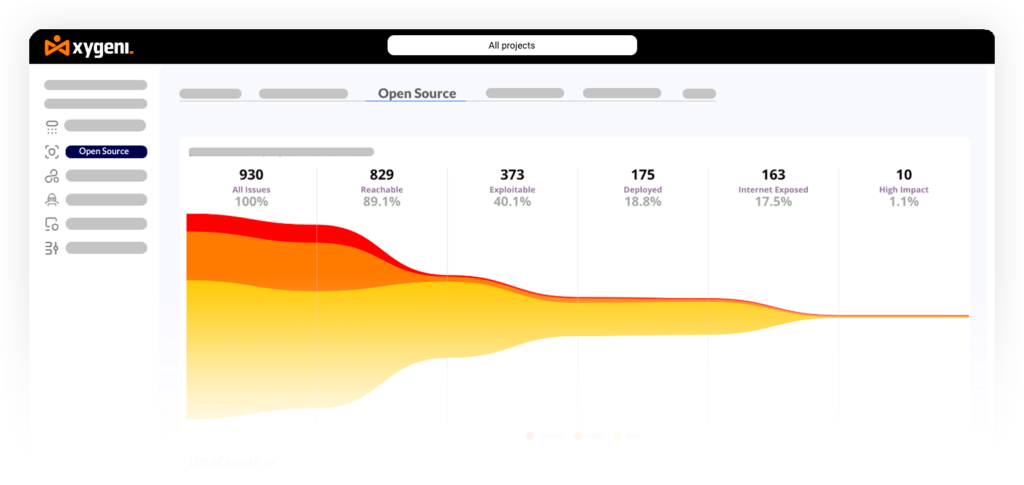
AI Triage runs over the evidence on demand for one finding or in bulk across a scan, so the output narrows to what threatens production rather than arriving as a flat severity list. Findings correlate across DAST, API Security, and SAST, and land in the same risk model as everything else you already manage, including findings ingested from tools you are not replacing.
That last point is the commercial argument in one line. Most AI pentesting tools give you a better queue. The value is in having one.
Test the Fifty Weeks You Are Not Testing
Annual pentesting told you what was true in a fortnight. The question worth answering now is what is true on the build you shipped this morning, and the one after that.
Xygeni tests running applications and APIs continuously, inside your own infrastructure, with the request and response attached to every finding and AI Triage over that evidence rather than a severity label. Findings land in the same risk model as your code, dependency, and pipeline findings, including the ones ingested from tools you are not replacing.
Schedule a demo to see it run against your own environment.

FAQ
What are AI pentesting tools?
Security testing tools that use AI to find and validate exploitable weaknesses, ranging from copilots that accelerate a human tester to autonomous agents that chain steps toward a goal without per-step direction.
Is agentic pentesting the same as automated pentesting?
No. Automation repeats a defined procedure faster. Agentic pentesting reasons about what to try next based on what the last step returned, which is why it reaches findings a fixed script cannot.
Can AI pentesting tools replace a human penetration test?
Not where a regulator requires attestation, and not for the creative work. They replace the assumption that testing happens twice a year.
How do AI pentesting tools fit into CI/CD?
The pipeline-native shape runs as a container in any CI system, with a severity threshold that fails the build. The other shapes generally run against deployed environments on their own schedule.
What should a mid-market team buy first?
Continuous runtime testing, in most cases. It covers the weeks an annual engagement does not, and it produces evidence your existing team can act on without new headcount.