
AI security (also called AI cybersecurity) refers to the practice of securing both the AI tools used in software development and the code and infrastructure they produce. As AI becomes embedded in every stage of the SDLC, from code generation to deployment, it introduces a new class of risk: models, agents, MCP servers, and AI coding assistants that are themselves exploitable, misconfigured, or weaponized.
Securing them requires visibility, risk scoring, and enforcement across the entire agentic development lifecycle, not just the code your team writes, but the AI that writes it, the tools it connects to, and the pipelines it runs through.
OWASP Global AppSec EU 2026 runs June 22–26 in Vienna, Austria, and for security teams navigating the shift to AI-native development, this is the most important gathering of the year. Xygeni will be at Booth G-08 all week, with live demos, product specialists, and the first public demonstration of Xygeni AI Inventory.
Why AI Security Is the Defining Challenge of 2026
AI is no longer just a productivity tool for development teams. It has become part of the attack surface. In under a year, the software supply chain absorbed a new class of threat. A self-propagating npm worm turned developers into delivery mechanisms. Nation-state actors hid malware inside a package downloaded 100 million times a week. An LLM was weaponized to plant malware inside an autonomous agent. These are not edge cases; they are the new baseline.
The numbers reflect the shift: credential theft surged 160% in 2025, with Recorded Future reporting 90% more credentials stolen in Q4 2025 than Q1 2025 alone, and AI is both accelerating the attacks and expanding the attack surface. A single MCP bridge vulnerability (CVE-2025-6514) was downloaded 437,000 times before it was caught. Today, 5.5% of public MCP servers carry tool-poisoning flaws, and 43% carry command-injection vulnerabilities.
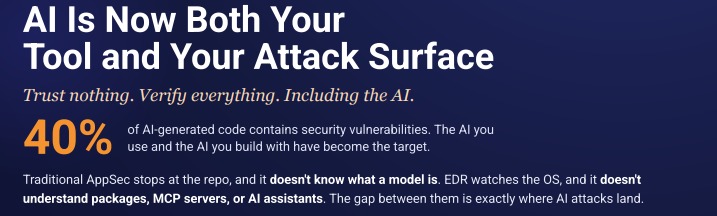
The core problem is an architectural gap. Traditional AppSec stops at the repository and does not know what a model is. EDR watches the operating system and does not understand packages, MCP servers, or AI assistants.
Closing that gap requires a different kind of platform.
What Xygeni AI Security Does
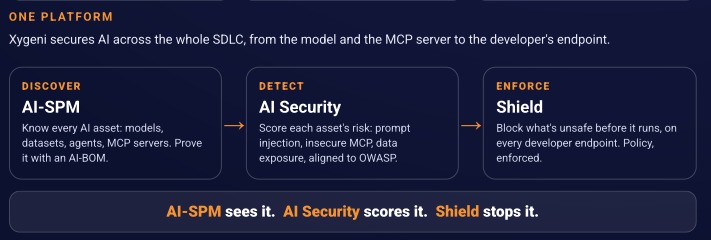
Xygeni AI Security is built around a single principle: trust nothing, verify everything, including the AI. It secures both the AI you use and the AI you develop with, across the entire agentic SDLC. The architecture has three layers: Discover, Detect, and Enforce.
Discover – AI-SPM: Know Every AI Asset
You cannot secure what you cannot see. Xygeni AI-SPM gives teams a live inventory of every model, dataset, agent, MCP server, and AI coding tool in their organization. It maps the relationships between them, surfaces the risk that connects them, and exports an audit-ready AI-BOM, the AI Bill of Materials that is rapidly becoming the successor to the SBOM.
For CISOs, this is one defensible source of truth for every AI audit, mapped to the EU AI Act, NIST AI RMF, and ISO/IEC 42001.
Detect – AI Risk Scoring: From Thousands of Findings to the Few That Matter
Xygeni AI Security combines deterministic analysis with LLM-based semantic understanding to catch what traditional SAST and SCA miss. It detects prompt injection and system-prompt leakage, insecure MCP configurations, sensitive information disclosure in AI files, vector and embedding weaknesses, malicious instructions in documents and rule files, slopsquatting AI dependencies, hardcoded LLM credentials, and agents operating beyond configured limits.
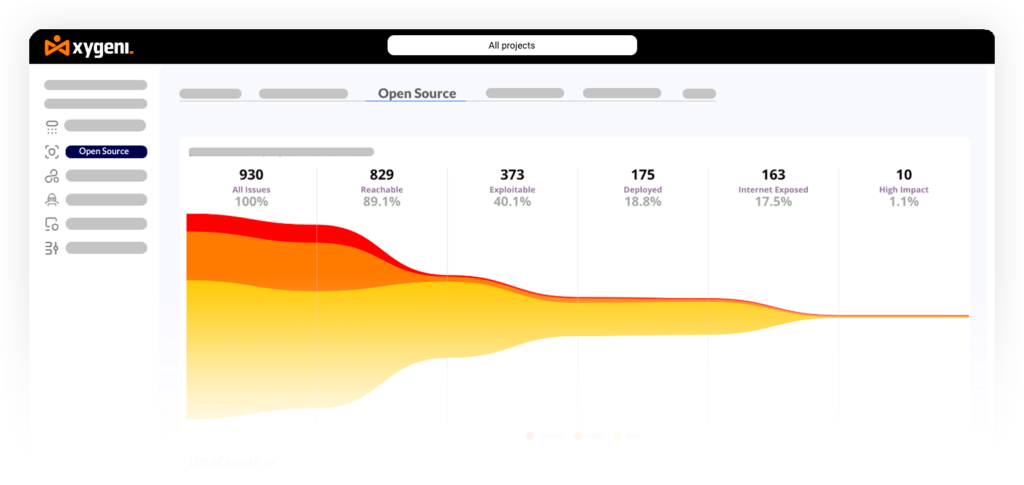
Critically, it prioritizes by real AI attack paths, not raw OWASP severity scores. Most AI security tools hand teams thousands of findings and call it visibility. Xygeni filters from all findings down through reachability, exploitability, and business impact, so instead of a backlog, teams get a short, accurate list of what actually needs fixing today.
Its AI also applies to findings from your existing SAST, SCA, and scanner tools, so teams extend rather than replace their current stack.
Enforce – Shield: Zero Trust at the Developer Endpoint
The developer’s machine is where a malicious package first executes, the moment npm install runs, long before anything reaches the build pipeline. Xygeni Shield brings the Dependency Firewall to the endpoint.
It evaluates every package as it is fetched and blocks unsafe or malicious installs before the post-install script runs. Powered by MEW (Malware Early Warning), Shield catches malicious packages using AI verdicts that work before a signature exists. It also enforces MCP allowlists, blocks untrusted AI skills and rule files, prevents unauthorized AI models and agents from running, and can isolate a compromised endpoint automatically when a critical alert lands, containing the incident before it spreads across the organization.
What to Expect at Booth G-08 This Week
- Vienna debut: Xygeni AI Inventory live demo. See your AI attack surface mapped in real time, every model, agent, MCP server, and AI coding tool your organization is using, with risk scores and relationship graphs.
- Live Dependency Firewall demo. Watch Shield evaluate and block a malicious package at the endpoint, before it installs, before a signature exists.
- Full platform walkthrough. See how Xygeni detects, prioritizes, and remediates vulnerabilities, malware, secrets, and supply chain risk across AI-native SDLCs, from the IDE to production.
- Talk to the team. Xygeni’s AppSec and DevSecOps specialists will be at the booth all week for conversations about AI-generated code security, CI/CD protection, MCP governance, software supply chain risk, and modern AppSec architecture. Alejandro, Agustin, Marcos, and Jesus will be there to meet you!
AI Cybersecurity in the Agentic Era: The Questions Worth Asking in Vienna
OWASP Global AppSec EU 2026 arrives at an inflection point for AI cybersecurity. The OWASP Top 10 for LLM Applications, the OWASP Top 10 for Agentic Apps (2026), and the OWASP MCP Top 10 are all live frameworks now, and most organizations have not yet mapped their exposure against any of them.
The questions security leaders should be asking this week:
- Where is the AI in your SDLC? Most organizations cannot answer this with confidence. Shadow MCP servers, unapproved models, and untracked AI agents are the new shadow IT, and they are already running in your pipelines.
- What happens when AI-generated code ships a vulnerability? 40% of AI-generated code contains security vulnerabilities. Without SAST that understands AI-generated patterns and IDE-level guardrails, those vulnerabilities reach production faster than ever.
- Is your AppSec stack MCP-aware? MCP servers have become a primary vector for tool-poisoning and command-injection attacks. If your security tooling does not have an MCP inventory and enforcement layer, you have a blind spot attackers are already exploiting.
- Can you produce an AI-BOM for an auditor today? Regulators and enterprise buyers are beginning to ask for it. The organizations that can answer yes will have a significant compliance and trust advantage.
Visit Xygeni at OWASP Global AppSec EU 2026
Booth G-08 · June 22–26 · Vienna, Austria
Stop by for a live demo, a conversation with the team, exclusive swag, or just a break from the sessions. If you want to guarantee time with a specialist, book an in-booth demo slot in advance at Xygeni.
Xygeni is the platform that discovers, prioritizes, and enforces AI security across the software supply chain, from AI inventory and risk scoring to policy enforcement at the developer endpoint. One platform. One risk model. One control plane.
AI-SPM sees it. AI Security scores it. Shield stops it.
FAQ’s
What is AI security in software development?
AI security in software development means securing both the AI tools your teams use (models, agents, MCP servers, AI coding assistants) and the code those tools produce. It covers AI asset discovery, risk scoring against OWASP frameworks, and policy enforcement at the developer endpoint.
What is an AI-BOM?
An AI Bill of Materials (AI-BOM) is a machine-readable inventory of every AI asset in an organization’s SDLC (models, datasets, agents, MCP servers, and AI coding tools) with their relationships, risk scores, and regulatory mapping. It is rapidly becoming the AI-era equivalent of the SBOM.
What is MCP security?
MCP (Model Context Protocol) security refers to the practice of securing the connections between AI assistants and external tools, APIs, and data sources. MCP servers have emerged as a primary attack vector in 2025–2026, with tool-poisoning and command-injection flaws documented across a significant share of public MCP servers.
What is Xygeni AI Security?
Xygeni AI Security is a platform that discovers, scores, and enforces AI security across the software supply chain. It combines AI-SPM (AI Security Posture Management) for inventory and AI-BOM generation, AI risk scoring aligned to OWASP LLM and MCP Top 10 frameworks, and Shield for zero-trust policy enforcement at the developer endpoint.
What is slopsquatting?
Slopsquatting is an attack where malicious actors register package names that AI coding assistants are likely to hallucinate or suggest, targeting developers who install AI-recommended dependencies without verification.