TL;DR
"Cybersecurity risk assessment" covers three different products, and this list contains all three. Infrastructure tools assess and patch the systems you run. Endpoint tools detect and respond on the machines themselves. Software and supply chain tools assess the code, dependencies, pipelines and now the AI assets your teams build with. They rank different risks, report to different owners, and are not substitutes. Decide which surface carries your risk before you compare features.
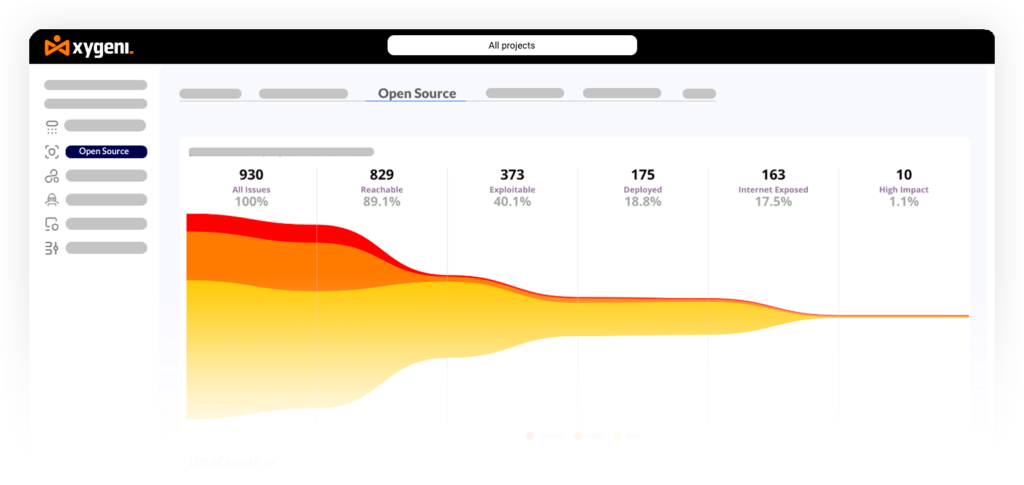
Severity scores stopped being a useful queue. Any scanner can mark thousands of findings critical. What changes outcomes is prioritisation by exploitability, reachability and business impact, so a team works the handful of findings that can actually compromise systems, data or operations rather than the ones that score highest in isolation.
The newest gap is the one nobody inventoried. Models, agents, MCP servers and AI coding assistants are now part of the SDLC and sit outside the coverage of traditional AppSec and endpoint tooling. One MCP bridge with a remote code execution flaw was pulled more than 437,000 times before it was widely flagged, and no CVE-based scanner had a signal to match against.
The short version of the list: Xygeni for software supply chain and AI risk, with AI asset discovery, attack-path prioritisation and enforcement at the developer endpoint. Qualys VMDR and Tenable for infrastructure and cloud vulnerability management at scale. Aikido for developer-first scanning inside CI/CD. SentinelOne for autonomous endpoint protection and ransomware recovery. Most mature programmes run more than one, which is why the extend rather than replace question matters more than any single feature comparison.
Cybersecurity risk assessment tools identify, analyse and prioritise security risk across an organisation’s assets, then track whether that risk is going down. They divide into three families: infrastructure and cloud assessment, endpoint detection and response, and software and supply chain assessment including AI assets. The five compared here span all three, so the first decision is which surface carries most of your risk, not which tool has the longest feature list.
Why is Security Risk Assessment So Important?
Cybersecurity risk assessment tools are no longer optional infrastructure; they are a core requirement for any organization that builds, ships, or operates software. Their function is fundamental: identify, analyze, and prioritize risks before they become incidents.
The threat landscape has shifted dramatically. Software supply chains are more complex than ever, and attackers have learned to exploit that complexity, hiding malware in widely-used open-source packages, weaponizing AI coding assistants, and targeting MCP servers that most security tools don’t even know exist. Between Q4 2025 and Q1 2026 alone, AI-targeted credential theft increased 376%. One compromised MCP bridge was downloaded 437,000 times before it was flagged.
In this environment, security teams need tools that go beyond traditional CVE scanning. The best cybersecurity risk assessment tools today help organizations identify vulnerabilities across the full software development lifecycle (including AI assets) prioritize remediation based on real exploitability rather than raw severity scores, and maintain continuous compliance with frameworks like NIS2, DORA, and the EU AI Act.
In this article, we review the top five cybersecurity risk assessment tools for 2026, covering their core capabilities, ideal use cases, and what makes each one stand out, so you have the information you need to make the right decision for your organization.
4 Benefits of Cyber Risk Assessment Tools
Organizations today face an evolving threat landscape that includes malware injection, software supply chain attacks, AI-targeted exploits, and zero-day vulnerabilities. The right cyber risk assessment tools address these challenges in four concrete ways:
- Full-stack visibility: Modern tools provide visibility not just into software dependencies and infrastructure vulnerabilities, but increasingly into AI assets: models, agents, MCP servers, and AI coding assistants that traditional AppSec tools don’t inventory.
- Smarter prioritization: The best tools go beyond raw CVE severity. They prioritize threats based on exploitability, reachability, and real-world attack paths, so security teams fix the handful of findings that actually matter, not thousands of low-signal alerts.
- Automated compliance and vulnerability management: From continuous scanning to audit-ready reporting, automated risk assessment tools reduce the manual overhead of meeting regulatory requirements like ISO 27001, SOC 2, NIS2, DORA, and the EU AI Act.
- Reduced false positives: By contextualizing alerts with real attack scenarios and filtering by active exploitation, modern tools dramatically cut the noise, letting teams focus on threats that can actually compromise systems, data, or operations.
Want to go deeper? Watch our SafeDev Talk on Risk Management for actionable insights from cybersecurity experts.
Essential Features Your Security Risk Assessment Tool Must Have
Not all automated risk assessment tools are built for today’s threat environment. When evaluating your options, look for these capabilities:
- Automated risk assessment: Continuous, automated scanning across code, dependencies, infrastructure, and AI assets, without requiring manual intervention.
- DevSecOps integration: Native integration with CI/CD pipelines, IDEs, and developer workflows so security is enforced where the code is written, not only at the perimeter.
- AI asset coverage: As AI becomes part of every SDLC, your tool should inventory and assess models, agents, MCP servers, and AI coding assistants, not just packages and repos.
- Real-time threat intelligence: Detection that keeps pace with emerging attack techniques, including pre-signature malware verdicts and novel supply chain attack patterns.
- Risk prioritization by attack path: The ability to filter findings down to what is actually exploitable and business-critical, not just what scores high on a CVSS scale.
- Compliance and audit reporting: Built-in mapping to security regulations and frameworks (NIS2, DORA, EU AI Act, ISO 27001, SOC 2) with exportable, audit-ready outputs.
- Scalability and ease of use: A platform that scales with your software ecosystem and provides an intuitive dashboard that security teams can act on without deep expertise.
Now let’s look at the five tools that best meet these criteria in 2026.
| Tool | Risk Assessment Coverage | AI Security | Prioritization Approach | Compliance | Best For |
|---|---|---|---|---|---|
| Xygeni | Code, dependencies, pipelines, AI assets, MCP servers, agents, developer endpoints | AI-SPM, AI risk scoring, Shield endpoint enforcement — full AI-era SDLC coverage | Attack path funnel: exploitability, reachability, business impact | NIS2, DORA, EU AI Act, NIST AI RMF, ISO/IEC 42001 | Organizations using or building AI that need end-to-end supply chain and AI security in one platform |
| Qualys VMDR | Devices, applications, cloud instances, hybrid infrastructure | No | AI-driven scoring based on exploitability and attack patterns | PCI DSS, HIPAA, CIS | Large enterprises managing heterogeneous infrastructure with high patch velocity needs |
| Aikido | Source code, dependencies, containers, IaC, cloud posture | No | Context-aware, runtime impact focus | ISO 27001, GDPR, SOC 2 | Developer-centric teams wanting shift-left security embedded in CI/CD |
| Tenable | Network, cloud infrastructure, containers, web applications | No | Predictive prioritization via AI-driven threat intelligence | PCI DSS, HIPAA, CIS, NIST | Security teams needing scalable, cloud-native vulnerability management with broad integrations |
| SentinelOne | Endpoints, servers, cloud workloads, IoT devices | Behavioral AI for threat detection and autonomous response | Real-time behavioral analysis, no signature dependency | SOC 2, HIPAA, GDPR | Enterprises needing autonomous endpoint protection and ransomware recovery |
Top 5 Cybersecurity Risk Assessment Tools for 2025
Best for: Organizations that use or build AI-powered software and need end-to-end supply chain security with zero-trust enforcement at the developer endpoint.
Xygeni has evolved significantly beyond its origins as a supply chain scanner. Its 2026 platform introduces a Zero Trust for the AI-Era SDLC approach, structured around three capabilities: Discover, Detect, and Enforce. This makes it one of the most comprehensive cybersecurity risk assessment tools for teams developing or deploying AI.
- AI-SPM (Discover): Xygeni automatically inventories every AI asset in your SDLC (models, datasets, agents, MCP servers, and AI coding assistants) and generates an audit-ready AI Bill of Materials (AI-BOM). The inventory maps relationships between assets and links them to regulatory obligations under the EU AI Act, NIST AI RMF, and ISO/IEC 42001.
- AI Security (Detect): Detection combines deterministic analysis with LLM-based semantic understanding, covering the OWASP Top 10 for LLM Applications, the OWASP Top 10 for Agentic Apps (2026), and the OWASP MCP Top 10. Rather than dumping thousands of alerts, Xygeni applies a prioritization funnel based on real attack paths: of 12,842 findings in a typical environment, only 14 (0.1%) are classified as business-critical. Detected risk categories include prompt injection, insecure MCP configurations, hardcoded LLM credentials, slopsquatted AI dependencies, and excessive agent agency.
- Shield (Enforce): A lightweight endpoint agent that enforces security policy on every developer machine before anything runs. Shield blocks malicious dependencies using MEW (Malware Early Warning) verdicts — before traditional signature-based tools can detect them — and enforces an approved-model and approved-MCP allowlist. If a critical alert fires, Shield can isolate the affected endpoint automatically, containing the incident before it spreads.
- Why the data matters: Between Q4 2025 and Q1 2026, AI-targeted credential theft increased 376%. One MCP bridge (CVE-2025-6514) was downloaded 437,000 times before the RCE vulnerability it enabled was widely flagged. Xygeni’s architecture was designed specifically to close this gap.
- Compliance: NIS2, DORA, EU AI Act, NIST AI RMF, ISO/IEC 42001. EU-hosted, with on-premises and air-gapped deployment options for regulated environments.
- Recognition: Named Hot Company in Application Security Posture Management 2026 and Hot Company in GenAI Application Security 2026 by the Global InfoSec Awards (Cyber Defense Magazine).
Best fit: Security teams in regulated industries, organizations with active AI development pipelines, and any company concerned about software supply chain attacks and MCP server risk.

2. Qualys VMDR
Best for: Large enterprises needing continuous vulnerability management across hybrid on-premises and cloud infrastructure.
Qualys VMDR (Vulnerability Management, Detection, and Response) remains one of the most widely deployed cyber risk assessment tools for infrastructure-level coverage. Its strengths lie in automated asset discovery, AI-driven vulnerability prioritization, and tight integration with patch management workflows.
Key capabilities: Real-time discovery and mapping of all connected devices, applications, and cloud instances; AI-driven risk scoring based on exploitability and real-world attack patterns; automated patch orchestration to reduce exposure windows; continuous scanning across on-premises, cloud, and hybrid environments.
Best fit: IT and security operations teams managing large, heterogeneous infrastructure footprints where patch velocity and asset visibility are the primary concerns.
3. Aikido
Best for: Development teams wanting supply chain security and compliance scanning embedded directly into CI/CD pipelines.
Aikido is a developer-centric security risk assessment tool designed for shift-left security. It integrates with CI/CD workflows and provides context-aware vulnerability prioritization focused on high-impact threats rather than raw CVE counts.
Key capabilities: Automated code and dependency scanning; context-aware prioritization that surfaces risks posing actual runtime impact; compliance reporting aligned to ISO 27001, GDPR, and SOC 2; actionable, developer-friendly remediation guidance.
Best fit: Product engineering teams that want security embedded in the development workflow without requiring dedicated security expertise.
4. Tenable
Best for: Organizations requiring continuous, cloud-native risk assessment across diverse IT environments with strong SIEM and DevSecOps integrations.
Tenable.io provides continuous visibility and proactive risk mitigation across IT infrastructure and applications. Its cloud-native architecture scales from startups to large enterprises, and predictive prioritization uses AI-driven analysis to focus remediation on the most exploitable vulnerabilities.
Key capabilities: Real-time threat monitoring with actionable insights to reduce attack surface; predictive prioritization based on exploitability, impact, and live threat intelligence; extensive integrations with SIEM platforms, cloud security tools, and IT asset management solutions.
Best fit: Security teams that need a scalable, integration-rich platform for infrastructure vulnerability management and want a unified view across cloud and on-premises assets.
5. SentinelOne
Best for: Enterprises prioritizing endpoint protection with autonomous threat response and ransomware recovery capabilities.
SentinelOne brings AI-driven threat detection, automated remediation, and self-healing capabilities to endpoint and workload security. It is particularly strong in environments where response speed and minimal human intervention are critical.
Key capabilities: Machine learning and behavioral AI for threat detection without reliance on signature-based methods; real-time automated response — containment, file removal, system restoration — without human intervention; protection across workstations, servers, cloud workloads, and IoT; ransomware rollback technology that restores encrypted files to their pre-attack state.
Best fit: Enterprise security operations teams that need autonomous endpoint protection and fast recovery from ransomware or fileless attacks.
How to Choose the Right Cybersecurity Risk Assessment Tool
The right tool depends on your primary risk surface:
- AI and software supply chain risk → Xygeni (the only platform with AI-SPM, AI risk scoring, and endpoint enforcement in one control plane)
- Infrastructure and patch management → Qualys VMDR
- Developer-first, CI/CD-embedded security → Aikido
- Cloud-native, scalable vulnerability management → Tenable
- Endpoint protection and autonomous response → SentinelOne
Most mature security programs use more than one. Xygeni’s “Extend, Don’t Replace” model is worth noting: its AI applies to findings from existing SAST, SCA, and third-party scanners, reducing the need to rip and replace incumbent tools.
How to Perform a Cybersecurity Risk Assessment
Whatever tool you choose, the underlying process follows these six steps:
- Identify assets and data: Define the critical applications, systems, AI assets, and sensitive data that need protection.
- Analyze threats and vulnerabilities: Evaluate potential threats: malware, insider risks, software vulnerabilities, insecure AI models, and supply chain exposure.
- Assess impact and likelihood: Determine the risk level based on the potential impact of an attack and the realistic probability of it occurring.
- Prioritize risk: Rank threats by severity and exploitability to focus remediation on what matters most.
- Mitigate and implement controls: Apply security measures: patching, encryption, access controls, endpoint policy enforcement, and AI governance.
- Monitor and improve: Continuously assess and refine your security posture to adapt to emerging threats and regulatory changes.
Want a deeper guide? Read our Cybersecurity Risk Assessment: A Developer’s Guide for a step-by-step walkthrough.
AI Changed the Game. Your Risk Assessment Tool Should Too.
Cybersecurity risk assessment tools are a necessity, not a nice-to-have. As threats grow more sophisticated (and as AI introduces an entirely new attack surface inside the SDLC itself), organizations need tools that can see everything, score what actually matters, and enforce policy before damage is done.
Among the solutions reviewed here, Xygeni stands out as the only platform purpose-built for the AI era: combining AI asset discovery (AI-SPM), risk scoring aligned to OWASP, and zero-trust endpoint enforcement (Shield) in a single control plane. For teams that use AI to build software, or build AI into their products, it closes a gap that no traditional AppSec or EDR tool was designed to address.
To make sure your software supply chain is fully protected, try Xygeni today and experience the next generation of cybersecurity risk assessment tools.
FAQ’s
What is the difference between a vulnerability scanner and a risk assessment tool?
A vulnerability scanner identifies known weaknesses (typically via CVE databases). A risk assessment tool goes further: it contextualizes findings by exploitability, reachability, and business impact, and increasingly covers AI assets and supply chain risks that scanners don’t reach.
Do cybersecurity risk assessment tools cover AI security?
Most traditional tools do not. Xygeni is currently the only platform that includes dedicated AI Security Posture Management (AI-SPM), covering models, agents, MCP servers, and AI coding assistants as part of its risk assessment scope.
How often should a cybersecurity risk assessment be performed?
Continuously. Modern risk assessment tools run in real time, not on a quarterly or annual schedule. Point-in-time assessments are no longer sufficient given the pace of software supply chain attacks and AI-targeted threats.
What is a cybersecurity risk assessment tool?
A cybersecurity risk assessment tool is a platform that automatically identifies, analyzes, and prioritizes security vulnerabilities across an organization’s software, infrastructure, and AI assets, helping security teams remediate the most critical risks before they are exploited.
How much do cybersecurity risk assessment tools cost?
Infrastructure and endpoint tools are usually priced per asset or per endpoint and quoted annually. Software and supply chain platforms are priced per repository, per developer or per platform, with published entry tiers and negotiated enterprise contracts. Almost nobody in this category publishes enterprise pricing, so compare on what is included before comparing rates.
Can one tool assess all our cyber risk?
No, and any vendor claiming otherwise is describing a roadmap. The realistic goal is one platform per surface with findings correlated into a single view, which is why the ability to ingest results from tools you already run matters more than raw detection breadth.