TL;DR
DAST tests running applications and APIs from the outside, the way an attacker does, catching the flaws that only exist once software is deployed. Seven tools, and the differences that actually decide a purchase are not the ones vendors lead with.
- Platform correlation is no longer the differentiator. Invicti added ASPM by acquiring Kondukto in August 2025, and Checkmarx One has had cross-tool correlation for years. Any comparison claiming one vendor owns it is out of date.
- Deployment decides what you can even scan. Cloud-delivered scanners cannot reach an application that never touches the internet. If internal APIs or air-gapped environments are in scope, a self-hosted analyzer is a qualification criterion, not a preference.
- How you buy it matters as much as what it finds. Checkmarx does not sell DAST standalone. Invicti and Escape are quote-only. Rapid7 charges per application. Pricing model, not headline rate, is what scales badly across a portfolio.
- Finding count is not the output. Exploitation of vulnerabilities was involved in 20% of breaches in the 2025 Verizon DBIR, up 34% year on year. What closes that gap is prioritisation by exposure, authentication and business criticality, not a longer list.
- API coverage is table stakes now. 57% of organisations report an API-related breach in the last two years. REST, GraphQL and SOAP support, plus discovery of shadow endpoints, separates a modern scanner from a web-form crawler.
Why DAST Tools Are Essential in 2026
Dynamic Application Security Testing (DAST) has become a non-negotiable part of any serious application security program. Unlike static analysis, DAST evaluates applications from the outside, simulating real attack techniques against live web services and APIs to detect runtime vulnerabilities such as SQL injection, cross-site scripting (XSS), authentication flaws, and misconfigurations that only appear once an application is deployed.
The numbers make the urgency clear. According to the 2025 Verizon Data Breach Investigations Report, exploitation of vulnerabilities was involved in 20% of breaches, a 34% jump year-over-year, now the second most common path attackers use to get in. Meanwhile, 57% of organizations experienced an API-related breach in the last two years, and API traffic now accounts for the majority of all web interactions. Traditional scanning approaches that focus only on web forms are simply insufficient.
The threat volume keeps accelerating. Over 23,000 CVEs were disclosed in the first half of 2025 alone, a 16% increase over the same period in 2024, with many remotely exploitable at minimal authentication. Xygeni’s own security research team tracks this in real time: the Malicious Code Digest publishes newly discovered malicious packages weekly across npm, PyPI, Maven, and beyond. In 2026, security and AppSec teams can’t afford to run a scan before release, triage hundreds of findings, and move on. That’s not a security program, that’s theater.
What’s needed are DAST tools built for continuous scanning, CI/CD integration, real API coverage, and a signal developers can actually act on. So when evaluating dynamic application security testing tools, the key question is: does this tool test running applications in context, or does it just surface findings you can’t prioritize?
Quick Comparison: Top DAST Tools for 2026
Scroll the table sideways to see all columns.
| Tool | Testing Approach | Deployment | API Coverage | CI/CD | Prioritization / ASPM | Pricing | Best For |
|---|---|---|---|---|---|---|---|
| Xygeni DAST | Standalone scanner (xy-dast), integrates natively into Xygeni ASPM | Self-hosted analyzer or SaaS. Scans internal apps with no inbound access | Web, SPA, REST, OpenAPI/Swagger, GraphQL, SOAP | Native CLI, Docker, build-failing quality gates | Prioritization Funnel always included. ASPM correlation optional | Per endpoint, not per scan. Unlimited parallel scanning | Mid-market teams wanting standalone DAST that runs in their own infrastructure and connects to ASPM when needed |
| Invicti | Proof-based DAST plus IAST, with ASPM via Kondukto (acquired August 2025) | Cloud and on-premise | REST, SOAP, GraphQL (stateful) | Broad | ASPM through an acquired orchestration layer over existing scanners | Quote-based. Around $15K to $60K per year for 1 to 10 targets, $60K to $250K mid-tier | Large enterprises with complex portfolios, budget and headcount |
| Escape | AI-powered, API-native, business-logic testing (BLST) | Cloud | REST, GraphQL (schema-aware), SOAP, with agentless API discovery | Broad, incremental scanning | Findings prioritization. Not a full ASPM platform | Per application, enterprise. No public price | API-first and GraphQL-heavy teams needing business-logic depth |
| Checkmarx One DAST | DAST add-on inside the Checkmarx One platform | Cloud, with tunneling to reach internal apps | REST, SOAP, gRPC | Strong | Platform ASPM with Fusion cross-tool correlation | Quote-based. Not sold standalone, requires Professional tier or higher | Enterprises consolidating their whole AppSec stack on one vendor |
| Rapid7 InsightAppSec | Cloud DAST with Universal Translator and Attack Replay | Cloud only | Web plus API (Swagger) | Jenkins, Azure, Jira | Within the Rapid7 Insight ecosystem | Around $175 per app per month, quote-based at scale | Existing Rapid7 customers with modern JavaScript apps |
| StackHawk | ZAP-based, CI/CD-native, configuration as code | Cloud, scanner runs in your pipeline | REST, GraphQL, SOAP, gRPC | 12+ platforms | Findings only. No correlation with SAST, SCA, secrets or IaC | Roughly $49 to $59 per contributor per month, billed annually | DevOps-mature, API-heavy engineering teams |
| ZAP (formerly OWASP ZAP) | Open-source proxy scanner, sponsored by Checkmarx since 2024 | Self-hosted, Docker | REST, GraphQL via schema imports and add-ons | Docker and CI, manual setup | None. Findings are a raw list | Free, Apache 2.0 | Small teams, learning, and baseline scanning with in-house expertise |
Comparison based on publicly documented vendor capabilities as of September 2026. Check current vendor documentation before making a purchase decision.
What to Look for in a DAST Tool in 2026
Before diving into the tools, here’s what separates a genuinely useful dynamic application security testing tool from one that just adds noise to your pipeline.
Runtime Vulnerability Detection
A DAST tool must test running applications, not just code, to catch vulnerabilities like SQL injection, XSS, broken authentication, and server-side misconfigurations that only manifest at runtime.
CI/CD Pipeline Integration
DAST should run continuously, not just at release. Look for CLI-driven execution, Docker support, quality gates that block vulnerable builds, and native integrations with your existing pipeline tools.
Authenticated Application Scanning
Most real applications require login. Your DAST tool should support form-based authentication, bearer tokens, API keys, MFA, SSO, OAuth, and scripted authentication workflows to scan what actually matters.
Real API Coverage
With APIs now the majority of web traffic, a modern DAST tool must handle REST (OpenAPI/Swagger), GraphQL, and SOAP, not just HTML forms. API discovery that surfaces shadow and undocumented endpoints is a growing differentiator.
Risk Prioritization, Not Just Volume
Raw finding counts create noise, not insight. The best DAST tools apply contextual filters: internet exposure, authentication requirements, and business criticality to surface only vulnerabilities that represent real, exploitable risk in production.
ASPM Correlation
DAST findings become far more actionable when correlated with code-level analysis, open-source dependencies, secrets, and business context. Platforms that connect runtime findings to the rest of your application security program dramatically reduce the time between detection and remediation.
Accurate, Actionable Reporting
Every finding should include severity, CWE classification, the attack payload used, HTTP request/response evidence, and remediation guidance, not just a list of endpoints to investigate manually.
The 7 Best DAST Tools for 2026
1. Xygeni: Runtime Security That Starts Where Attacks Begin

Overview: Xygeni DAST is an enterprise-grade dynamic scanner that runs on its own: point it at a web application or API and get results without adopting anything else. It also integrates natively into the Xygeni Application Security Posture Management (ASPM) platform, so when you want it, DAST findings are automatically correlated with code analysis, open-source vulnerabilities, asset exposure, secrets detection, CI/CD security, and business context in a single unified view.
That flexibility matters because runtime vulnerabilities don’t exist in isolation. A SQL injection finding in a production API is far more critical when it’s linked to a publicly exposed asset with no authentication requirement and a known dependency vulnerability. Run standalone, Xygeni DAST delivers fast, accurate dynamic testing; run inside the platform, it surfaces that full risk picture automatically, so teams fix the vulnerabilities that truly impact production instead of chasing false positives across disconnected tools.
It’s powered by xy-dast, a scanner built for automated runtime testing, CI/CD integration, and detailed vulnerability reporting, with no complex configuration or dedicated security headcount required.
Because the analyzer runs inside your own infrastructure, Xygeni DAST can test internal applications and APIs that are never exposed to the internet: no inbound access, no opening your environment to a third-party cloud. And because pricing is per endpoint rather than per scan, teams run as many scans in parallel as their infrastructure allows. Tuned scan profiles keep those scans fast: in customer evaluations, Xygeni DAST has matched or exceeded the detection of competing scanners while completing scans in roughly a third of the time.
How Xygeni DAST Works
Discover and Scan
The xy-dast scanner analyzes running web applications and APIs, automatically crawling endpoints and launching dynamic security tests against exposed functionality.
Detect Runtime Vulnerabilities
Identifies exploitable issues including SQL injection, XSS, authentication weaknesses, server-side flaws, and security misconfigurations.
Correlate Risk in ASPM (when used within the platform)
Used inside the Xygeni platform, DAST findings are automatically correlated with code analysis, open-source vulnerability data, asset exposure, and business context, giving a unified risk picture across the full program.
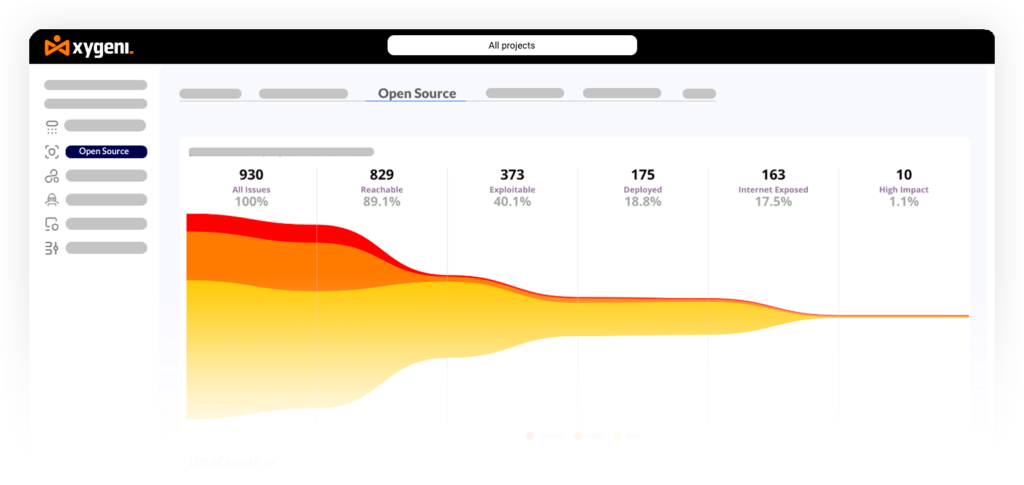
Prioritize What Matters with the Xygeni Prioritization Funnel
Findings are progressively filtered by contextual factors such as internet exposure, authentication, and business criticality, removing noise so teams focus only on genuine production risk.
Fix Faster
Findings integrate into CI/CD workflows with quality gates that fail builds when they exceed defined thresholds, enabling remediation earlier in the lifecycle.
Key Features
- CLI-driven automation: trigger dynamic scans from scripts, pipelines, or test environments with a single command.
- Flexible scan profiles: built-in profiles for traditional web apps, single-page apps (React, Angular, Vue), REST APIs (OpenAPI/Swagger), GraphQL, and SOAP/WSDL, plus quick smoke scans and deep maximum-coverage scans.
- Authenticated application testing: form auth, bearer tokens, API keys, basic auth, custom headers, JSON bodies, or script-based workflows.
- CI/CD pipeline integration: Docker images, CLI execution, and build-failing quality gates.
- ASPM correlation: runtime findings linked to code-level analysis, asset inventory, secrets, and open-source risk in one platform.
- Runs inside your own infrastructure: self-hosted analyzer that scans internal apps and APIs with no internet exposure and no inbound access to your environment, ideal for regulated, air-gapped, and data-sovereign deployments.
- Unlimited parallel scanning: priced per endpoint, not per scan, so teams scale scans across their pipeline as fast as their infrastructure allows.
- High-performance scan profiles: profiles tuned per application type (web, SPA, REST, GraphQL, SOAP) and depth (quick smoke to deep max-coverage) deliver full detection in a fraction of the scan time.
- Detailed reporting: severity, CWE classification, attack payload, affected endpoint, HTTP request/response evidence, and remediation guidance; mappable to NIST 800-53, SANS25, and other taxonomies.
- Exportable results: JSON or PDF for automation, audit, and SIEM integration.
- SaaS or on-premise deployment: full flexibility, including air-gapped environments, with European data sovereignty.
Pricing: Xygeni DAST is priced per endpoint and built for mid-market teams, not gated behind the enterprise-only minimums and large annual contracts of legacy scanners. It runs standalone, and connects to the wider Xygeni platform (SAST, SCA, secrets, IaC, containers, CI/CD, and ASPM) whenever a team wants unified posture management. For specific pricing, book a demo or request a PoC.
Limitations
- As a newer, ASPM-integrated entrant, Xygeni doesn’t yet carry the decades-long brand recognition or analyst-report footprint of legacy DAST incumbents, a consideration for buyers who select primarily on analyst positioning.
- For teams whose sole mandate is deep, specialist API business-logic exploitation (complex BOLA/IDOR chains), a dedicated API-security engine will go further on that narrow dimension.
- Its biggest advantage, cross-signal correlation and the Prioritization Funnel, is fullest when connected to the Xygeni platform; run purely standalone, you get fast, accurate DAST but not the complete correlation story.
Bottom Line: Xygeni DAST is the right choice for security and AppSec teams that want runtime testing that works on its own, and connects to a full application security platform when they need correlation, without paying enterprise prices or stitching tools together. CLI-first automation, native ASPM correlation, and the Prioritization Funnel mean teams spend less time triaging alerts and more time fixing what actually matters in production.
2. Invicti: Proof-Based DAST for Enterprise-Scale Portfolios
Overview: Invicti (formerly Netsparker) is an enterprise-grade DAST platform built around accuracy and scale. Its defining capability is proof-based scanning: when the scanner identifies a potential vulnerability, it attempts to safely exploit it to confirm the issue is real, producing a proof of exploit for each finding. In August 2025, Invicti acquired ASPM pioneer Kondukto, adding the ability to correlate runtime-validated DAST findings with data from a broad set of security tools.
Key Features:
- Proof-Based Scanning: safely confirms exploitable vulnerabilities to cut false-positive triage.
- DAST + IAST: an interactive sensor correlates runtime and code-level context.
- ASPM capabilities: unifies, validates, and prioritizes alerts across the stack following the Kondukto acquisition.
- Comprehensive asset discovery: automatically finds web apps, APIs, and hidden assets.
- CI/CD integration: Jenkins, GitHub Actions, GitLab CI, Azure DevOps, and more.
- Compliance reporting: PCI DSS, HIPAA, SOC 2, ISO 27001 templates.
Cons
- Enterprise-only pricing, opaque, with no free tier or public self-service trial.
- High cost that scales steeply with target count, often prohibitive for smaller teams.
- API and business-logic depth trails API-specialist tools.
- ASPM is a recently acquired orchestration layer rather than a natively unified single platform.
- Requires dedicated security expertise to configure and manage at scale.
Pricing: Quote-based and enterprise-only, with no public price list. Independent buyer data (Vendr) puts the median annual spend near $21,600; small portfolios of 1 to 10 targets typically run $15,000 to $60,000 per year, and mid-sized deployments of 10 to 50 targets $60,000 to $250,000, before professional-services and premium-support add-ons.
Bottom line: Invicti is the right choice for large enterprises that need high-accuracy, proof-verified scanning across complex web and API portfolios, with the budget and headcount to match. Teams that want deeper API coverage or an accessible, all-in-one platform will find stronger fits on this list.
3. Escape: AI-Powered DAST Built for Modern APIs
Overview: Escape is a modern, API-native DAST platform. What sets it apart is its Business Logic Security Testing (BLST) engine, a feedback-driven engine that goes beyond OWASP Top 10 injection flaws into how attackers actually break modern applications: broken object-level authorization (BOLA), insecure direct object references (IDOR), access-control flaws, and multi-step workflow manipulation. Agentless API discovery surfaces shadow APIs and unknown endpoints from code, not just from provided specs.
Key Features
- Business Logic Security Testing (BLST): tests workflows, access control, and multi-step processes, detecting BOLA, IDOR, and broken access control that legacy scanners miss.
- AI-powered exploit validation: every finding is validated before reporting, keeping false-positive rates low.
- Native API support: first-class REST, GraphQL (schema-aware), and SOAP, built for API-first architectures.
- CI/CD integration: GitHub, GitLab, Jenkins, and more, with incremental scanning.
- Stack-specific remediation: code fixes tailored to your framework, not generic references.
Cons
- Not an all-in-one AppSec platform; teams still need separate SAST, SCA, secrets, and IaC tooling.
- No public pricing; evaluation requires a sales conversation.
- No free community edition or self-service trial.
- Strongest for API and SPA testing; broad traditional-web portfolios may prefer platform tools.
Pricing: Per-application and enterprise pricing, no public price list. Contact Escape for a quote.
Bottom line: Escape is the strongest choice on this list for teams that need to go beyond surface-level scanning and test the business logic attackers actually exploit, provided they’re comfortable running it alongside the rest of their AppSec stack
4. Checkmarx One DAST: Enterprise DAST Inside a Consolidation Platform
Overview: Checkmarx One DAST is delivered as an add-on module inside the Checkmarx One cloud-native platform, which also spans SAST, SCA, IaC, API security, container, and supply chain security. It’s built for enterprises consolidating their AppSec tooling on a single vendor, with cross-tool correlation and compliance framework mapping.
Key Features
- Unified platform: DAST correlated with SAST, SCA, and more via Checkmarx’s Fusion correlation.
- Live API testing: REST, SOAP, and gRPC in running environments.
- Authenticated scanning: browser recorder with 2FA support.
- Internal app testing: built-in tunneling reaches internal apps without firewall changes.
- Governance and compliance: enterprise ASPM and framework mapping.
Cons
- Enterprise-only with opaque, quote-based pricing.
- DAST is not sold standalone, only within Checkmarx One Professional or higher.
- Reported as costly, with some users citing scan speed and reporting friction.
- Limited fit for mid-market teams.
Pricing: Subscription licensed per contributing developer with module-based add-ons; no public pricing. DAST requires a higher-tier platform bundle.
Bottom Line: Checkmarx One DAST fits large, regulated enterprises consolidating their entire AppSec stack on one platform and willing to commit to enterprise contracts. Mid-market teams and those wanting à la carte DAST will find it hard to access.
5. Rapid7 InsightAppSec: Cloud DAST for the Rapid7 Ecosystem
Overview: Rapid7 InsightAppSec is a cloud-based DAST tool on the Rapid7 Insight platform. Its Universal Translator normalizes single-page-app traffic (React, Angular, Vue) into a consistent testing format, and Attack Replay lets developers reproduce and validate findings locally without rerunning a full scan. It covers 95+ vulnerability types, including newer LLM-oriented checks.
Key Features
- Universal Translator: strong handling of modern JavaScript SPAs.
- Attack Replay: reproduce and validate findings without a full rescan.
- Broad vulnerability coverage: 95+ types, with compliance templates (PCI-DSS, HIPAA, OWASP Top 10).
- CI/CD integration: Jenkins, Azure Pipelines, Jira, and more; concurrent multi-target scanning.
- Ecosystem tie-in: integrates with InsightVM and InsightIDR.
Cons
- Per-app pricing adds up quickly across a portfolio.
- Detection accuracy, reporting, and third-party integrations flagged by users as improvement areas.
- Best value only realized inside the broader Rapid7 ecosystem.
Pricing: Per application, commonly cited around $175/app per month, quote-based at scale. Free trial available.
Bottom Line: InsightAppSec is a solid fit for existing Rapid7 customers and teams with modern JavaScript apps who value ease of use and Attack Replay. As a standalone DAST purchase, per-app costs and ecosystem lock-in are the trade-offs.
6. StackHawk: CI/CD-Native DAST for Engineering Teams
Overview: StackHawk is a developer-first, CI/CD-native DAST tool built on the OWASP ZAP engine. Configuration lives in the repository as code and is reviewed in pull requests, scans run in-pipeline in minutes, and every finding ships with a cURL-based command to reproduce it. Its HawkAI source-code analysis discovers undocumented endpoints and spec drift.
Key Features
- Config-as-code: a stackhawk.yml file version-controlled with the app.
- Fast pipeline scans: typically minutes, ideal for shift-left workflows.
- Strong modern API coverage: REST (OpenAPI), GraphQL (introspection), SOAP, and gRPC.
- Broad CI/CD support: 12+ platforms including GitHub Actions, GitLab CI, Jenkins, CircleCI, and Azure Pipelines.
- Reproducible findings: validation commands with every result.
Cons
- Inherits the ZAP engine’s false positives, adding triage overhead.
- Per-contributor minimums raise entry and scaling costs.
- Not a full ASPM platform; no correlation with SAST, SCA, secrets, or IaC.
- YAML configuration adds setup effort for less mature teams.
Pricing: More transparent than legacy players, roughly $49-59 per contributor per month (billed annually), with a free trial and evolving self-service tiers.
Bottom Line: StackHawk is a strong fit for DevOps-mature engineering teams that own their security pipeline, especially API-heavy REST shops. Teams wanting correlation across the full AppSec program will still need a platform layer on top.
7. OWASP ZAP: The Free, Open-Source Standard
Overview: OWASP ZAP (Zed Attack Proxy) is the free, open-source DAST tool maintained by a community team, now backed by a partnership with Checkmarx. It works as a man-in-the-middle proxy with passive and active scanning, ships official Docker images, and offers baseline and full scan modes for CI/CD.
Key Features
- Free and open-source: no license cost, with a large, active community.
- Extensible: scriptable in Python, Groovy, and JavaScript, with a rich add-on marketplace.
- CI/CD-ready: Docker images and baseline/full scan modes.
- API support: REST and GraphQL via schema imports and add-ons.
Cons
- Significant manual configuration and tuning required.
- Struggles with business-logic vulnerabilities.
- False positives require manual verification.
- No prioritization, correlation, or ASPM, findings are a raw list.
- Doesn’t scale for enterprise continuous testing without heavy engineering effort.
Pricing: Free.
Bottom Line: ZAP is the ideal starting point for small teams, learning, and baseline scanning by those with in-house expertise. Most organizations eventually outgrow it, needing the automation, prioritization, and correlation that a platform like Xygeni provides.
Why Xygeni DAST Stands Out in 2026
Every tool here is a capable scanner, and they serve different buyers. Invicti and Checkmarx suit large enterprises with proof-based accuracy requirements, compliance at scale, and budget to match. Escape is the choice for API-first teams needing deep business-logic testing. StackHawk and Rapid7 serve DevOps-mature and Rapid7-ecosystem teams. ZAP remains the free baseline.
Platform correlation is no longer what separates them. Invicti added ASPM by acquiring Kondukto in August 2025, and Checkmarx One has offered cross-tool correlation for years. What still separates them is how you buy it and where it runs.
Checkmarx does not sell DAST standalone. Invicti’s posture layer orchestrates other scanners rather than being built as one platform. Rapid7 and Escape are cloud-delivered, which means an application that never touches the internet cannot be scanned at all.
Xygeni DAST runs inside your own infrastructure. No inbound access, no exposing an internal environment to a third-party cloud, which makes internal APIs and air-gapped deployments testable rather than out of scope. It is sold on its own, priced per endpoint rather than per scan or per application, and connects to the full Xygeni platform when a team wants correlation. That combination, standalone purchase, self-hosted execution, European data sovereignty and native ASPM when you want it, is not available elsewhere on this list.

Frequently Asked Questions
What is dynamic application security testing (DAST)?
DAST is a black-box security testing method that analyzes running web applications and APIs to identify vulnerabilities from an attacker’s perspective, without needing access to source code. It simulates real attacks against live services to detect issues like SQL injection, XSS, broken authentication, and misconfigurations that only appear at runtime.
What is the difference between DAST and SAST?
SAST (Static Application Security Testing) analyzes source code before deployment to find coding errors and known vulnerability patterns. DAST tests running applications to find vulnerabilities that only manifest at runtime, including those emerging from how the application behaves under real conditions. Most mature programs use both, ideally correlated in a single platform.
Which DAST tool integrates best with CI/CD pipelines?
Xygeni DAST and StackHawk both offer strong native CI/CD integration. Xygeni’s CLI-first xy-dast scanner, Docker support, and build-failing quality gates make it easy to embed into any pipeline, with the added advantage that findings are correlated across the full AppSec program.
Can DAST tools test APIs?
Yes. Modern DAST tools support REST, GraphQL, SOAP, and OpenAPI/Swagger definitions. API coverage is now a critical evaluation criterion: with APIs comprising the majority of web traffic and 57% of organizations having experienced an API-related breach in recent years, API security testing is no longer optional.
What is the most cost-effective DAST tool in 2026?
OWASP ZAP is free but requires significant manual effort and doesn’t scale. Among commercial tools, Xygeni DAST is designed to be accessible to mid-market teams rather than gated behind the enterprise-only, large annual contracts common with Invicti, Checkmarx, and Veracode. And because it’s part of a single platform, one subscription covers DAST alongside SAST, SCA, secrets, IaC, and ASPM, so cost-effectiveness scales with the program rather than paying per app for each separate scanner.
What is ASPM and why does it matter for DAST?
Application Security Posture Management (ASPM) correlates security findings from multiple sources (DAST, SAST, SCA, secrets scanning, and more) into a unified risk view. When DAST is integrated with ASPM, as in Xygeni, runtime vulnerabilities are prioritized in context with code-level risk and business impact, dramatically reducing the time between detection and remediation.
What types of vulnerabilities does DAST detect?
DAST detects runtime vulnerabilities including SQL injection, XSS, broken authentication, insecure session handling, server-side misconfigurations, security header issues and, in modern tools, business-logic flaws like BOLA and IDOR. Many of these are invisible to static analysis because they only appear when the application is running.
Ready to see runtime security correlated across your whole SDLC? Book a demo or request a PoC of Xygeni DAST.