Why Software Supply Chain Security Matters in 2026
Software Supply Chain Security (SSCS) is no longer a niche concern for large enterprises, it’s a frontline priority for any team that builds, ships, or depends on software. And in 2026, the numbers are hard to ignore.
Third-party involvement in breaches doubled to 30% in 2025, the single largest annual shift in the Verizon DBIR’s history. Open-source malware detections jumped 73% in 2025 compared to 2024, with npm volume climbing over 100% to more than 10,800 malicious packages. 454,600+ new malicious open-source packages were identified in 2025 alone (a 75% year-over-year increase) bringing the cumulative total across npm, PyPI, Maven, NuGet, and Hugging Face to over 1.2 million. And when a supply chain breach does occur, IBM puts the average cost at $4.91 million, with a mean lifecycle of 267 days, the longest of any attack vector tracked.
Attackers have made their strategy clear: rather than breaching organizations directly, they compromise the tools, dependencies, and automation that development teams trust every day. A single poisoned package, a misconfigured pipeline, or a leaked secret in a build script can cascade across hundreds of downstream organizations simultaneously.
As a result, teams need end-to-end protection, from source code to deployed artifact. This means securing dependencies, managing SBOMs, hardening CI/CD pipelines, detecting secrets and malware, and continuously monitoring for anomalies across the entire SDLC.
Quick Comparison: Top Software Supply Chain Security Tools for 2026
| Tool | SDLC Coverage | SBOM Generation | CI/CD Security | Policy-as-Code | Pricing Model | Best For |
|---|---|---|---|---|---|---|
| Xygeni | Full (code to cloud) | Yes — CycloneDX, SPDX | Native — pipeline scanning + guardrails | Yes — XyFlow (YAML) | From $35/mo per contributor | Teams needing full-stack SSCS in a single unified platform |
| Snyk | SCA, SAST, containers, IaC | Enterprise tier only | Partial — no pipeline guardrails | No | From $25/user/mo (min 5 users) | Developer-first teams focused on open-source and container scanning |
| Aikido | SCA, SAST, containers, CSPM | Yes — one-click generation | Limited — no deep CI/CD scanning | No | From $350/mo (10 users) | Small to mid-size GitHub-native teams wanting fast onboarding |
| Cycode | SCM, pipelines, secrets, SBOM drift | Partial — SBOM drift monitoring | Yes — CI/CD observability and access governance | No | Enterprise / custom | Enterprise teams needing SCM visibility and CI/CD access governance |
| Anchore | Container images, SBOM, policy enforcement | Yes — container-focused | Partial — container policy gates only | Yes — container policies | Free (OSS) / Enterprise (custom) | Teams securing containerized workloads with policy enforcement |
What to Look for in a Software Supply Chain Security Tool in 2026
The best SSCS platforms share one key trait: they do more than scan code. They help teams enforce policies, monitor pipelines, and stop threats before they reach production. Here are the essential capabilities to evaluate.
SBOM Generation and Validation
Look for automatic creation and validation of SBOMs using CycloneDX or SPDX formats on every build. This ensures transparency, traceability, and compliance with frameworks like SLSA and NIST SSDF.
SCA with Exploitability-Based Prioritization
The tool should detect known vulnerabilities, outdated dependencies, and license risks — and go beyond CVSS scores by applying EPSS, reachability analysis, and contextual signals. With 95% of vulnerabilities found in transitive dependencies, depth matters.
CI/CD Pipeline Security
Your pipeline is an attack surface. The tool should scan pipeline configurations, detect misconfigurations, and enforce guardrails across GitHub Actions, GitLab CI, Jenkins, Azure DevOps, and more, not just report issues after the fact.
Secrets and Malware Detection
Real-time detection is non-negotiable. The tool should catch hardcoded secrets, obfuscated code, malware payloads, and trojanized packages before they execute, across repositories, containers, and build scripts.
Build Integrity and Artifact Provenance
Knowing that your code is clean at commit time is not enough. The best platforms track the origin of every artifact, apply cryptographic signing, and verify that no unauthorized changes occurred during the build process, aligned with SLSA and in-toto provenance requirements. This is increasingly a hard requirement for enterprise customers and regulated industries.
AI-Generated Code Security
With most development teams now using AI coding assistants, AI-generated code has become a new and underexamined attack surface. Look for platforms that can identify and assess AI-written components — detecting vulnerabilities, policy violations, and risky patterns introduced by tools like Copilot and Cursor — not just code written by humans.
Policy-as-Code
Security policies work best when treated as code. YAML-based guardrails let you define, enforce, and audit rules across branches, pipelines, and environments at scale.
Compliance Automation
Top platforms support OWASP, SLSA, NIST SP 800-204D, OpenSSF Scorecard, and CIS Benchmarks, reducing the manual effort of compliance audits and regulatory reporting.
Seamless Integration
Any serious tool must integrate with your existing workflows (GitHub, GitLab, Jenkins, Bitbucket, Azure DevOps)without adding manual steps or disrupting development velocity.
Best Software Supply Chain Security Tools for 2026
1. Xygeni: Full-Stack Software Supply Chain Security from Code to Cloud
Overview: Xygeni is a complete Software Supply Chain Security platform that protects every stage of the SDLC, from source code and open-source dependencies to CI/CD pipelines, build artifacts, containers, and infrastructure. It combines real-time SCA, SBOM generation, CI/CD security, secrets and malware detection, anomaly monitoring, and build integrity in a single unified platform.
As a result, Xygeni covers all capabilities defined in the GigaOm Radar for Software Supply Chain Security. It supports automated enforcement, policy-as-code via XyFlow (YAML), and full visibility across complex CI/CD pipelines, without requiring teams to manage a patchwork of disconnected tools.
Where most platforms require separate products for SCA, pipeline security, secrets detection, and compliance, Xygeni delivers all of these natively, with findings correlated in context through its ASPM layer, so security and engineering teams can focus on the risks that actually matter.
Key Features
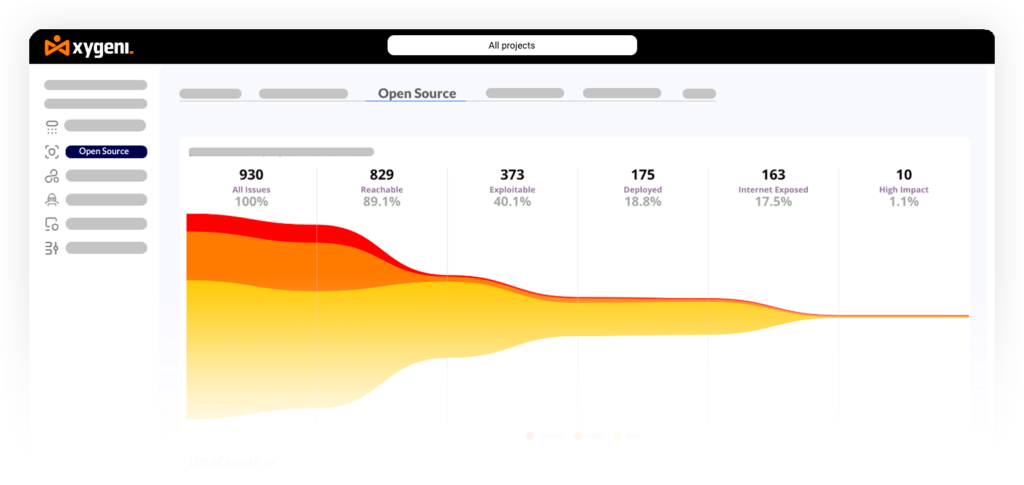
SBOM & SCA: Auto-generates and validates SBOMs in CycloneDX and SPDX formats. Detects typosquatting, dependency confusion, and license risks. Goes beyond CVEs with reachability, EPSS scoring, and business impact context, reducing noise by 90%. Includes Remediation Risk analysis and automated fix PRs.
CI/CD Security: Scans pipeline configurations, build scripts, and CI job definitions for misconfigurations. Enforces OWASP Top 10 CI/CD controls, MFA, and branch protection across GitHub Actions, GitLab, Jenkins, Azure DevOps, CircleCI, and more.
Secrets and Malware Detection: Detects secrets across files, pipelines, containers, repositories, and Git history, with auto-revocation and Git hook integration. Combines real-time malware detection, package analysis, and registry monitoring to block reverse shells, malicious downloads, and zero-day threats before they reach production.
Build Integrity and Artifact Provenance: Tracks artifact origin, applies cryptographic signing, and verifies no unauthorized build changes. Supports SLSA provenance and custom in-toto attestations.
Guardrails and Policy-as-Code: Custom YAML rules that block risky builds or trigger alerts on secrets, malware, non-compliant jobs, or policy violations, enforced across every pipeline and environment.
Compliance Automation: Automated evidence collection and continuous audit readiness. Enforces OWASP, SLSA, NIST SP 800-204D, CIS Benchmarks, OpenSSF Scorecard, and DORA.
Integrations: GitHub, GitLab, Bitbucket, Jenkins, Azure DevOps, CircleCI, Travis CI, REST APIs, webhooks, Jira, and GitHub Issues.
What Makes Xygeni Different
Most SSCS platforms cover one or two layers well. Xygeni covers the entire supply chain (from open-source dependencies and proprietary code through CI/CD pipelines, build artifacts, containers, and infrastructure) in a single unified platform. Its ASPM layer correlates findings across every scanner into one prioritized risk view, eliminating the alert noise that comes from managing disconnected tools. And with AI Security (AI-SPM + Shield), Xygeni is the only platform on this list that also secures the AI assets, models, agents, and MCP servers, that now sit at the center of modern software development.
💲 Pricing
Starts at $35/month per contributor for the complete all-in-one platform. Includes SBOM generation, SCA, SAST, CI/CD security, secrets and malware detection, IaC scanning, container protection, and ASPM, with no hidden limits or per-feature charges. Flexible tiers available for startups through enterprise.
Bottom line: Xygeni is the strongest choice for security and engineering teams that need end-to-end software supply chain protection without managing multiple siloed tools. Its combination of native CI/CD guardrails, policy-as-code enforcement, ASPM correlation, and full compliance automation makes it the most complete SSCS platform on this list.
2. Snyk
Overview
Snyk is a developer-first Software Supply Chain Security tool. Additionally, it supports multiple languages and integrates directly into developer environments, CI/CD pipelines, and source control platforms. As a matter of fact, it is widely adopted for scanning open-source dependencies and containers.
Key Features
- Supports SCA, container security, SAST, and IaC scanning
- Integrates with GitHub, GitLab, Docker, Bitbucket, and VS Code
- Offers reachability-based risk prioritization and auto-generated PRs
- Known for its usability and strong developer experience
- Commonly used for shift-left security and automated fixes in developer workflows
Cons
- According to GigaOm, Snyk lacks maturity in CI/CD enforcement and ASPM capabilities.
- No policy-as-code or guardrails for secure pipeline execution.
- SBOM generation, CI/CD visibility, and risk-based prioritization require the Enterprise tier.
- Pricing grows quickly with team size due to per-seat billing — no bundled SSCS plan available.
💲 Pricing:
- Snyk’s SSCS features span multiple products (SCA, Container, AppRisk), each sold separately.
- Team plans start at $25/month per developer (minimum 5).
SBOM, CI/CD visibility, and risk-based prioritization are only in the Enterprise tier. - No bundled SSCS plan is available. A custom quote is required for full coverage.
3. Aikido
Overview
Aikido is a GitHub-native platform designed for developers who want a simple, all-in-one security dashboard. In addition, it combines SCA, SBOM, SAST, CSPM, and container scanning into a single tool. As a result, it is known for fast onboarding and user-friendly automation.
Key Features
- One-click SBOM generation and open-source scanning
- Static code analysis with AI-powered fix suggestions
- Includes basic cloud posture management and container runtime security
- Detects malware using Phylum’s engine
- Recognized in the GigaOm Radar as an innovative solution focused on developer simplicity
Cons
- Best suited for GitHub — limited support for other SCMs and pipeline platforms.
- GigaOm notes it does not yet support deep CI/CD scanning or enterprise-grade policy enforcement.
- Lacks advanced customization for compliance frameworks.
- Support for enterprise CI/CD policies is limited even on paid plans.
💲 Pricing:
- Aikido offers a free plan for public GitHub repositories.
- Team plans start at $350/month for 10 users.
- SSCS features like SBOM and malware scanning are included, but support forenterprise CI/CD policies is limited.
- Currently, there is no dedicated SSCS bundle. Pricing grows with team size and platform usage.
4. Cycode

Overview
Cycode offers visibility and control over source code and CI/CD environments. Moreover, it monitors secrets, user permissions, and SBOM drift across pipelines. Above all, its strength lies in CI/CD observability and access governance.
Key Features
- Tracks repository changes, pipeline activity, and permission audits in real time
- Identifies exposed credentials and misconfigurations
- Supports compliance workflows and artifact verification
- Uses AI to detect unusual CI/CD behaviors
- Highlighted in the GigaOm report as a mature tool for CI/CD integrity
Cons
- Limited support for open-source SCA and no reachability-based vulnerability triage.
- Does not include customizable SBOM enforcement or rich policy-as-code options.
- Enterprise-only pricing — no free tier or public plan.
- May be complex to configure for smaller teams with simpler pipelines.
💲 Pricing
Cycode offers customizable pricing tailored to Software Supply Chain Security needs:
- Enterprise-level only pricing; no free tier available.
- Plan cost is based on number of repositories, pipeline integrations, and scan volumes.
- Adds value through SBOM drift alerts, secret detection, and CI/CD visibility.
- Requires a custom quote to define full coverage, cost typically increases with scale and complexity
5. Anchore
Overview
Anchore focuses on container image security. It scans Docker and OCI images for vulnerabilities and applies policy checks during the CI/CD process. It is often used in regulated environments where container trust is a priority.
Key Features
- Performs deep CVE scanning of container images
- Supports custom security policies in CI pipelines
- Integrates with Kubernetes, GitOps, and OCI registries
- Known in the GigaOm Radar for its strong performance in container policy enforcement
Cons
- Does not support SBOM validation or source code SCA — coverage is limited to containers.
- No visibility into pipeline configurations or CI/CD misconfigurations beyond container gates.
- Additional tools required for secrets detection, dependency scanning, and supply chain coverage beyond containers.
- Enterprise features require a custom quote with no public pricing.
💲 Pricing:
Anchore offers both open-source and enterprise plans:
- Free tier via Anchore Engine and Syft/Grype CLI tools
- Anchore Enterprise includes SBOM scanning, policy enforcement, and CI/CD integration
- Pricing depends on container registry size, scan frequency, and compliance needs
- No public pricing is available; a custom quote is required for full SSCS coverage
Software Supply Chain Security Best Practices for 2026
Choosing the right platform is only part of the equation. Here are six proven practices that modern security and engineering teams should embed into their SDLC.
1. Automate SBOM Generation on Every Build
Generate a Software Bill of Materials automatically with every build using CycloneDX or SPDX. Automating SBOM validation in CI prevents insecure artifacts from moving downstream and gives you the traceability regulators and enterprise customers increasingly require.
2. Scan Dependencies with Reachability and EPSS
Go beyond CVSS scores. Apply EPSS, reachability analysis, and contextual signals to focus on what’s truly exploitable. With 86% of commercial codebases containing open-source vulnerabilities and the average codebase now including 911 components, prioritization is the difference between signal and noise.
3. Harden Your CI/CD Pipeline
Your CI/CD pipeline is a primary attack target. Apply the OWASP Top 10 CI/CD security controls, enforce least privilege, detect pipeline drift, and add policy guardrails. Treat every workflow file, runner, and build script as part of your attack surface.
4. Detect Secrets and Malware Early
Scan commits, containers, and build scripts continuously, not just at release. Hardcoded credentials, typosquatting packages, reverse shells, and suspicious downloads are among the most exploited entry points in modern supply chain attacks.
5. Enforce Policy-as-Code
YAML-based guardrails let you scale security rules across environments and support auditability for compliance. Policies enforced in the pipeline catch violations before they reach production, not after.
6. Monitor Anomalies and Access Patterns
Attackers move laterally inside pipelines after gaining initial access. Watch for unknown IPs cloning repositories, sudden permission changes, unplanned pipeline edits, and unusual build behavior. Behavioral detection is the last line of defense when everything else looks clean.
Why Xygeni Is the Smartest Choice for Software Supply Chain Security in 2026
Each tool on this list addresses a real dimension of supply chain security. Snyk has strong developer adoption for SCA. Aikido makes onboarding fast for GitHub-native teams. Cycode offers deep pipeline observability. Anchore excels at container policy enforcement. But none of them secure the entire supply chain on their own, and in 2026, partial coverage is a liability.
Xygeni is the only platform on this list that protects every layer natively: open-source dependencies, proprietary code, CI/CD pipelines, build artifacts, containers, infrastructure, and AI assets, in a single unified platform. No tool sprawl. No blind spots. No reconciling findings from disconnected dashboards.
Its policy-as-code engine enforces custom security rules across every pipeline and environment. Its ASPM layer correlates findings from SBOM, SCA, secrets, malware, and anomaly detection into one prioritized risk view, eliminating the noise that makes traditional supply chain security so operationally expensive. And with AI Security (AI-SPM + Shield), Xygeni is the only tool here that also governs the models, agents, and MCP servers now embedded in modern development workflows.
At $35/month per contributor (with no hidden limits, no per-feature charges, and no enterprise-only gating) it’s also the most cost-effective full-platform option on this list.
If you need to secure your software supply chain end to end without managing a stack of disconnected tools, Xygeni is the place to start.
Frequently Asked Questions
What is software supply chain security?
Software supply chain security (SSCS) refers to the practices and tools used to protect every component involved in building and delivering software, source code, open-source dependencies, build pipelines, CI/CD systems, containers, and deployment artifacts. It addresses risks that arise not just from your own code, but from everything your software depends on.
Why has software supply chain security become critical in 2026?
Third-party involvement in breaches doubled to 30% in 2025, the largest single-year shift in the Verizon DBIR’s history. At the same time, malicious open-source package detections jumped 73% year-over-year, and the average supply chain breach takes 267 days to detect and contain. Attackers have made indirect entry through trusted dependencies and pipelines their primary strategy.
How does policy-as-code improve supply chain security?
Policy-as-code allows teams to define security rules in YAML or similar formats and enforce them automatically across pipelines, branches, and environments. This scales security governance across large teams and complex CI/CD setups — making it auditable, repeatable, and far less dependent on manual review.