



The average AppSec team manages thousands of open findings at any given time. Most of them are not worth fixing today. Some are not worth fixing ever. The problem is not that security teams lack effort; it is that manual triage does not scale, and remediation without prioritization produces a backlog that grows faster than it shrinks. AI triage and AI AutoFix change the economics of vulnerability remediation. AI triage filters the noise, reducing thousands of findings to the handful that are genuinely exploitable, reachable, and business-critical. AI AutoFix closes those findings automatically, delivering safe, context-aware fixes directly into the developer workflow without requiring manual patching. Together, they are the practical answer to the security backlog problem that has plagued AppSec teams since static analysis tools first started generating more findings than anyone could act on.
This guide explains how AI triage works, what AI AutoFix actually does in practice, how noise reduction and automated vulnerability remediation connect, and what to look for when evaluating tooling.
The Backlog Problem: Why Manual Remediation Breaks at Scale
Security backlogs are not a discipline problem. They are a math problem.
A modern application security program running SAST, SCA, secrets detection, IaC scanning, and DAST across a mid-sized engineering organization generates tens of thousands of findings per month. Each finding requires a human to read it, assess its severity in context, determine whether it is exploitable in the specific application and environment, decide whether it is worth fixing now or later, assign it to a developer, wait for the fix, and verify the result. That process takes time most security teams do not have.
The result is a backlog that compounds. High-severity findings from six months ago sit next to medium findings from last week. Developers receive tickets with no clear fix guidance. Security teams spend their time in triage rather than in remediation. And the findings that actually represent exploitable risk, the ones that would matter in a real attack- are buried in a list of low-signal alerts that nobody has time to read carefully.
Three dynamics make the backlog worse over time. First, AI-generated code has accelerated the volume of code entering production, and with it, the volume of findings. Veracode’s 2025 analysis found that only 55% of AI-generated code was secure across 100+ models tested. Second, the proliferation of AppSec tools means findings arrive from multiple scanners with no unified view and no shared prioritization logic. Third, most static analysis tools are tuned for completeness rather than precision; they would rather flag something safe than miss something dangerous, which generates false positives that erode developer trust and slow remediation further.
AI triage and automated vulnerability remediation address all three dynamics directly.
What AI Triage Actually Does
AI triage is the application of machine learning and contextual analysis to the problem of finding prioritization. Its goal is not to find more vulnerabilities; it is to identify which of the vulnerabilities already found are worth acting on, in what order, and why.
Traditional severity scoring (CVSS, for example) assigns a score based on the vulnerability’s general characteristics: attack vector, complexity, privileges required, impact. It does not know whether the vulnerable function is actually called in your application, whether it is reachable from the internet, whether it sits behind authentication, or whether it affects a system that handles sensitive data. A critical CVSS score on a function that is never invoked in production is not a critical risk; it is noise.
AI triage applies the context that CVSS cannot. It combines:
- Reachability analysis: determining whether the vulnerable code path is actually executed in the running application, not just present in the codebase. A vulnerability in dead code is not exploitable. AI triage knows the difference.
- Exploitability scoring: using data from EPSS (Exploit Prediction Scoring System) and real-world attack telemetry to assess the probability that a given vulnerability will be exploited in the wild. Not every CVE with a public exploit is actively being used. Not every vulnerability without one is safe.
- Business impact context: understanding which applications, services, and data assets are affected by a finding, and weighting severity accordingly. A SQL injection in a public-facing API that handles payment data is categorically different from the same finding in an internal reporting tool with no external access.
- False positive filtering: identifying findings that match a known-vulnerable pattern but are not actually exploitable in context, and removing them from the active queue before a developer ever sees them.
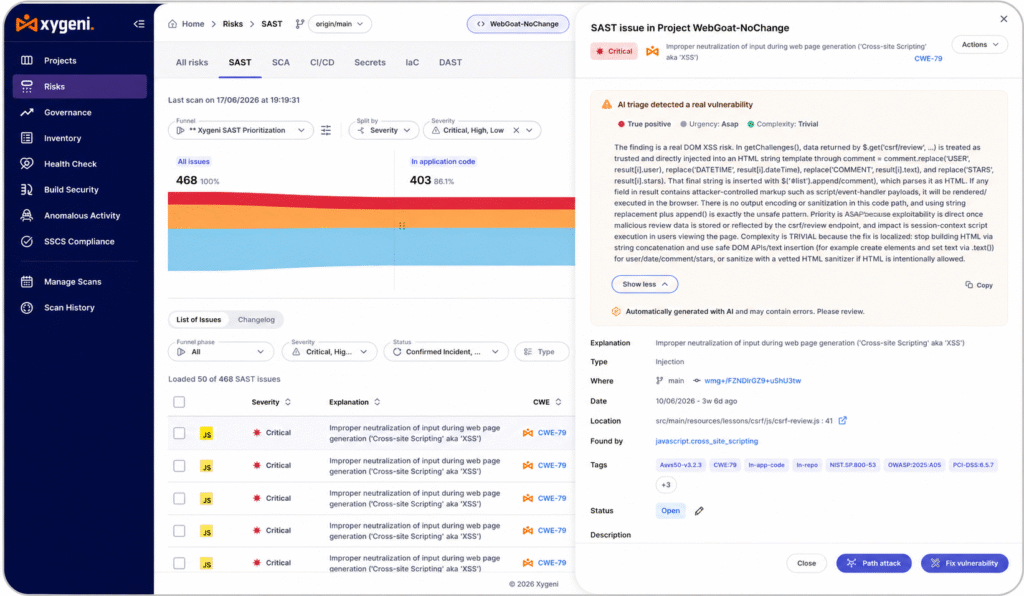
The output of AI triage is not a shorter list of the same findings. It is a qualitatively different list, one where every item represents a genuine, prioritized, actionable risk rather than a theoretical possibility. Teams running AI triage typically see 80–90% noise reduction from raw scanner output to actionable findings.
What AI AutoFix Actually Does
AI AutoFix is the remediation side of the equation. Where AI triage identifies what to fix, AI AutoFix generates the fix itself, a safe, context-aware code change that resolves the vulnerability without introducing new problems.
The distinction from generic AI code generation matters here. A general-purpose AI assistant asked to fix a SQL injection vulnerability will produce code that looks reasonable. AI AutoFix in a security platform produces code that is validated against the specific vulnerability pattern, the specific language and framework in use, the specific coding conventions of the repository, and the specific risk context identified by the triage layer. The fix is not a suggestion, it is a pull request, ready for developer review, with the vulnerability resolved and the fix explanation included.
What AI AutoFix does in practice:
- Replaces risky patterns with safe alternatives. A parameterized query instead of string concatenation. A safe deserialization library instead of a vulnerable one. An input validation function instead of direct user input in a system call. The fix addresses the root cause, not just the symptom.
- Handles breaking change awareness. Updating a vulnerable dependency is straightforward when the new version is a drop-in replacement. It becomes complex when the API has changed, when transitive dependencies conflict, or when the fix breaks existing tests. AI AutoFix understands the dependency graph and flags or handles breaking changes before the pull request is opened.
- Delivers fixes where developers work. The most effective AutoFix implementations surface fixes in the IDE as code is written, in the CI/CD pipeline as code is committed, and in pull requests as code is reviewed, not in a separate security dashboard that developers never open. Friction is the enemy of remediation velocity.
- Scales without headcount. A security team of five cannot manually review and fix five thousand findings. AI AutoFix can generate and submit fixes for all five thousand, leaving the security team to review and approve rather than author every change.
Noise Reduction in Practice:From Thousands of Findings to the Ones That Matter
Noise reduction is not just a quality-of-life improvement. It is a security outcome. When developers receive thousands of alerts, they develop alert fatigue, the well-documented phenomenon where high volumes of low-signal notifications cause humans to stop reading them carefully. Alert fatigue does not just slow remediation. It causes real vulnerabilities to be missed.
The noise reduction pipeline that AI triage enables looks like this in practice:
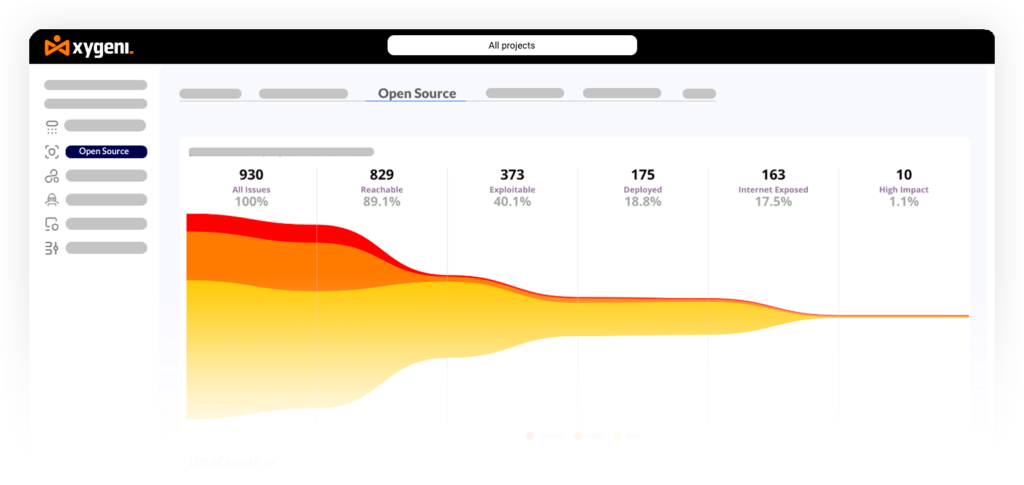
A SAST scanner runs across a repository and produces 2,400 findings. Without triage, all 2,400 land in a backlog. With AI triage, the findings are filtered by reachability (removing findings in unreachable code paths), by exploitability (removing findings with no realistic attack vector in the current context), by false positive probability (removing findings that match a pattern but are demonstrably safe in context), and by business impact (ranking the remaining findings by the severity of the data and systems they affect). The output is 60 prioritized findings, the ones that represent real, actionable risk in the specific application and environment.
Those 60 findings go to developers with fix guidance. AI AutoFix generates pull requests for those with clear, safe automated fixes. The security team reviews and approves. The 60 genuine risks are resolved. The 2,340 non-issues never reached a developer’s queue.
That is not a marginal efficiency improvement. It is the difference between a security program that scales and one that doesn’t.
Tool Consolidation: A Side Effect Worth Planning For
One of the less-discussed benefits of AI triage and AI AutoFix is what they do to tool sprawl.
Most AppSec teams run multiple scanners: one for SAST, one for SCA, one for secrets, one for IaC, one for containers, one for DAST. Each scanner produces its own findings format, its own severity scale, its own false positive rate, and its own remediation guidance, or no remediation guidance at all. Security teams spend significant time reconciling findings across tools, deduplicating alerts that represent the same underlying issue, and translating scanner output into developer-readable tickets.
A platform that combines AI triage across all finding sources with unified AutoFix delivery eliminates most of that overhead. Findings from SAST, SCA, secrets, and IaC flow into a single prioritization engine. The triage layer applies consistent scoring logic across all sources. AutoFix generates fixes regardless of which scanner identified the issue. The developer sees one queue, one severity scale, one fix format.
The security team manages one platform instead of five. Vendor contracts consolidate. Integration maintenance reduces. And the unified data model means the triage layer has more context, a finding that appears in both SAST and SCA output, and is also reachable from a publicly exposed endpoint, gets scored higher than either scanner would score it alone.
Tool consolidation is not the primary goal of AI triage and AutoFix; backlog reduction is. But it is a consequence that compounds over time, reducing operational overhead and improving the quality of the prioritization signal.
How to Evaluate AI Triage and AutoFix Tooling
Not all implementations of AI triage and AutoFix deliver the same outcome. These are the capabilities that separate genuine noise reduction and automated vulnerability remediation from a marketing claim:
- Reachability-based prioritization, not just severity scoring. If the tool scores findings purely on CVSS without understanding whether the vulnerable code path is actually executed, it is not doing AI triage; it is doing sorting. Ask vendors specifically how reachability is determined and what data sources inform exploitability scoring.
- Cross-scanner correlation. A triage layer that only sees findings from one scanner has an incomplete picture. The most accurate prioritization comes from correlating findings across SAST, SCA, secrets, IaC, and DAST, understanding when multiple tools flag the same underlying risk, and weighting that signal appropriately.
- AutoFix quality and validation. A fix that introduces a new vulnerability or breaks existing functionality is worse than no fix. Evaluate the fix quality by asking whether AutoFix is validated against known-safe patterns, whether it handles breaking changes, and whether it includes test coverage for the remediated code path.
- IDE and pipeline integration. AutoFix that surfaces in a separate dashboard requires developers to leave their workflow to act on it. The highest-velocity remediation happens when fixes are available in the IDE, in the PR, and in the CI/CD pipeline, wherever the developer is already working.
- False positive rate, not just true positive rate. The true positive rate tells you how much the tool catches. The false positive rate tells you how much noise it generates. Both matter, and the ratio between them is the real signal. Ask for benchmark data, not just marketing claims.
- Audit trail and override capability. AutoFix in a production pipeline needs governance. Developers and security teams need to be able to review, approve, modify, and reject automated fixes, with a full audit trail of what was changed, why, and by whom.
AI Triage and AutoFix With Xygeni
Xygeni’s approach to automated vulnerability remediation is built around one principle: detection without remediation is a backlog waiting to happen.
The Xygeni Prioritization Funnel applies AI triage across all finding sources (SAST, SCA, secrets detection, IaC, CI/CD security, and DAST), reducing raw scanner output through successive layers of reachability analysis, exploitability scoring, and business impact context. The output is a prioritized queue of genuinely actionable findings, not a flat list of everything the scanner found.
AI AutoFix generates context-aware, language-specific fixes delivered directly to pull requests, covering SAST findings, vulnerable dependencies, and secrets exposure across human-written and AI-generated code. Breaking change intelligence flags dependency updates that would break the build before the PR is opened. Fix explanations give developers the context to review and approve changes with confidence rather than blind trust.
DevAI, Xygeni’s IDE-embedded AI security copilot, surfaces triage results and AutoFix suggestions directly in the developer’s environment, as code is written, before a commit is made. The MCP server integration means AI coding assistants can trigger security scans, receive prioritized findings, and apply safe fixes without leaving the IDE.
The result: teams running Xygeni report moving from thousands of open findings to a manageable, prioritized queue, and from manual patching to automated remediation that scales with the codebase rather than with headcount. If your security backlog is growing faster than your team can address it, the problem is not effort. It is that the tools you are using were not built to solve it.

FAQ
How much can AI triage reduce security backlog noise?
Teams using AI triage with reachability-based prioritization typically see an 80–90% reduction from raw scanner output to actionable findings. The exact figure depends on the codebase, the number of scanners in use, and the specificity of the triage model, but the directional impact is consistent: most findings produced by static analysis tools are not exploitable in context, and AI triage identifies and removes them before they reach the developer queue.
Is AI AutoFix safe to use in production pipelines?
Yes, when implemented with appropriate governance. AI AutoFix should always include human review before changes are merged to production; the value is in generating the fix automatically, not in bypassing the review process. Look for implementations that include fix explanations, breaking change detection, and a full audit trail of what was changed and why.
How does automated vulnerability remediation differ from manual patching?
Manual patching requires a security engineer or developer to read the finding, understand the vulnerability, research the safe fix, implement it, test it, and submit it for review. Automated vulnerability remediation generates the fix automatically based on the vulnerability type, language, framework, and coding conventions, reducing the time from finding to fixing from days or weeks to hours or minutes, and scaling across the full finding queue rather than one issue at a time.
What is the connection between noise reduction and security backlog reduction?
They are two sides of the same problem. Noise (low-signal, non-exploitable, or false-positive findings) fills the backlog with items that should never have reached a developer’s queue. Noise reduction through AI triage removes those items upstream, so the backlog contains only genuine risks. AutoFix then closes those genuine risks faster. The combination shrinks the backlog from both ends simultaneously.