
AI has changed who can write a malicious package and how fast they can publish one. A working, obfuscated, dependency-confusion-ready package that used to take a skilled attacker days to build can now be generated, tested, and pushed to a public registry in minutes. Your review process was not built for that speed, and neither was your scanner’s signature database. What stops an AI-generated malicious package is not a faster review; it is a dependency firewall sitting on the machine where the install actually happens. Xygeni AI Shield covers npm, PyPI, and Maven today, on Linux workstations, servers, and CI runners. Everything below is what it does within that scope.
This Isn’t Hypothetical
Supply chain compromises like Shai-Hulud and the string of npm and PyPI incidents through early 2026 share a pattern: a dependency that looked legitimate was pulled by a developer and executed before anyone, tool or human, flagged it as malicious. None of those attacks needed a human attacker working around the clock. AI-assisted tooling makes that same pattern faster and cheaper to run at scale, which is what makes the gap between repository scanning and endpoint execution more dangerous now than it was two years ago, not less.
AI Didn’t Just Speed Up Development. It Sped Up Attacks Too.
Every team adopting AI coding assistants has heard the pitch: faster development, faster releases. Attackers heard the same pitch. AI-assisted tooling now lets threat actors generate convincing package names, working exploit code, and install scripts that evade static reputation checks, all faster than any human red team could. A malicious package built with AI assistance does not need to reuse a known signature. It can be new every time, which is exactly what defeats a scanner that is waiting for a CVE or an advisory to catch up.
Your code scanner is still looking at the repository, after the fact. Your EDR is still watching a process, not a package. Neither one was designed for a world where a novel, AI-generated malicious package can appear and get pulled by a developer before any human or automated review has seen it. That gap is where a dependency firewall does its job.
What a Dependency Firewall Does About It
Xygeni AI Shield is a dependency firewall for the developer endpoint. It intercepts package installs in real time, checks them against Xygeni’s malware intelligence, and blocks anything malicious before the install script runs, whether that package was hand-written by a person or generated in seconds by an AI tool. The same logic applies to the network: connections to known-malicious infrastructure are cut before anything leaves the machine, which matters because AI-assisted malware still needs to phone home to be useful to whoever built it.
Because this dependency firewall works on behavior and risk analysis rather than waiting for a published signature, it catches exactly the kind of fast-mutating, AI-generated malicious packages that reputation-based tools are structurally too slow to flag. That is the point of stopping an attack before a signature exists, not after.
Shield runs as one lightweight agent across workstations, servers, and CI runners, with policy managed centrally and floating seats so coverage follows your people rather than your hardware.
Inside the Xygeni AI Shield Dependency Firewall
- Block it before it executes. Every install is intercepted and validated in real time, and blocking happens before the install script runs, not after a report surfaces the next morning.
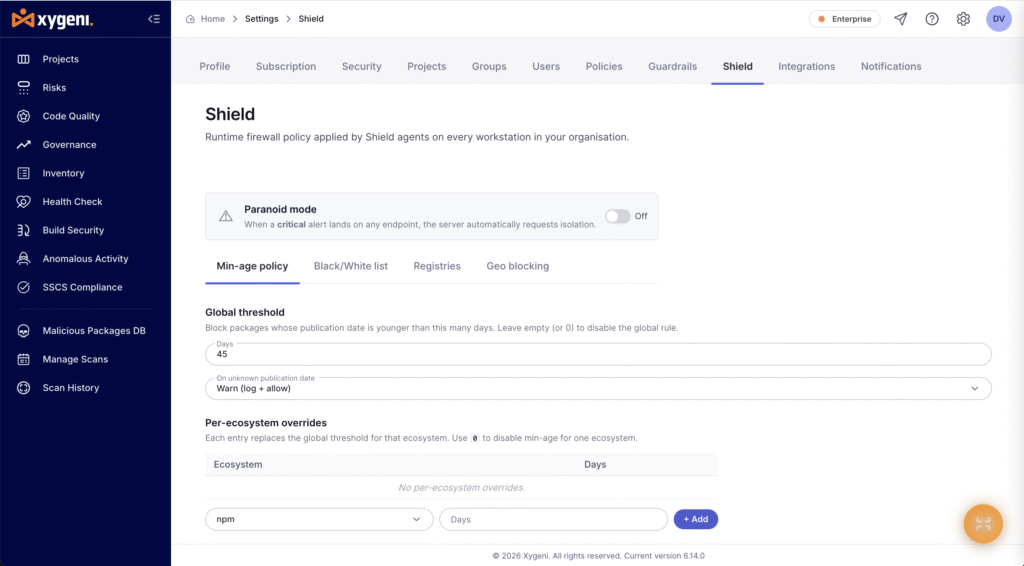
- Minimum-age policy. AI-generated malicious packages are, by definition, brand new. This dependency firewall lets you block anything published more recently than your threshold, set a global rule, override it per ecosystem, and decide what happens when a publication date cannot be determined.
- Allow lists, deny lists, and approved registries. Decide exactly what your developers can pull and where from, down to the registry level.
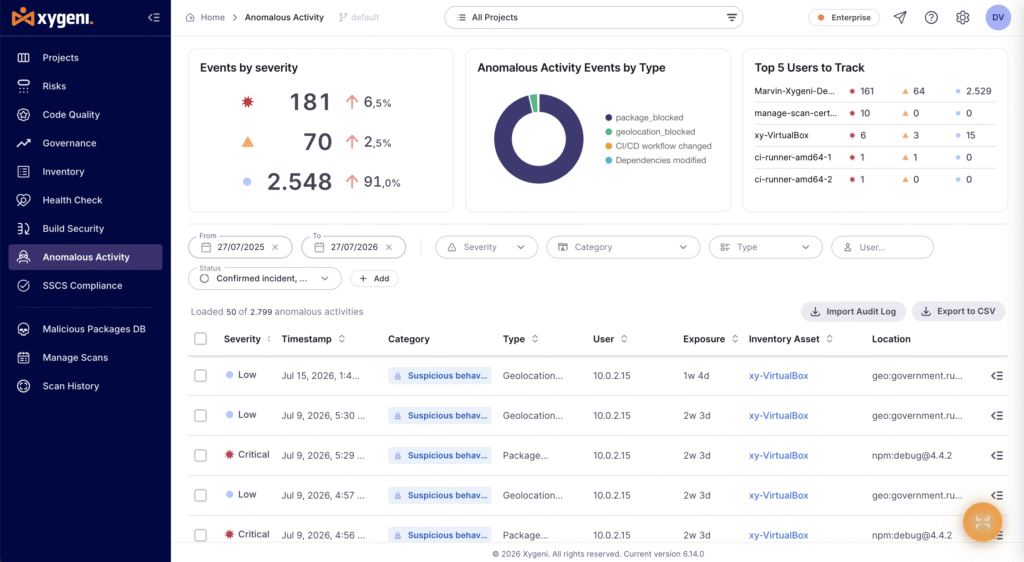
- Network firewall with geo policy. The same firewall logic applies to outbound traffic. Connections to known-malicious IPs and domains are cut automatically, and you can restrict traffic to high-risk geographies. Every blocked connection is logged with the destination it tried to reach.
- Endpoint isolation, manual or automatic. When something critical lands on a machine, AI Security Shield can cut that endpoint’s outbound traffic except its own management channel, containing the incident at one laptop instead of letting it spread. Paranoid mode triggers isolation automatically the moment a critical alert fires.
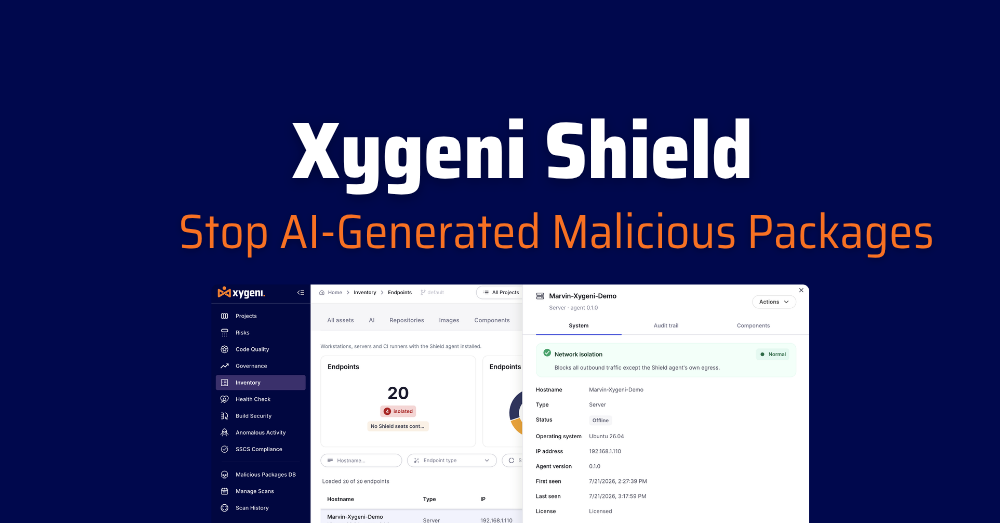
- A live inventory of every protected endpoint. See every workstation, server, and CI runner running the agent, its OS, version, status, and license seat, filterable by hostname or type.
- Real-time alerts with the evidence attached. Every block is an event with severity, timestamp, endpoint, exposure duration, and exactly what was stopped: the package and version, or the destination.
- Audit trail per endpoint. Each protected machine keeps its own record, so you can reconstruct exactly what happened when someone asks.
Why This Firewall Sits Where Nothing Else Does
Reputation and signature-based tools tell you about a malicious package after someone else has already been hit by it. That model was already too slow before AI. Now that AI-generated malicious packages can be produced and published faster than any advisory pipeline can catalog them, a dependency firewall built on behavior and risk analysis is the only layer that is useful on day zero, when the attack is new and no signature exists yet. And because it is Xygeni’s dependency firewall, every block, isolation, and geo event lands in the same console as your code, dependency, pipeline, and secrets findings, with one audit trail. Not another agent, another dashboard, another login to check.
Where AI Security Shield Fits Next to Your EDR
Teams sometimes assume their existing EDR already covers this. It does not. EDR watches processes, files, and connections at the OS level, but it has no application-security context: it cannot tell you whether a dependency is malicious, whether a package version shipped yesterday, or whether it was likely generated by an AI tool built to evade exactly the checks you have in place. Xygeni Shield brings that context to the endpoint and enforces policy on the things AppSec actually cares about, running alongside whatever EDR you already have.
What This Means for the CISO, Not Just the AppSec Team
A CISO does not need to know how the interception works. What matters at that level is simpler: there is a stage of the supply chain, the moment of install on a developer’s own machine, that today’s AppSec spend and today’s EDR spend both leave uncovered, and it is the stage where an AI-generated malicious package actually does damage. Xygeni Shield closes that gap without adding another standalone tool: every block, isolation, and audit trail lands in the same console and the same evidence trail as the rest of your AppSec findings, which is what an auditor or a board update actually needs to see: one consistent record rather than a fourth dashboard to reconcile.
Get Started with Xygeni AI Shield
Xygeni Shield covers npm, PyPI, and Maven ecosystems today, running on workstations, servers, and CI runners with policy managed centrally from one place.
Start Free or Schedule a Demo to see the dependency firewall block a real install in real time.
FAQ
How is Xygeni AI Shield different from the EDR we already run?
Endpoint detection watches processes, files, and connections at the operating system level. It does not know what a package registry is, whether a dependency is malicious, or whether a version was published yesterday. Xygeni Shield brings application-security context to the developer endpoint and enforces policy on the things AppSec cares about, running alongside whatever EDR you already have.
Can a dependency firewall catch a malicious package that was generated by AI, with no prior signature?
Yes. Xygeni AI Security Shield blocks on behavior and risk analysis, not on matching a known signature, CVE, or advisory. That is what makes it effective against a package that is new every time it is generated, whether it was hand-written or produced by an AI tool built to evade reputation-based checks.
Does it slow developers down?
Xygeni AI Security Shield is a lightweight agent that checks installs as they happen. Developers only notice it when something is blocked, and the block comes with the reason.
What can Xygeni AI Shield block today?
Malicious and unauthorized package installs, packages newer than your minimum-age threshold, installs from registries you have not approved, packages on your deny list, outbound connections to known-malicious IPs and domains, and traffic to geographies you have restricted.
What happens if a package’s publication date cannot be determined?
You decide. The minimum-age policy lets you either warn and allow, or block, when the publication date is unknown.
Can I set different rules per ecosystem?
Yes. The global minimum-age threshold can be overridden per ecosystem, and disabled for a specific ecosystem if you need to.
What does endpoint isolation actually do?
It blocks all outbound traffic from that machine except Xygeni AI Security SHield own management channel, so the endpoint stays contained but still manageable. You can trigger it on demand, or enable paranoid mode so isolation is requested automatically when a critical alert lands.
Where does the Shield agent run?
On developer workstations, on servers, and on CI runners. Licensing uses floating seats.
Do the blocks show up anywhere I can audit?
Yes. Every block is an event with full detail, and each endpoint keeps its own audit trail. Events can be filtered and exported.