
Run a code quality check on a codebase and you get a report on complexity, duplication, dead code, and naming. Run a code security check on the same codebase and you get a report on SQL injection, cross-site scripting, and authentication flaws. Same files. Two reports. Usually two different tools, two different dashboards, and two teams that rarely compare notes.
That split is so normal in software development that most teams have stopped noticing it. It’s also the reason a maintainability problem and a security problem sitting in the same function get treated as two unrelated tickets instead of one.
Here’s what each check actually does, where they overlap, and where the “two tools” model breaks down.
What Is a Code Quality Check?
A code quality check is a static analysis pass that measures how maintainable, readable, and structurally sound a codebase is, independent of whether it’s exploitable. It doesn’t ask “can an attacker break this?” It asks “can a developer safely change this six months from now?”
A code quality check typically evaluates:
- Code smells: structural patterns that make code harder to change over time
- Cyclomatic and cognitive complexity: functions and classes that have grown past the point where anyone can safely modify them
- Maintainability: the aggregate cost of continuing to work in a given file or module
- Dead code: unreachable or unused code carried at permanent cost
- Duplication: copy-paste debt, where one fix needs to happen in five places and gets made in three
- Naming conventions: violations that raise the cost of every future reader
The output of a code quality check is usually a score, a trend line, and a long list of findings ranked by a fixed rule severity, not by actual impact.
What Is a Code Security Check?
A code security check, more formally Static Application Security Testing (SAST), scans source code for exploitable vulnerabilities before the application ever runs. It’s looking for the specific patterns that let an attacker do something the application was never meant to allow.
A code security check typically catches:
- Injection flaws: SQL injection, command injection, code injection
- Cross-site scripting (XSS): unsanitized input that lets an attacker run scripts in another user’s session
- Misconfigurations and information leakage: settings and code paths that expose data unintentionally
- Buffer overflows: memory-handling issues that can compromise application integrity
- Authentication and authorization gaps: weak or missing access control
Findings from a code security check carry a CWE classification, a severity rating, and (in mature tools) evidence of exploitability, which is what separates a serious SAST tool from one that just pattern-matches and hopes.
Code Quality Check vs. Code Security Check: The Key Differences
| Code Quality Check | Code Security Check (SAST) | |
|---|---|---|
| Core question | Can this be safely maintained? | Can this be exploited? |
| What it measures | Complexity, duplication, dead code, naming, maintainability | Injection, XSS, misconfiguration, auth flaws, memory issues |
| Standard reference | Internal quality model, no universal certification standard | CWE (Common Weakness Enumeration), validated against benchmarks like OWASP |
| Typical owner | Engineering / VP Engineering | AppSec / DevSecOps |
| Consequence of ignoring it | Rising cost of change, slower onboarding, brittle releases | Data breach, compliance failure, exploited production system |
| Where it runs | CI, local CLI | CI, local CLI, and (in more advanced tooling) the IDE |
They’re not competing checks. They’re answering two different questions about the same lines of code, which is exactly why running them in isolation causes problems.
Why Most Code Analysis Tools Keep Them Apart
Most organizations already run both checks. They just run them in two different products, with two different consoles, two different backlogs, and two different prioritization models, over the same repositories.
That split produces three predictable problems:
- Nobody sees the two backlogs together. A function with a critical security finding and a maintainability score in the danger zone shows up as two disconnected tickets in two disconnected tools, when it’s really one piece of code that needs attention twice as urgently.
- Findings pile up faster than anyone can fix them. Every code analysis tool on the market is good at identification. The bottleneck has never been finding issues. It’s that a quality scan or a security scan on any real codebase returns more findings than any team has hours to work through, and a flat severity label doesn’t tell you which ten to fix first.
- A flat rule severity is not a priority. “Critical” from a rule engine and “critical because this is actually reachable and exploitable” are different claims. Most code analysis tools only make the first one.
The Better Way: One Platform, One AI, One Prioritization Model
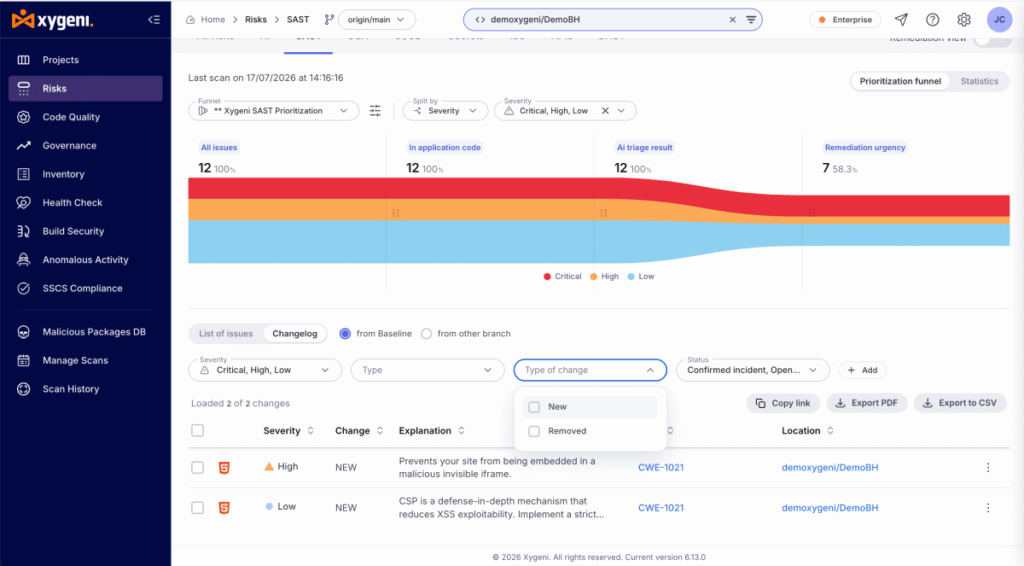
Xygeni runs code quality and code security analysis in the same scanner, the same console, and the same prioritization model, so a maintainability problem and a security flaw in the same file are visible together instead of living in two unrelated systems.
- Measure. Xygeni’s code security check (SAST) scans for injection flaws, XSS, misconfigurations, buffer overflows, and authentication weaknesses, with every finding carrying a CWE classification. Xygeni’s code quality check runs the same analysis discipline across ten languages, Java, JavaScript, Python, PHP, C#, Go, HTML, Swift, Kotlin, and C/C++, measuring complexity, maintainability, duplication, dead code, and naming under one consistent standard, so quality findings carry the same severity, CWE-where-applicable, and file-and-line detail as security findings.
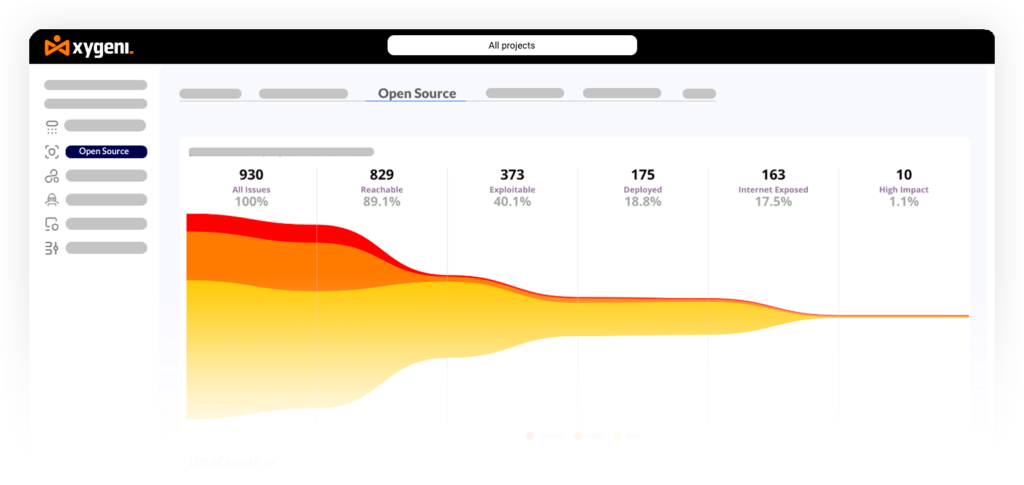
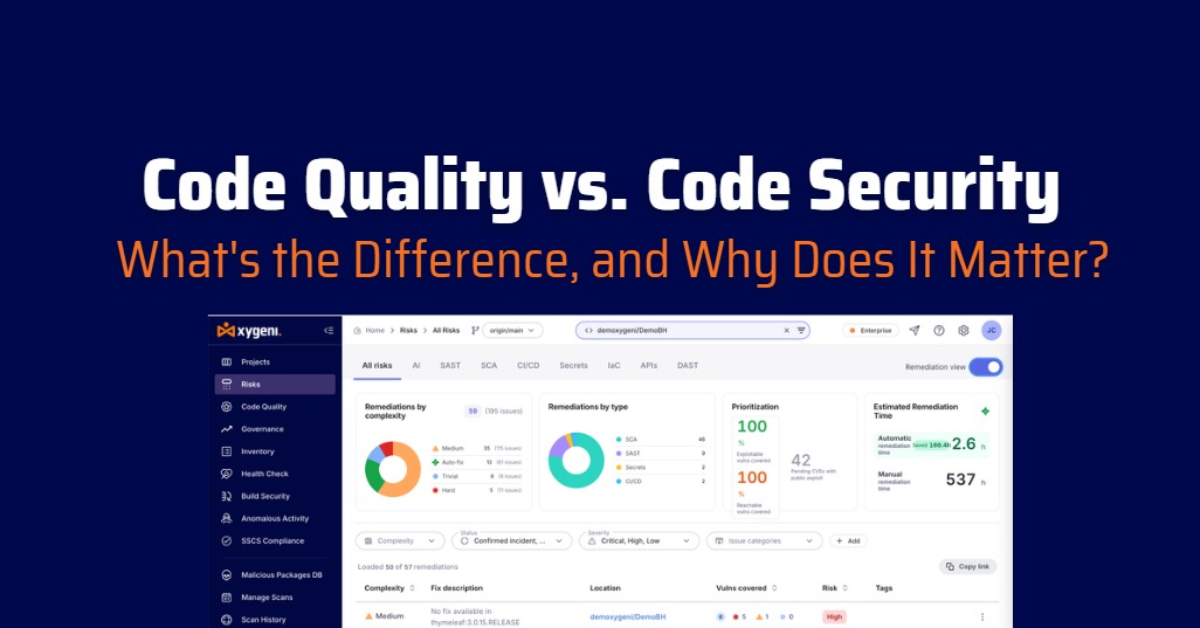
- Prioritize. Both check types feed the same AI Triage funnel, which ranks findings by real impact rather than a flat rule severity, and both participate in a unified All Risks view, so a security lead and an engineering lead are looking at the same picture of risk instead of two separate spreadsheets.
- Remediate. Xygeni doesn’t stop at identification. AI Remediation proposes ready-to-apply fixes for security findings, including pull request creation, and does the same for quality findings, ranked by remediation complexity with estimated effort saved. The question a code analysis tool should answer isn’t “how many rules do you have.” It’s “when this finds a thousand issues, who fixes them?”
This works whether the findings come from Xygeni’s own scanners or from third-party tools already ingested into the platform. AI Triage and AI Remediation apply to Xygeni’s own security findings and to security findings pulled in from tools like Snyk, Veracode, or Checkmarx, so switching to a unified check doesn’t mean ripping anything out first.
What to Look for in Code Analysis Tools
If you’re evaluating code analysis tools, whether for a code quality check, a code security check, or both, a few questions cut through most vendor pitches fast:
- Does it rank findings by real impact, or just by a fixed rule severity? A severity label is not prioritization.
- Does it validate its detection accuracy against an independent benchmark? SAST accuracy claims are easy to make and hard to prove; a published OWASP Benchmark result, with true positive rates and false positive rates disclosed, is the difference between a claim and evidence.
- Are the rules transparent? A detector catalogue you can browse before you run a scan tells you what the tool checks for before you commit to it.
- Does it stop at identification, or does it propose the fix? A finding without a path to remediation is a longer backlog, not a solved problem.
- Does it work across your whole stack, including findings from tools you already run? Consolidating visibility beats consolidating vendors on day one.
- Does it integrate with where the work already happens? CI/CD pull request checks, and for security findings, IDE feedback while the code is being written, not just after it’s merged.
The Short Version
A code quality check asks whether your code can be safely maintained. A code security check asks whether it can be exploited. Both questions matter, both produce findings you need to act on, and running them through two disconnected tools makes the same code look like two separate problems instead of one prioritized list.
Xygeni runs both checks in one scanner, ranks both by real impact in one funnel, and remediates both with pull requests instead of leaving you with a longer backlog.
Want to see your own code security findings prioritized instead of just listed? Start scanning free on Xygeni’s Developer plan.
Curious what a unified quality and security view looks like across your portfolio? Request a demo of Xygeni Code Quality alongside Code Security.
FAQ
Is a code quality check the same as a code security check?
No. A code quality check measures maintainability, complexity, duplication, and naming. A code security check (SAST) measures exploitability: injection flaws, XSS, misconfigurations, and authentication weaknesses. They analyze the same code but answer different questions, and a finding can be quality-flagged, security-flagged, or both at once.
What is SAST, and how does it relate to a code security check?
SAST stands for Static Application Security Testing. It’s the technical name for what most people mean by a “code security check”: scanning source code for vulnerabilities before the application runs, without executing it. Every code security check in this post refers to SAST specifically, as opposed to DAST, which tests a running application from the outside.
Can one tool run both a code quality check and a code security check?
Yes. Xygeni runs code quality and code security analysis in the same scanner and console, so both check types share one prioritization model instead of living in two separate tools with two separate backlogs. Findings from each still carry their own classification (CWE for security, complexity/maintainability metrics for quality).
How often should you run a code quality check or a code security check?
Both should run continuously, not as a one-off audit. The standard pattern is a scan on every pull request in CI, with guardrails that gate on new issues introduced rather than the full inherited backlog, so teams are judged on what they added, not on years of accumulated debt.