
TL;DR
A policy document isn't an AI governance framework. A PDF that says "we use AI responsibly" has no way to prove which AI is actually running, who approved it, or whether the policy is being followed. Governance needs structure underneath the words.
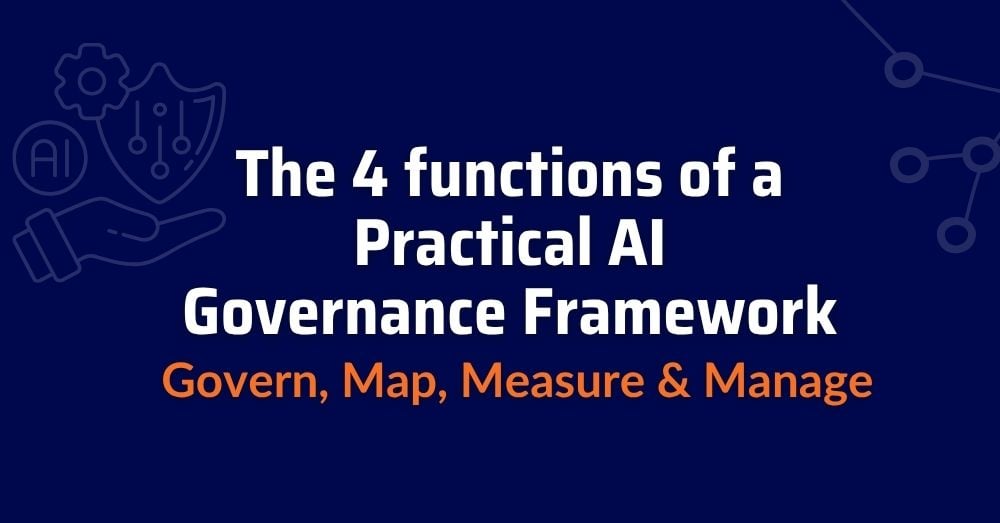
Four functions, borrowed from a real standard, hold a framework together. The NIST AI RMF's Govern, Map, Measure, Manage is a stable, citable structure: govern sets the policy, map builds the inventory, measure assesses the risk, manage enforces and remediates.
Inventory is the function most frameworks skip, and the one that breaks first. You cannot govern, measure, or enforce policy against an AI asset nobody knows exists. Shadow AI is a governance failure before it's a security one.
Standards give you the vocabulary, not the tooling. An AI governance framework built on NIST AI RMF, ISO/IEC 42001, and the EU AI Act gets the vocabulary for what a program needs to demonstrate. None of them hand you the inventory, the evidence, or the enforcement, that's the part organizations still have to build.
Most “AI governance” a company can produce today is a document. A set of principles, a list of approved tools, a paragraph on responsible use, signed off by legal and filed somewhere nobody reads it twice. It answers the question “what do we say we do,” and it cannot answer the question that actually matters in an audit or an incident: what AI is running right now, who approved it, and how do we know. That gap, between the policy and the proof, is where most AI governance efforts quietly fail. A real AI governance framework is the structure that closes it.
Why a Policy Document Alone Doesn’t Work
A responsible AI policy is necessary. It is not sufficient, and the reason is structural, not a matter of writing a better policy.
A policy states intent. It says developers should use approved AI coding tools, that models handling personal data need a privacy review, that AI-generated code gets the same scrutiny as human-written code. None of that is enforceable without something underneath it that can answer three questions on demand:
- What AI is actually in use? Not what was approved, what is running: which models, which agents, which MCP servers, which AI coding assistants, in which repositories, connected to what.
- Does reality match the policy? An unapproved model quietly called from a script, a developer’s personal API key sitting in a config file, an MCP server nobody reviewed, these are policy violations a document cannot detect on its own.
- Can you prove it, not just assert it? When an auditor, a regulator, or a customer’s security questionnaire asks for evidence, “we have a policy” is not evidence. A dated inventory, a signed AI bill of materials, and a mapped set of controls are.
Without those three, a governance program is a statement of values. With them, it’s a system that can be audited.
The Four Functions Every AI Governance Framework Needs
Rather than inventing a new structure, the most durable frameworks borrow from one that's already stable and widely recognized: the NIST AI Risk Management Framework, built around four functions. They translate cleanly into a practical AI governance program.
| Function | In Practice | Common Failure Point |
|---|---|---|
| Govern | Policy, roles, and accountability: who approves an AI use case, who owns the risk, what "acceptable use" actually means | Written once, never operationalized into a process anyone follows day to day |
| Map | A live inventory of every AI asset: models, datasets, agents, MCP servers, and AI coding tools in actual use | Built once from a survey, stale within a month, missing everything nobody self-reported |
| Measure | Assessing risk against each asset: prompt injection exposure, data handling, model provenance, configuration weaknesses | Assessed at intake, never reassessed as the asset or its configuration changes |
| Manage | Acting on what Measure finds: remediation, enforcement, and evidence generation for auditors and regulators | Findings pile up in a spreadsheet with no owner and no deadline |
Where Shadow AI Breaks the Framework
Shadow AI, the models, agents, and AI coding tools running without security or governance ever finding out, is not a side issue. It is the single most common reason the Map function fails, and when Map fails, the whole framework fails with it. A developer connects an unapproved model to a script. An MCP server gets added to a project because it solved a problem quickly. An AI coding assistant gets installed because it was free. None of that shows up in a survey, and a governance framework that relies on self-reporting will always undercount.
The fix isn’t a stricter policy asking people to self-report better. It’s discovery that doesn’t depend on anyone remembering to report anything, built from what AI tools actually leave behind in code, configuration, and dependencies.
How to Actually Build This, in Order
The four functions describe what a framework needs. This is the order that actually works when you're starting from nothing, or from a policy document with no structure underneath it.
What Standards Actually Give You, and What They Don’t
A handful of frameworks and regulations now define the vocabulary of AI governance. None of them ship the tooling; they define what a program needs to demonstrate, not how to build the underlying system that demonstrates it.
| Framework | What It Actually Is | Status |
|---|---|---|
| NIST AI RMF | A voluntary risk-management framework (Govern, Map, Measure, Manage) plus a Generative AI Profile. Vocabulary, not certification | Published, stable |
| ISO/IEC 42001 | The first international standard for an AI management system. Certifiable, unlike NIST's framework | Published 2023, active certification market |
| OWASP LLM Top 10 | A community-developed awareness list of the most critical LLM application risks. Not a certification | Published, stable, community-maintained |
| EU AI Act | Binding law for high-risk AI systems, requiring technical documentation and risk management under Article 11 and Annex IV | In force; high-risk obligations deferred to Dec 2027 (Annex III) and Aug 2028 (Annex I) under the Digital Omnibus |
A note on the EU AI Act specifically, because the deadline gets misquoted often: the Digital Omnibus, in force since 27 July 2026, pushed the bulk of high-risk obligations out to December 2027 and August 2028. Article 50 transparency obligations remain live from August 2026. Building toward the later deadlines now is still the right call, an AI inventory and the evidence behind it take time to stand up, but there's no accurate version of this that says the clock ran out already.
What AI Governance Tools and Software Actually Need to Do
“AI governance software” gets used loosely to describe everything from a policy-management wiki to a full risk platform. Whatever you’re evaluating, it needs to do these four things or it isn’t governing anything, it’s documenting an intention:
- Discover without depending on self-reporting. If the only way an AI asset enters the inventory is someone filling out a form, the inventory is wrong by definition. Discovery from code, configuration, and dependencies catches what a survey misses.
- Produce a machine-readable AI-BOM. An AI bill of materials in a real format, like CycloneDX’s ML-BOM or the SPDX 3.0 AI profile, is what an auditor can actually ingest and verify, not a spreadsheet exported for the occasion.
- Map findings to a named framework. Risk findings that reference the OWASP LLM Top 10 or the NIST AI RMF are checkable. A vague “risk score” with no framework behind it is not.
- Stay current, not point-in-time. An inventory or risk assessment from the last audit cycle is already out of date the day a new model gets added. Governance is continuous, or it’s theater with a timestamp.
Common Mistakes That Undermine a Governance Framework
- Treating the policy as the finish line. A published AI use policy with no enforcement mechanism behind it is a first draft, not a program.
- Inventorying only what was formally requested. Approved tools get tracked. Everything a developer installed on their own initiative doesn’t, and that’s usually the larger set.
- One-time risk assessments. A model reviewed at intake and never again misses every configuration change, every new integration, and every new MCP server connected after the fact.
- No connection between the technical evidence and the compliance narrative. Security teams hold the inventory. Compliance teams write the report. When those two don’t talk, the report is guesswork.
- Confusing a certification with a control. ISO/IEC 42001 certification and OWASP alignment are strong signals, but they describe intent and structure. They don’t replace the actual inventory and evidence a specific audit will ask for.
From Policy to Evidence
Most governance policies are written on the assumption that someone can already answer “what AI do we actually have?” In practice, almost nobody can. Xygeni AI Security is built to close exactly that gap: it finds the models, agents, MCP servers, and AI coding tools already running across an organization by reading what they leave behind in source code and configuration, not by asking developers to report them. That inventory feeds a relationship graph showing how each asset connects to the rest of the SDLC, and exports as a machine-readable AI-BOM auditors can actually work with, aligned to the OWASP LLM Top 10 and the NIST AI RMF rather than a homegrown scoring system. Because discovery runs continuously, the inventory reflects what’s true this week, not what was true at the last audit.
None of that replaces the Govern function. Deciding who owns AI risk, what gets approved, and what “acceptable use” means is still a policy and accountability question, one a scanning tool can’t answer for you. What it does is give that policy something to stand on: evidence instead of an assumption. If you’re weighing this against other options on your shortlist, our checklist for evaluating an AI security company walks through the same decision from the buyer’s side, and the pricing page has the detail on how it fits alongside a broader ASPM program.
FAQ: Building an AI Governance Framework
What’s the difference between an AI governance framework and an AI policy?
A policy is a document stating intent, what’s approved, what’s expected, and who’s accountable. A framework is the structure that makes the policy enforceable and verifiable: discovery, risk assessment, enforcement, and evidence. A policy without a framework behind it can’t be audited against reality.
Is ISO/IEC 42001 certification required to have an AI governance program?
No. Certification is optional and signals maturity to customers and auditors, but a functioning governance program, discovery, risk assessment, and enforcement, can and should exist before pursuing certification, not as a substitute for it.
Does an AI-BOM satisfy EU AI Act requirements?
Not by itself. Article 11 and Annex IV require technical documentation for high-risk AI systems, and an AI-BOM is strong supporting evidence toward that documentation, but the Act doesn’t name an “AI-BOM” as a mandated artifact. Treat it as evidence, not a compliance checkbox.
What’s the single most common gap in AI governance programs today?
Inventory. Most organizations can produce a policy faster than they can produce an accurate, current list of every model, agent, and AI coding tool actually in use. Without that list, every other function in the framework is working from incomplete information.
Do AI governance tools replace the need for a compliance or legal team?
No. Tools provide the technical evidence, discovery, risk scoring, and audit-ready documentation that a compliance program needs. Interpreting regulatory obligations, setting policy, and making risk-acceptance decisions still require human governance structures that a tool doesn’t replace.