
TL;DR
"AI security company" means at least three different things. Some vendors secure the code AI writes, some secure the models and agents themselves, and some just bolt an AI feature onto an existing tool. Know which one you're actually evaluating before you compare pricing.
Discovery method separates real coverage from a demo. A vendor that needs live traffic or a deployed agent to find something can only tell you about what's already running; static, code-level discovery catches it in a pull request instead.
Framework alignment should be checked, not taken on faith. OWASP's LLM Top 10, NIST's AI RMF, and MITRE ATLAS are stable and citable; ask a vendor to show the actual mapping, not just the logo on a slide.
The category has consolidated fast. Several AI-native specialists have been folded into larger platforms since 2024. That's not disqualifying, but it's worth asking directly whether the roadmap you're buying still exists in two years.
What to Look for in an AI Security Company
Type “AI security company” into a search bar and you’ll get dozens of vendors that all use the same five words: AI-powered, comprehensive, unified, next-generation, agentic. None of that tells you what the product actually does, or whether it does what your team needs. This guide is the checklist to cut through it: what “AI security” actually covers, the questions that separate a real capability from a slide, and the red flags that show up in almost every evaluation.
“AI Security Company” Means at Least Three Different Things
Before comparing anyone, figure out which problem you’re actually trying to solve. The label covers three distinct categories, and a vendor that’s excellent at one is often absent from the other two.
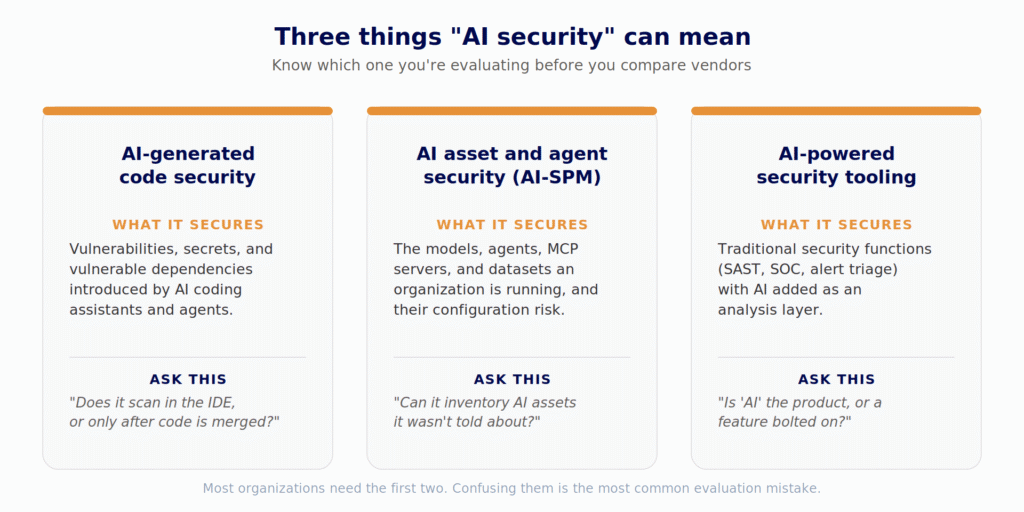
A tool built to secure models in production won’t catch a hallucinated package name in a pull request, and a code scanner won’t tell you an unapproved MCP server showed up in someone’s IDE last week.
The Buying Criteria That Actually Matter
Once you know which category you need, these are the questions worth asking every vendor on your shortlist, regardless of how their homepage describes them.
Red Flags Worth Walking Away From
A few patterns show up often enough in this category that they’re worth naming directly, without pointing at any specific vendor:
- “AI-powered” with no detail underneath. If a vendor can’t explain, in one sentence, what the AI actually does differently from a rule-based scanner, it’s a marketing label, not a capability.
- A framework badge with nothing behind it. Citing OWASP or NIST is easy. Ask for one concrete example, a real finding tied to a real category in that framework, not the full mapping, just one. If the vendor can’t produce a single example on the spot, the badge is decorative.
- Vagueness about where scanning happens. Ask directly: does our code ever leave our infrastructure during analysis? A vendor confident in its architecture answers in one sentence. A vendor that pivots to talking about encryption-in-transit, without answering the actual question, just told you the answer.
- A free tier that’s really a 14-day trial. A genuinely free developer tier, not a countdown timer, is a signal the vendor is confident enough to let the product speak first.
- Every capability is “coming soon.” A roadmap slide is not a product. Ask what’s shipping today, in writing.
What This Looks Like in Practice
Xygeni AI Security discovers the AI running across an organization- models, agents, MCP servers, and AI coding tools- from what they leave behind in code and configuration, not from a survey or a deployed agent. It generates an AI-BOM in standard CycloneDX ML-BOM format and maps findings to the OWASP LLM Top 10 and the NIST AI RMF. Xygeni DevAI runs inside the IDE as developers write code, human-written or AI-generated, and its AI Triage, AI Explanation, and AI Remediation apply equally to findings from Xygeni’s own scanners and to findings already sitting in the AppSec tools an organization has in place, which means adopting it doesn’t require replacing anything. Source code never leaves the customer’s environment, with support for bringing your own LLM contract where that matters.
If you’re weighing that against your own checklist above, the developer tier is free to start, and a broader look at how it fits alongside an existing ASPM program is available on the pricing page.
FAQ: Choosing an AI Security Company
What’s the difference between AI security and AI-SPM?
AI security is the broad category. AI Security Posture Management (AI-SPM) is a more specific term, recognized by Gartner as an emerging analyst category, for tools that discover and continuously assess the posture of an organization’s AI assets: models, agents, datasets, and their configuration risk, the same way CSPM does for cloud infrastructure.
Do I need a separate vendor for AI-generated code versus AI infrastructure?
Not necessarily, but you do need to confirm a single vendor actually covers both rather than assuming it does because the word “AI” appears twice on their homepage. Ask each specifically about IDE-level code scanning and about AI asset discovery; they’re different engineering problems.
Is a framework like the OWASP LLM Top 10 something a vendor can be “certified” in?
No. It’s a community-developed awareness standard, not a certification you pass. A vendor can map its detections to it, which is checkable, but “OWASP certified” isn’t a real claim, and should be treated as a small red flag on its own.
Does an AI-BOM satisfy a specific regulation?
Not by itself, and no regulation names an “AI-BOM” as a mandatory artifact today. It helps satisfy documentation expectations under frameworks like the EU AI Act’s technical-documentation requirements, but it’s evidence toward compliance, not a compliance checkbox.
Why does it matter if a vendor was recently acquired?
It’s not disqualifying; acquisitions can bring resources and staying power. But roadmaps, pricing, and support models often change after an acquisition, so it’s worth asking directly rather than assuming continuity.