Xygeni vs Aikido

The Aikido alternative: ​when developer-first isn't enough

Proprietary engines, the full platform on-premise and malware detection that starts before a signature exists.

See how Xygeni compares to Aikido on your own repositories.

Alternative to aikido

Five differences that matter

Where Xygeni goes further

Where others stop at the basics, Xygeni goes further: across deployment, supply-chain depth, multi-vendor ASPM, engineering ownership and smart prioritization.
01
Deployment freedom

Full platform on-premise (single-tenant). DAST runs inside your infrastructure with no internet exposure.

02
Supply chain depth

Behavioral malware at registry publication, extending across pipelines, containers, source-code commits.

03
Multi-vendor ASPM

Ingest findings from Snyk, Veracode, Checkmarx. Apply AI Triage, Explanation, Fix to all of them.

04
Engineering ownership

Proprietary native scanning engines (not OSS orchestration). One SLA, one roadmap, plus SLSA + in-toto + CBOM.

05
Smart Prioritization

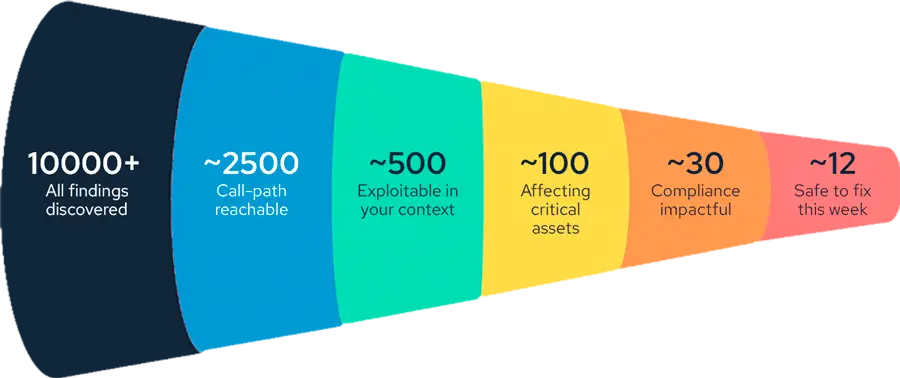
A business-aware funnel that narrows thousands of findings to the few that are reachable and exploitable.

What changes your workflow most

From thousands of findings to a few actions

Xygeni decides what to fix first and reduce the noise. 

After the funnel Remediation Risk method-level is applied: Xygeni analyzes the call graph and tells you which fixes will break which callers — before you apply them.

Side by side

Capability snapshot

Capability Aikido
Scanning engines ✅ Proprietary native engines ⚠️ OSS-based (Opengrep, Trivy, ZAP)
Pre-signature malware detection in the free plan ✅ MEW included in the free Developer plan ❌ Free plan relies on known signatures
Developer endpoint protection ✅ Packages, IDE extensions and plugins, plus network traffic, under one org policy. ⚠️ Package installs only
Full platform on-premise / single-tenant ✅ Full platform on-prem ⚠️ Local Scanner + cloud dashboard
DAST execution model ✅ On-prem capable, unlimited parallel ⚠️ Cloud-only (IP whitelist + internet exposure)
Bring Your Own AI Model ✅ Any LLM, including self-hosted ⚠️ Aikido's own LLM only
Pre-signature malicious package detection (MEW) ✅ Behavioral at registry publication ⚠️ Aikido Intel (feed-style)
Malware detection across the SDLC ✅ Pipelines + containers + commits ⚠️ Packages-focused
CI/CD pipeline security (integrity + provenance) ✅ Pipeline integrity, anomaly, SLSA + in-toto ⚠️ Scans in the pipeline, doesn't secure it
AI Triage + risk prioritization ✅ Triage on own + third-party findings + funnel + method-level ⚠️ Own scanners only, no third-party findings
Secrets auto-revocation + merge block ✅ Auto-revoke + merge block ⚠️ Detect & validate only
CBOM — Cryptography Bill of Materials ✅ Generated per release ❌ Not available

Competitor information is based on publicly available documentation, reviewed September 2026. Spotted something out of date? Let us know.

Differential

Deployment freedom without compromises.

Local scanners are not on-prem. Real on-prem runs the entire platform in your environment.
Component Aikido
Dashboard / Server ✅ Customer environment* ⚠️ Aikido cloud
Findings storage ✅ Customer environment ⚠️ Aikido cloud
DAST execution ✅ Customer infrastructure (no internet exposure) ⚠️ Aikido cloud (IP whitelist + domain verification)
AI / LLM inference ✅ Customer choice, including self-hosted ⚠️ Aikido infrastructure
AutoFix available offline ✅ Yes ❌ No (Local Scanner accounts lose AutoFix UI)

Differential

Supply chain depth beyond packages

Most attacks don't stop at the package. Neither does Xygeni.
Behavioral at publication
MEW — Malware Early Warning

Two-layer AI analysis at package registry publication. Catches malicious behavior before a signature exists — typosquatting, obfuscation, exfiltration patterns, dependency confusion.

Pipelines + containers + code
Malware across the SDLC

Detection extends to pipelines, container images, and source-code commits. Catches reverse shells in pipelines, malicious commands in build scripts, and tampered artifacts, not just bad packages.

Signed, traceable, post-quantum ready
Build integrity & provenance

Native SLSA and in-toto attestations for every build, plus a Cryptography Bill of Materials (CBOM) per release, so you know which cryptography you will need to migrate.

More than a dependency firewall

A dependency firewall checks packages. Xygeni Shield governs everything that reaches the developer machine.
Package Cooldown
Age-based install control

Packages, IDE extensions and plugins stay blocked until they reach the minimum age your policy sets.

Network Blocking
Network control

Traffic to malicious IPs and domains is blocked at the endpoint, and a compromised machine is isolated.

central policy
One policy for the whole organization

The security team sets allowed and denied components and authorized registries.

MEW Intelligence
Backed by MEW

Decisions use Xygeni’s pre-signature malware intelligence, not only known-bad feeds.

FAQs

Is Xygeni a good alternative to Aikido?

Yes, especially if you need the full platform on-premise, your own LLM or malware detection beyond packages. Xygeni uses proprietary scanning engines and runs the dashboard, findings, DAST and AI inference in your own environment.

Yes. On the Enterprise plan, the full platform runs on-premise, air-gapped or hybrid, including DAST and AI capabilities with a self-hosted model.

Any LLM: a commercial provider, a self-hosted model or Xygeni’s own. Data stays in your environment and usage stays on your contract.

MEW analyzes every new package behaviorally at registry publication, before a signature exists. Detection also covers pipelines, container images and source-code commits.

Yes. The free Developer plan includes MEW pre-signature malware detection.

See the difference on your own code

Bring the questions your Aikido evaluation left open. We will walk through them on your stack.

Recognized for Pioneering ASPM Solution
Top Software Composition Analysis Tool
Devops Dozen 2023 Finalist Home-min
Best DevSecOps Solution