



TL;DR
Most API breaches trace back to broken authorization, not exotic exploits. Three of the OWASP API Security Top 10's top five categories are authorization failures, led by BOLA.
You can't secure what you don't know exists. Improper inventory management is its own named OWASP risk category, and it's the foundation every other control depends on.
Catch exposure before deployment, not after. Static analysis of code and API specs finds a broken endpoint in a pull request, for the cost of one commit; runtime testing finds the same issue live, for the cost of an incident.
This is a checklist to run continuously. On every pull request, not a pre-launch review: 10 practices, from inventory and authorization to rate limiting, response data exposure, and third-party trust.
Your API attack surface grows with every pull request. Most teams only find out an endpoint is exposed once it’s live and taking traffic, which means the fix that would have cost one commit in review now costs an incident report. This guide walks through the API security best practices that actually hold up in production, organized as a checklist you can run against your own codebase today, not a list of abstract principles nobody implements.
Why API Security Best Practices Look Different Now
APIs used to be the connective tissue between systems. Now they’re the primary interface for nearly everything: mobile apps, partner integrations, AI agents, internal microservices. That shift changed what API protection best practices need to cover. It’s no longer enough to secure the API you documented; you have to account for the ones your teams built and forgot to write down.
Two numbers explain why this matters. The OWASP API Security Top 10 puts broken authorization issues in three of its top five categories, meaning most real-world API incidents trace back to a handful of preventable patterns, not exotic zero-days. And improper inventory management sits on that same list as its own named risk category: teams get breached through APIs they didn’t know were still running.
That’s the theme running through every item below. Good API management best practices start with knowing what you have, not just defending what you remembered to document.
API Security Best Practices at a Glance
Before the detailed checklist, here’s the short version: what to implement, what it actually protects against, and how urgently.
| Practice | What It Protects Against | Priority |
|---|---|---|
| HTTPS/TLS encryption | Data interception, man-in-the-middle attacks | Required |
| Authentication (OAuth 2.0, JWT) | Unauthorized access, identity spoofing | Required |
| Authorization and access control | Privilege escalation, data leakage | Required |
| Input validation | Injection attacks, malformed requests | Required |
| Complete API inventory | Undocumented and deprecated endpoints left exposed | Required |
| Rate limiting | Brute-force attacks, DDoS, abuse | High |
| API key management | Credential theft, unauthorized usage | High |
| Logging and monitoring | Undetected breaches, slow incident response | High |
| Static analysis before deployment | Exposure shipped to production before anyone reviews it | High |
| Security testing (SAST + DAST) | Unknown vulnerabilities, regressions | High |
Treat the “Required” row as the non-negotiable baseline for any API, internal or public-facing. The “High” priority items are what separates a program that catches problems in a pull request from one that finds out in an incident report.
The API Security Best Practices Checklist
1. Build a complete inventory before you build a defense
You cannot protect an endpoint you don’t know exists. Start every API protection best practices effort with a real inventory: every endpoint, its method, its path, the service and module it belongs to, and whether it requires authentication. Pull this from source code and from your API specifications (OpenAPI, Swagger) together, not from documentation alone, because the gap between the two is exactly where forgotten and orphaned endpoints hide.
Where Xygeni fits: Xygeni API Security builds this inventory directly from your application source code and API specs, surfacing the endpoints your team documented and the ones nobody did, before any of them reach production.
2. Enforce authorization at the object and function level
Broken object-level and function-level authorization consistently top the OWASP API Security Top 10. The best practice isn’t “add authentication”, it’s checking, on every request, whether this specific user is allowed to access this specific object, not just whether they’re logged in at all. Authentication answers who someone is. Authorization answers what they’re allowed to touch, and it needs to be checked every time, not assumed from a valid token.
3. Validate and sanitize everything the API receives
Every parameter, header, and body field is untrusted input until proven otherwise. Enforce strict schema validation, reject unexpected fields (this is your defense against mass assignment), and never trust client-supplied data to determine access scope or pricing logic.
4. Rate-limit and throttle by design, not as an afterthought
Unrestricted resource consumption lets a single client exhaust your infrastructure or run up costs on pay-per-use backend services. Set limits per endpoint, per user, and per API key, and make sure limits scale with the actual cost of the operation, not a flat number applied everywhere.
5. Treat every response as a potential data leak
Excessive data exposure happens when an API returns more than the client needs and relies on the frontend to filter it. That’s a habit, not a rare mistake, and it’s one of the most common API protection best practices violations because it’s invisible until someone inspects raw responses instead of the rendered UI.
Where Xygeni fits: Xygeni API Security flags PII exposure directly in API responses, catching over-sharing before it ships rather than after a customer, or a regulator, notices.
6. Keep an accurate, current API inventory, including the deprecated ones
Improper inventory management is its own named category on the OWASP list for a reason: deprecated API versions and undocumented staging environments are frequently still reachable, and frequently still vulnerable, long after anyone remembers they exist. An API management best practices program has to include decommissioning, not just discovery.
7. Scrutinize what your API trusts from third parties
Unsafe consumption of third-party APIs is an underrated risk. Developers tend to trust data coming from another API more than user input, which is exactly backwards; a third-party integration is still an external, unverified source and should be validated the same way.
8. Put evidence in front of developers, not just alerts
A finding that says “broken authorization on this endpoint” is a ticket someone has to investigate before they can even start fixing it. A finding that points to the exact file, class, method, and line is something a developer can act on immediately. This is a best practice for the security program itself, not just the API: findings that require investigation before remediation slow everything down.
Where Xygeni fits: every Xygeni API Security finding points to the exact handler, file, class, method, and the line that introduced it, so the fix starts the moment the finding lands.
9. Find exposure before deployment, not after
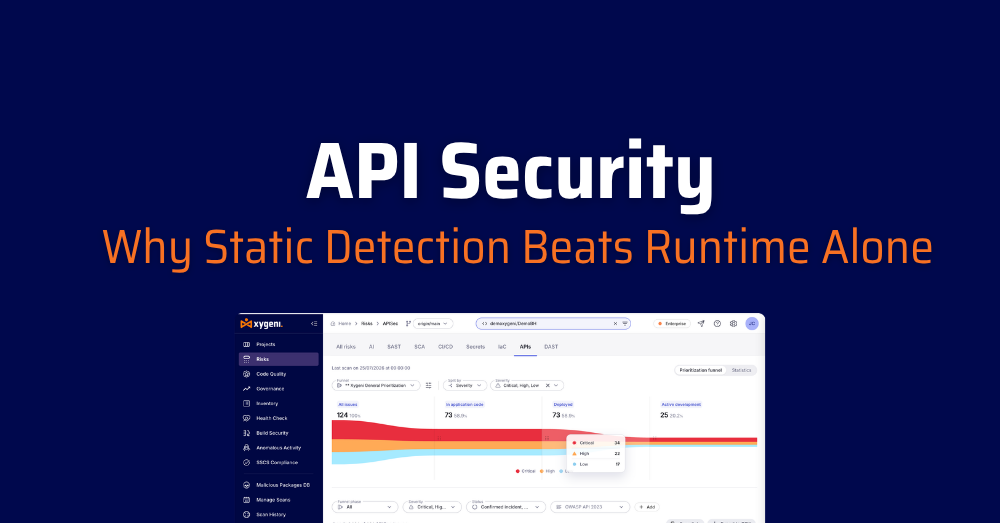
Runtime API testing tells you an endpoint is exposed once it’s already serving traffic. Static analysis of code and API specs finds the same exposure while it’s still sitting in a pull request, when the fix costs one commit instead of an incident response. The strongest API management best practices treat static discovery as the first layer, with runtime testing as a second, complementary check on what’s already live.
Where Xygeni fits: Xygeni API Security is static by design, analyzing code and specs before release, and works alongside Xygeni DAST for runtime coverage of applications already in production.
10. Keep API risk in the same place as the rest of your application risk
APIs don’t fail in isolation. An API vulnerability often sits downstream of a dependency issue, a misconfigured pipeline, or a leaked secret. Treating API security as a separate tool with its own console means losing that context exactly when it matters most.
Where Xygeni fits: API Security sits alongside SAST, SCA, Secrets, IaC, and DAST in a single Xygeni platform, so an API finding is visible next to the code and dependency risk that produced it, not in a separate login.
Turning the Checklist Into a Habit
API security best practices only work as a continuous practice, not a pre-launch review. Run inventory and static analysis on every pull request, not once a quarter. Treat a new, undocumented endpoint the same way you’d treat a new, undocumented dependency: as something to investigate immediately, not eventually. And measure your API protection best practices the same way you measure any other part of the SDLC, by how early you catch the problem, not just whether you caught it at all.
Quick Answers: API Security Best Practices Q&A
| Question | Answer |
|---|---|
| What's the most critical API security best practice? | Strong authentication and authorization, enforced on every single endpoint, not just the ones you remembered to secure. |
| Should internal APIs use HTTPS? | Yes. Encrypt all API traffic, including service-to-service communication, not just public-facing endpoints. |
| Are API keys enough for security? | No. API keys identify an application, not a user. Pair them with OAuth 2.0 or JWT for real authentication. |
| What is BOLA? | Broken Object Level Authorization: an API fails to verify that a user is allowed to access a specific resource. It has held the #1 spot on the OWASP API Security Top 10 since 2019. |
| How often should I rotate API keys? | Regularly, every 60 to 90 days, and immediately after any suspected compromise. |
| What status code should rate limiting return? | 429 Too Many Requests, with a Retry-After header telling the client when to try again. |
| Should I validate input on the server, even behind a gateway? | Always. Validate at the API layer regardless of what an upstream client or gateway already checked. |
| How can I test API security in CI/CD? | Check authentication, authorization, input validation, and rate limiting on every pull request, not just before a release, and automate it rather than relying on manual review. |
Key Takeaways
- Inventory comes before defense. You can’t apply authorization, rate limits, or data controls to an endpoint you don’t know exists, and improper inventory management is its own named risk on the OWASP API Security Top 10.
- Authorization, not just authentication, is where most breaches happen. Three of the top five OWASP API Security risks are authorization failures. Checking who someone is isn’t the same as checking what they’re allowed to touch.
- Static analysis catches what runtime testing catches too late. Finding exposure in a pull request costs one commit. Finding it in production costs an incident.
- Every response is a potential data leak. Excessive data exposure is a habit, not a rare mistake, and it’s invisible until someone inspects raw API responses instead of the rendered UI.
- API security best practices only work as a continuous habit, run on every pull request, not a quarterly review or a pre-launch checklist.
- API risk shouldn’t live in a separate tool. The most useful API protection best practices treat API findings as part of the same risk picture as code, dependency, and pipeline security, not an isolated console.
FAQ
What are the most important API security best practices to start with?
Start with inventory. You can’t apply authorization checks, rate limits, or data exposure controls to an endpoint you don’t know exists, so a complete, accurate inventory of every API endpoint is the foundation everything else in this checklist depends on.
What’s the difference between API security best practices and general application security best practices?
APIs introduce risks general AppSec practices don’t fully cover: object and function-level authorization at scale, the specific danger of trusting third-party API responses, and the challenge of tracking deprecated or undocumented endpoints. API security best practices are application security best practices, applied to the parts of the attack surface that are easiest to forget.
Should API security testing happen before or after deployment?
Both, but the highest-leverage point is before. Static analysis of code and API specifications catches exposure while it’s still a pull request. Runtime testing (DAST) then validates what’s actually reachable once the application is live. Relying on runtime testing alone means every fix costs more than it needed to.
How often should an API inventory be updated?
Continuously, ideally on every pull request. An inventory built once and reviewed quarterly is already out of date the moment a new endpoint ships, which is exactly the gap improper inventory management exploits.
Do API management best practices apply to internal APIs, not just public-facing ones?
Yes. Internal APIs are frequently held to a lower security bar because they “aren’t exposed to the internet”, but they still handle sensitive data and are still reachable by anyone with internal network access, including a compromised account or an insider.