
Cyber threats are any attempt to steal data, disrupt systems or gain unauthorized access by exploiting a weakness in people, processes or technology. Ask five security engineers to name the biggest one and you’ll get five answers, each describing the last incident that kept them up at night. Threat categories used to be simple: phishing, malware, a stolen password. Today, the attack surface includes the code your developers write, the open-source packages they import, the pipelines that build and ship that code, and the AI tools sitting inside the IDE itself.
This post breaks down the main types of cyber threats facing modern software organizations, grounded in how attacks actually happen across the software development lifecycle (SDLC), not in a generic list copied from a decade-old glossary.
The main cyber threats facing software teams today are:
- Supply chain malware
- Secrets leakage
- Dependency attacks (typosquatting, dependency confusion, slopsquatting)
- CI/CD and build pipeline attacks
- IaC misconfigurations
- AI-generated code risk
- AI agent and MCP threats
- Insider and maintainer compromise
Classic cyber threats such as phishing, ransomware and DDoS still matter, but most modern breaches of software organizations start inside the software supply chain.
Why classic cyber threat lists miss today’s risks
Most “types of cyber threats” content still treats security as a perimeter problem: firewalls, endpoints, phishing emails. That framing made sense when software was mostly built in-house and shipped slowly. It doesn’t hold up when:
- Applications are assembled from hundreds of open-source dependencies, any one of which can be compromised.
- Code moves through CI/CD pipelines that run with broad permissions and little human oversight.
- A growing share of code is AI-generated or AI-assisted, which changes both the volume and the nature of the flaws that ship.
Understanding today’s threats means understanding where in the software supply chain each one originates, not just what damage it eventually causes.
Common cyber threats: the classic types
These are the cyber threats most lists stop at. They still cause breaches every day.
| Threat | What it is | Example |
|---|---|---|
| Malware | Malicious software that damages systems or steals data | A trojan hidden in a fake software update |
| Ransomware | Malware that encrypts data and demands payment to release it | A hospital's files locked until a ransom is paid |
| Phishing and social engineering | Tricking people into handing over access or data | A fake login page sent from a "vendor" email |
| DDoS attacks | Flooding a service with traffic until it goes down | A botnet taking an online store offline |
| Man-in-the-middle | Intercepting traffic between two parties | Stealing session tokens on public Wi-Fi |
| SQL injection | Injecting database commands through user input | A login form that dumps the user table |
| Zero-day exploits | Attacks on a flaw the vendor has not patched yet | An exploit sold before any fix exists |
These cyber threats target the inbox, the endpoint and the network. Software organizations face a second set that starts much earlier, inside the code and the tools used to build it.
Each of these cyber threats, explained
1. Malware in the software supply chain
Supply chain malware is malicious code hidden in a component your software trusts: an open-source package, a GitHub Action, or a build artifact. It no longer arrives only through an infected email attachment. It increasingly arrives through an open-source package, a compromised GitHub Action, or a tampered build artifact. Attackers publish or hijack packages, inject backdoors and trojans into dependencies, and wait for developers to pull them in through routine install commands.
This is why software supply chain attacks have become one of the fastest-growing threat categories: they exploit trust. A developer trusts a package registry the same way they trust their own code editor, and attackers know it.
See the malicious packages we catch every week
The Malicious Code Digest breaks down real npm, PyPI and Maven attacks: how they hide, what they steal and how they were caught.
2. Secrets leakage
Secrets leakage is the exposure of passwords, API keys or tokens in source code, configuration files or CI/CD logs. It remains one of the most common and most preventable causes of breaches. GitGuardian found 28.65 million new secrets on public GitHub in 2025, up 34% in a year, and more than 64% of credentials confirmed valid in 2022 still worked in January 2026. Once a secret is committed, even to a private repository, it stays in version history long after anyone remembers it’s there.
3. Dependency and open-source risks
Dependency attacks exploit the way developers, and now AI coding assistants, choose and install open-source packages. Beyond known CVEs, they include:
- Typosquatting: publishing a malicious package with a name deceptively similar to a popular one.
- Dependency confusion: tricking a build system into pulling a public package instead of an intended internal one.
- Slopsquatting: registering a package name that an AI coding assistant hallucinates and recommends, so the “helpful” suggestion installs malware instead of a real library.
4. CI/CD and build pipeline attacks
Pipelines run at machine speed with elevated, often poorly scoped permissions and non-human identities that are rarely audited the way user accounts are. That combination makes them an efficient target: unauthorized code injection, dependency chain abuse, inadequate access controls, and compromised build artifacts are the risk categories called out explicitly in frameworks like NIST SP 800-204D and the OWASP Top 10 CI/CD Security Risks. A single compromised GitHub Action can run in thousands of pipelines before anyone notices.
5. Infrastructure as Code (IaC) misconfigurations
IaC misconfigurations are insecure settings in the templates that provision your infrastructure: Terraform, CloudFormation, Kubernetes and Helm. A public storage bucket, an open security group or a container running as root doesn’t stay a single mistake. It is copied to every environment, every time that template runs.
6. AI-generated code risk
AI-generated code risk is the security debt that comes from code written by AI coding assistants. Assistants reproduce the insecure patterns they learned from, including authentication and access control flaws, and they produce code faster than most review processes were designed to handle. They leak secrets too: GitGuardian found that commits co-authored with Claude Code leaked secrets at 3.2%, more than double the 1.5% baseline. The risk isn’t the AI tool itself; it’s the volume and speed of what reaches the repository.
7. AI agent and MCP-layer threats
As AI moves from autocomplete to autonomous agents with tool access, a new threat layer has opened up: prompt injection, tool poisoning (where an agent is tricked by a malicious tool description into taking unintended actions), and vulnerabilities in the Model Context Protocol (MCP) servers that connect agents to real systems. This layer is invisible to legacy AppSec and endpoint tools, because it lives inside the IDE and the agent’s own decision-making, not in a scanned file.
8. Insider threats and maintainer compromise
Insider threats and maintainer compromise come from people who already have trusted access. That covers a hijacked maintainer account, a new owner taking over a popular package, or an unreviewed change from a contributor nobody checked. That’s why tracking package ownership changes and maintainer reputation matters as much as scanning code.
The common thread across modern cyber threats
Look at the list above, and a pattern emerges. These cyber threats aren’t eight unrelated problems; they’re the same attack surface viewed from five layers of the SDLC: the code developers write, the dependencies they import, the pipelines that build and ship it, the AI models and agents now embedded in that workflow, and the developer environment itself. An attacker doesn’t need to breach all five. One weak layer is usually enough, which is exactly why treating these as isolated categories, with a separate tool bolted onto each one, leaves gaps between them.
How to detect these cyber threats from one platform
Xygeni secures all five of those layers from a single platform, rather than stitching together point tools for each cyber threat. Malware Defense detects malicious packages as soon as they are published, including zero-day malware with no known signature, which most scanners miss because they rely on existing detection rules. Secrets Security detects over 100 types of secrets and blocks them before they’re committed. CI/CD Security, Build Security and IaC Security harden pipelines and infrastructure templates. DevAI secures code as AI assistants write it, directly in the IDE. AI Security finds the models, agents, skills and MCP servers in your code and flags risks such as prompt injection and over-privileged tools. Shield protects the developer endpoint itself, blocking malicious packages and IDE extensions before they install.
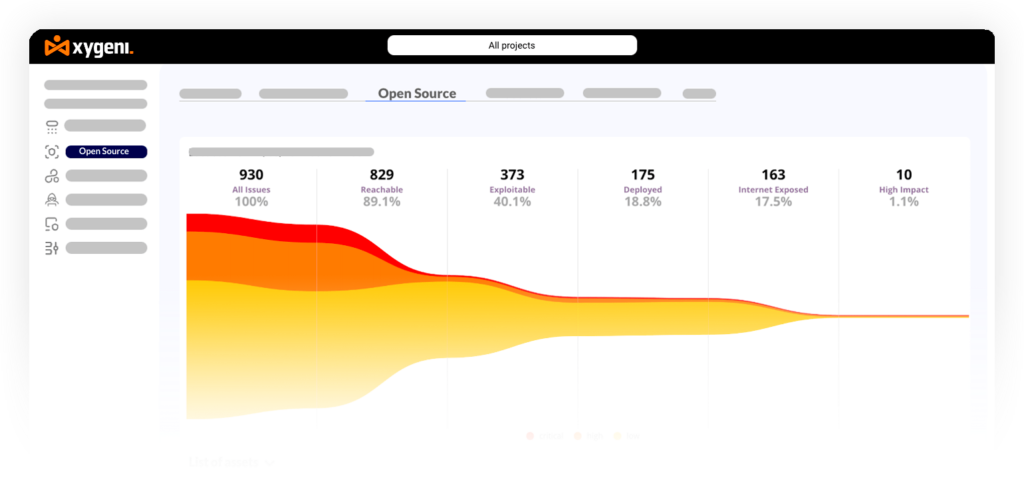
And because Xygeni’s ASPM layer ingests findings from third-party scanners too, the same AI-powered triage and prioritization applies whether a risk was found by Xygeni or by a tool you already run. The result is one prioritized view of what’s actually exploitable across code, dependencies, pipelines, AI tools and the developer environment. Keeping up with cyber threats isn’t about adding another tool for every new category; it’s about closing the gaps between the ones you already have.
FAQ
What’s the difference between a cyber threat and a vulnerability?
A vulnerability is a weakness, like an outdated dependency or a misconfigured pipeline. A cyber threat is the actual attempt to exploit that weakness. Software can have thousands of vulnerabilities and see zero threats against it, or one exploited vulnerability can cause a breach. Security teams that only count vulnerabilities miss which ones are actually being targeted.
What’s the most common type of cyber threat facing software teams right now?
Supply chain attacks and secrets leakage remain the two most common entry points, largely because they exploit routine developer behavior (installing a package, committing code) rather than requiring a sophisticated exploit. Attackers don’t need to break in if a trusted workflow lets them walk in.
How is AI changing the types of cyber threats security teams face?
AI adds two new threat surfaces rather than replacing the old ones. First, AI-generated code ships with more flaws than code written without assistance. Second, AI coding assistants and agents introduce entirely new attack patterns, like slopsquatting (malware planted under a package name an AI hallucinates) and tool poisoning against AI agents with MCP access. Both sit outside what legacy AppSec tools were built to catch.
Can a company defend against all these types of cyber threats with one tool?
Not with a single-purpose scanner, since each threat type (malware, secrets, dependency risk, pipeline attacks, AI code risk) tends to map to a different point tool. What closes the gap is a platform that covers the layers together and prioritizes findings across all of them, rather than eight separate alerts with no shared context.