

Ask five security engineers to define “cyber threat” and you’ll get five different answers, each describing the last incident that kept them up at night. That’s the problem. Threat categories used to be simple: phishing, malware, a stolen password. Today, the attack surface includes the code your developers write, the open-source packages they import, the pipelines that build and ship that code, and increasingly, the AI tools sitting inside the IDE itself.
This post breaks down the main types of cyber threats facing modern software organizations, grounded in how attacks actually happen across the software development lifecycle (SDLC), not in a generic list copied from a decade-old glossary.
Why old types of cyber threats don’t cover today’s risks
Most “types of cyber threats” content still treats security as a perimeter problem: firewalls, endpoints, phishing emails. That framing made sense when software was mostly built in-house and shipped slowly. It doesn’t hold up when:
- Applications are assembled from hundreds of open-source dependencies, any one of which can be compromised.
- Code moves through CI/CD pipelines that run with broad permissions and little human oversight.
- A growing share of code is AI-generated or AI-assisted, which changes both the volume and the nature of the flaws that ship.
Understanding today’s threats means understanding where in the software supply chain each one originates, not just what damage it eventually causes.
The main types of cyber threats security teams face today
| Threat Type | Where It Originates | Visible As |
|---|---|---|
| Supply chain malware | Package registries, CI/CD | Hijacked package, tampered build artifact |
| Secrets leakage | Source code, CI/CD logs | Hardcoded API key or token in a commit |
| Dependency risks | Package install, AI suggestions | Typosquat, dependency confusion, slopsquat |
| CI/CD & build attacks | Pipeline execution | Compromised GitHub Action, token theft |
| IaC misconfigurations | Terraform, Helm, K8s templates | Malicious command replicated at scale |
| AI-generated code risk | IDE, AI coding assistants | Auth/IAM flaws shipped faster than review |
| AI agent & MCP threats | Agent tool calls, MCP servers | Prompt injection, tool poisoning |
| Insider / maintainer compromise | Maintainer accounts, contributors | Unreviewed change, ownership transfer |
Each type of cyber threat, explained
1. Malware in the software supply chain
Malicious code no longer arrives only through an infected email attachment. It increasingly arrives through an open-source package, a compromised GitHub Action, or a tampered build artifact. Attackers publish or hijack packages, inject backdoors and trojans into dependencies, and wait for developers to pull them in through routine install commands.
This is why software supply chain attacks have become one of the fastest-growing threat categories: they exploit trust. A developer trusts a package registry the same way they trust their own code editor, and attackers know it.
2. Secrets leakage
Passwords, API keys, and tokens hardcoded into source code, configuration files, or CI/CD logs remain one of the most common and most preventable causes of breaches. Once a secret is committed to a repository, even a private one, it can persist in version history long after anyone remembers it’s there, and exposed secrets are frequently found still active days after leaking.
3. Dependency and open-source risks
Beyond known CVEs, this category includes attack patterns that specifically target how developers (and increasingly, AI coding assistants) select packages:
- Typosquatting: publishing a malicious package with a name deceptively similar to a popular one.
- Dependency confusion: tricking a build system into pulling a public package instead of an intended internal one.
- Slopsquatting: registering a package name that an AI coding assistant hallucinates and recommends, so the “helpful” suggestion installs malware instead of a real library.
4. CI/CD and build pipeline attacks
Pipelines run at machine speed with elevated, often poorly scoped permissions and non-human identities that are rarely audited the way user accounts are. That combination makes them an efficient target: unauthorized code injection, dependency chain abuse, inadequate access controls, and compromised build artifacts are the risk categories called out explicitly in frameworks like NIST SP 800-204D and the OWASP Top 10 CI/CD Security Risks. A single compromised GitHub Action can run in thousands of pipelines before anyone notices.
5. Infrastructure as Code (IaC) misconfigurations
Terraform, CloudFormation, Kubernetes, and Helm templates define how infrastructure gets provisioned, which means a malicious or careless command in an IaC file doesn’t just describe a mistake; it replicates it at scale, every time that template runs.
6. AI-generated code risk
AI coding assistants write a growing share of production code, and that code carries measurably more flaws than code written without assistance, including authentication and identity-and-access-management issues. The risk isn’t the AI tool itself; it’s that AI-assisted code ships faster than most review processes were designed to handle.
7. AI agent and MCP-layer threats
As AI moves from autocomplete to autonomous agents with tool access, a new threat layer has opened up: prompt injection, tool poisoning (where an agent is tricked by a malicious tool description into taking unintended actions), and vulnerabilities in the Model Context Protocol (MCP) servers that connect agents to real systems. This layer is invisible to legacy AppSec and endpoint tools, because it lives inside the IDE and the agent’s own decision-making, not in a scanned file.
8. Insider threats and maintainer compromise
Not every threat is external. Compromised maintainer accounts, unauthorized privilege use, and unreviewed changes from trusted contributors account for a meaningful share of breaches, which is why tracking package ownership changes and maintainer reputation matters as much as scanning code.
The common thread across these types of cyber threats
Look at the list above, and a pattern emerges. These types of cyber threats aren’t eight unrelated problems; they’re the same attack surface viewed from five layers of the SDLC: the code developers write, the dependencies they import, the pipelines that build and ship it, the AI models and agents now embedded in that workflow, and the developer environment itself. An attacker doesn’t need to breach all five. One weak layer is usually enough, which is exactly why treating these as isolated categories, with a separate tool bolted onto each one, leaves gaps between them.
From eight alerts to one prioritized view
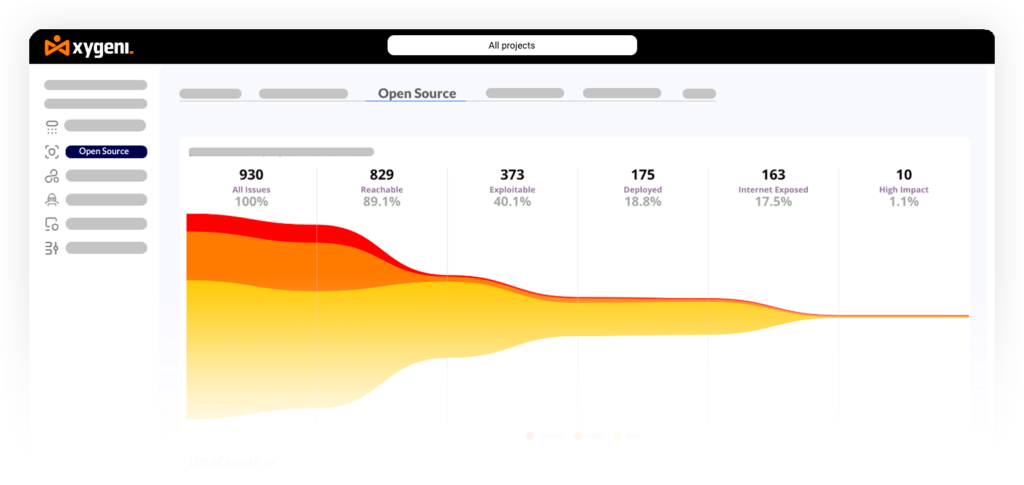
Xygeni secures all five of those layers from a single platform, rather than stitching together point tools for each threat type. Xygeni’s Malware Defense detects malicious packages and pipeline tampering in real time, including zero-day threats that don’t yet have a known signature, a capability most scanners can’t offer because they rely on matching against existing detection rules. Secrets Security scans for over 100 types of secrets and blocks them before they’re committed. CI/CD and Build Security harden pipelines against unauthorized code injection and unsafe IaC commands. DevAI secures code as AI assistants write it, directly in the IDE, without adding prompts or friction to the developer’s workflow. And because Xygeni’s ASPM layer ingests findings from third-party scanners too, the same AI-powered triage and prioritization applies whether a risk was found by Xygeni or by a tool you already run, so consolidating visibility doesn’t mean ripping anything out.
The result is one prioritized view of what’s actually exploitable across code, dependencies, pipelines, AI tools, and the developer environment, instead of eight disconnected alerts fighting for attention. Keeping up with these types of cyber threats isn’t about adding another tool for every new category; it’s about closing the gaps between the ones you already have.
FAQ
What’s the difference between a cyber threat and a vulnerability?
A vulnerability is a weakness, like an outdated dependency or a misconfigured pipeline. A cyber threat is the actual attempt to exploit that weakness. Software can have thousands of vulnerabilities and see zero threats against it, or one exploited vulnerability can cause a breach. Security teams that only count vulnerabilities miss which ones are actually being targeted.
What’s the most common type of cyber threat facing software teams right now?
Supply chain attacks and secrets leakage remain the two most common entry points, largely because they exploit routine developer behavior (installing a package, committing code) rather than requiring a sophisticated exploit. Attackers don’t need to break in if a trusted workflow lets them walk in.
How is AI changing the types of cyber threats security teams face?
AI adds two new threat surfaces rather than replacing the old ones. First, AI-generated code ships with more flaws than code written without assistance. Second, AI coding assistants and agents introduce entirely new attack patterns, like slopsquatting (malware planted under a package name an AI hallucinates) and tool poisoning against AI agents with MCP access. Both sit outside what legacy AppSec tools were built to catch.
Can a company defend against all these types of cyber threats with one tool?
Not with a single-purpose scanner, since each threat type (malware, secrets, dependency risk, pipeline attacks, AI code risk) tends to map to a different point tool. What closes the gap is a platform that covers the layers together and prioritizes findings across all of them, rather than eight separate alerts with no shared context.