This is a guest post by Mohammad-Ali A'râbi, Docker Captain and author of "Docker and Kubernetes Security".
TL;DR
- October brought four big incidents: two runtime flaws that can lead to remote code execution (PHP2Shell in PHP, Node2Shell in Node.js) and two malicious releases (LiteLLM and Shai-Hulud via Tensorlake).
- The next one can hit any ecosystem: the goal is to be ready before the next CVE or supply chain worm, not to react after it.
- Five controls cover the path from laptop to release: isolate AI agents and builds in a sandbox, add a 5-day cooldown to new dependencies, harden and patch runtime images, generate SBOMs and provenance attestations, and make release checks fail on High and Critical issues.
- No single control is enough: hardening limits the damage but doesn't replace patching, and valid provenance doesn't prove a release is clean.
The internet is still smoldering. 🔥 PHP2Shell, Node2Shell, LiteLLM, Shai-Hulud. October (or should I call it Hacktober?) was generous with incident names. Cybersecurity Awareness Month is over, but the supply-chain security lessons aren’t.
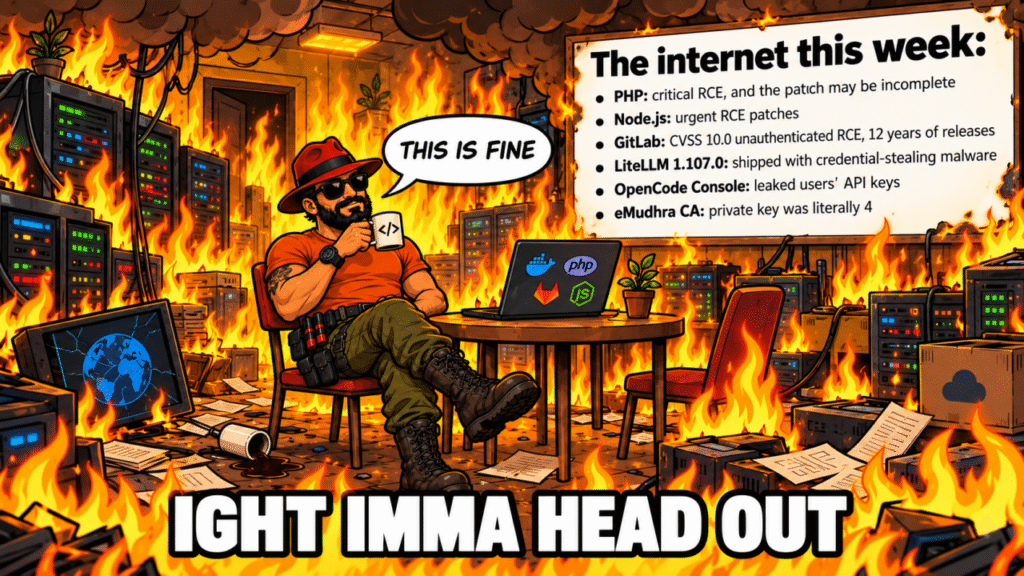
These incidents showed that the next CVE or supply-chain worm can hit any ecosystem. We need to prepare ourselves for the next Java2Shell or Rust4Shell.
What the Hell Happened?
On October 21, PHP2Shell brought two critical PHP runtime vulnerabilities: CVE-2026-109618, involving out-of-memory corruption, and CVE-2026-109619, involving stale state between requests. Both can lead to remote code execution (RCE).
The same day’s Node.js fixes included Node2Shell, the informal name used for the Brotli decoder issue, CVE-2026-111497. Crafted compressed input can trigger an out-of-bounds write and potentially remote code execution when decoded. Node.js rates it High. Exposure depends on whether an application processes that input through the affected decoder; merely running a Node.js server doesn’t establish exploitability.
Meanwhile, LiteLLM’s release pipeline was compromised. Its maintainers confirmed that litellm==1.107.0 wheels and official container images shipped credential-stealing malware and a remote-code loader. Malicious Python startup files could execute without an application importing LiteLLM. The legitimate source tag didn’t contain those files. The compromised artifacts were pulled, but environments that ran them still need investigation and credential rotation.
Earlier, on October 8, Shai-Hulud reached tensorlake@0.5.144. Tensorlake’s advisory describes a compromised maintainer account, a malicious preinstall hook, credential theft, and propagation through stolen tokens. The poisoned release went through the project’s own workflow and carried valid npm provenance.
Two runtime flaws. Two malicious releases.
Five Controls, Applied Where They Matter
So, what should we do before the next CVE or worm hits?
My Security Immediate Plan (SIP) follows the path from local agents to dependencies, container builds, attestations, and release checks. It’s a supply-chain security starter pack. Let’s check it out.
1. Isolate Agents, Installs, and Builds
Run local AI agents in an isolated environment. For the Juggernaut AI agents, I want a separate kernel and explicit controls over what they can reach. Docker Sandboxes provide that microVM boundary:
sbx run –name secure-agent claude
Sandbox Kits package the tools together with their network and credential requirements. In my Sandbox Kits tutorial, I also explain “Authority as Code”. It basically means that you can define what the agent can do in the sandbox, and what it cannot, through written text:
capabilities:
  - type: com.docker.sandbox/network-policy@2
    config:
      runtime:
        allow:
          - github.com
          - hosts: [api.github.com]
            methods: [GET, HEAD, POST, PATCH, PUT, DELETE]
          - hosts: [uploads.github.com]
            methods: [POST, PUT]
        deny:
          - hosts: [api.github.com]
            methods: [DELETE]
            paths: [/repos/**]
Would this have kept you safe from LiteLLM?
- Host credentials: The sandbox, by default, only mounts the project files. So, the host credentials were out of reach. Also, sbx keeps tokens out of the AI agent’s reach and injects them into the outbound requests.
- Exfiltration and remote loading: To exfiltrate data or load a remote payload, the malicious process needs a network path. A policy denying the attacker’s destinations would block those connections.
- Workspace and application secrets: Mounted .env files, credentials supplied directly, and accessible databases would remain exposed. Writable project files could also be poisoned for later execution on the host. Review changes before using them outside the sandbox.
2. Be Cool for Five Days
Xygeni’s npm worm playbook mentions SIP and the 5-day cooldown as an effective defense against the Shai-Hulud worms. That still holds true.
On npm versions supporting min-release-age, put a five-day cooldown in the project’s .npmrc:
min-release-age=5
ignore-scripts=true
If you need to exclude a package from the cooldown, e.g., in the case of a zero-day attack, you can exclude it from the min-release-age settings:
min-release-age-exclude=handlebars
Commit and review the lockfile, then use npm ci –ignore-scripts in CI. The flag –ignore-scripts protects you from lifecycle scripts running before or after the installation of packages. Most of the Shai-Hulud worms use these scripts to infest your machine.
Note. Not all worms use lifecycle scripts. One example is Phantom Gyp. Read The Shai-Hulud Family for more details.
Xygeni’s Malware Early Warning monitors public registries for suspicious releases and notifies affected users; its CI/CD guardrails can block flagged components. That gives dependency review another signal alongside version pinning and cooldowns.
And yet again, if you run your development environment in a sandbox, the blast radius is limited.
3. Harden the Image. Patch the Runtime.
Use multi-stage builds to leave build tools out of production, and a minimal, non-root runtime image. Restrict capabilities, filesystem writes, and outbound traffic to what the service needs:
docker run --rm \
  --read-only \
  --tmpfs /tmp \
  --cap-drop ALL \
  --security-opt no-new-privileges:true \
  my-node-app:patched
The Docker Hardened Images (DHI, catalog at dhi.io) are a set of open-source, secure-by-default base images that come in two shapes:
- Prod images: They are non-root, with no package manager, and shell-less. E.g., dhi.io/php:8.5.12.
- Dev images: They are designed to be used in earlier stages, when you need a package manager and root access. E.g., dhi.io/php:8.5.12-dev.
The DHI also has near-zero CVEs by default. Near-zero CVEs don’t mean near-zero zero-days.
And no shell doesn’t mean no RCE. Compromised code still has the process’s access to application data, credentials, and networking. Removing /bin/sh is useful. It is not an exorcism.
Hardening reduces the blast radius, but it doesn’t replace patching.
If you’re still running an affected PHP or Node.js version, patch it now. These are the first fixed versions from October 21:
| Incident | Runtime branch | Patched version | Official image | DHI runtime image |
|---|---|---|---|---|
| PHP2Shell | PHP 8.2 | 8.2.35 | php:8.2.35-fpm | dhi.io/php:8.2.35-fpm |
| PHP2Shell | PHP 8.3 | 8.3.36 | php:8.3.36-fpm | dhi.io/php:8.3.36-fpm |
| PHP2Shell | PHP 8.4 | 8.4.27 | php:8.4.27-fpm | dhi.io/php:8.4.27-fpm |
| PHP2Shell | PHP 8.5 | 8.5.12 | php:8.5.12-fpm | dhi.io/php:8.5.12-fpm |
| Node2Shell | Node.js 22 | 22.23.4 | node:22.23.4 | dhi.io/node:22.23.4 |
| Node2Shell | Node.js 24 | 24.22.1 | node:24.22.1 | dhi.io/node:24.22.1 |
| Node2Shell | Node.js 26 | 26.12.1 | node:26.12.1 | dhi.io/node:26.12.1 |
4. Record What You Built, Then Check the Evidence
Generate SBOM and provenance attestations:
docker buildx build \
  --sbom=true \
  --provenance=mode=max \
  --push \
  -t registry.example.com/my-app:1.0 .
The SBOM attestations can help you answer, “Am I affected?”
In the case of PHP2Shell:
docker scout sbom my-php-app:latest --format list | grep -i php
If you have an SBOM attestation, Docker Scout picks it up and doesn’t need to scan through your whole image. And SBOM attestations are text files at the end of the day, so you can check them with your tool of choice, even jq!
5. Make Release Checks Enforceable
Scan the SBOM attached to the exact release image digest and make policy violations fail CI. SIP starts with blocking fixable Critical CVEs, but Node2Shell shows why that threshold alone is insufficient: Node.js rated the flaw High. So, better block High as well.
Conclusion
| SIP step | How it could have helped | What it wouldn't do |
|---|---|---|
| 1. Sandbox | Contain LiteLLM and Tensorlake execution; protect unshared host credentials and block connections to denied destinations. | Protect shared secrets or prevent abuse of permitted API access. |
| 2. Freeze dependencies | Delay the poisoned Tensorlake release; block its preinstall hook with --ignore-scripts. | Stop LiteLLM's Python startup hooks with npm settings. |
| 3. Harden runtimes | Limit privileges, tools, writes, and egress after PHP2Shell or Node2Shell exploitation. | Fix either runtime vulnerability. Patching is still required. |
| 4. Generate attestations | Locate affected components through SBOMs; check LiteLLM's artifact origins against the expected source and builder. | Certify clean code: Tensorlake's malicious release had valid provenance. |
| 5. Enforce release checks | Block affected PHP and Node.js images once vulnerability data is available, including High severity; reject known malicious releases through malware checks or deny rules. | Detect every malicious package through CVE scanning alone. |
Limit the damage. Patch the bugs. SIP before you ship. ☕🐳
About the author

Mohammad-Ali A'RÂBI
Mohammad-Ali A'râbi is a software engineer, Docker Captain, public speaker, meetup organizer, and author of "Docker and Kubernetes Security."
FAQs
What are supply chain security controls?
Supply chain security controls are the safeguards that protect everything your software depends on and passes through, from the dependencies you install and the AI agents that write code, to the images you build and the releases you ship. They include sandboxing, dependency cooldowns, hardened images, SBOMs and provenance attestations, and enforceable release checks.
How does a dependency cooldown protect against npm worms like Shai-Hulud?
A cooldown, such as min-release-age=5 in your .npmrc, stops your projects from installing package versions published in the last five days. Malicious releases are usually detected and pulled within that window, so you avoid installing them. Combined with –ignore-scripts, it also blocks the install scripts many worms use to run on your machine.
Does valid provenance mean a package is safe?
No. Provenance proves where and how a package was built, not that its code is clean. The malicious Tensorlake release went through the project’s own workflow and carried valid npm provenance. That’s why provenance needs to be combined with malware checks and release policies that can block known malicious versions.