



An SQL injection vulnerability is still one of the most common and dangerous flaws in web applications, even decades after it was first documented. Attackers inject malicious SQL into a query and the database executes it as if a developer had written it. Without the right SAST tool for SQL injection vulnerability detection in place, that flaw can sit in a codebase for years before anyone finds it, usually because an attacker finds it first.
This guide covers how SQL injection vulnerabilities happen, why SQL injection vulnerability prevention still needs both automated tooling and secure coding discipline, and how a SAST tool fits into that picture from the first line of code.
What Is an SQL Injection Vulnerability?
An SQL injection vulnerability occurs when user input is inserted directly into a database query instead of being handled as data. Take a login form that builds its query by concatenating a username and password straight into the SQL string. An attacker who enters admin' OR '1'='1 as the username changes the logic of the query itself, and the database returns a match regardless of the real password. That single unescaped input bypasses authentication entirely.
This is exactly the class of bug a SAST tool for SQL injection vulnerability detection is built to catch: unsanitized input flowing into a query, visible in the source code before it ever reaches a database.
Why Use a SAST Tool for SQL Injection Vulnerability Detection?
A Static Application Security Testing (SAST) tool scans source code to find insecure patterns, including the unsanitized input that leads to SQL injection, before that code ever reaches production. That timing is what separates SQL injection vulnerability prevention from SQL injection incident response.
Benefits of Using a SAST Tool for SQL Injection Vulnerability Prevention
- Early detection: findings surface while the application is still being built, not after it ships.
- Detailed remediation: actionable guidance toward fixes like parameterized queries, instead of just a flagged line number.
- CI/CD integration: vulnerabilities get caught on commit or build, inside the workflow developers already use.
- Low false positive rate: a tool that buries real SQL injection findings in noise gets ignored. Precision is what keeps a SAST tool for SQL injection vulnerability detection actually useful day to day.
Real-World Examples of SQL Injection Attacks
SQL injection has caused some of the largest data breaches on record, and it is still doing damage today. Below are notable examples, from most recent to oldest:
- Metabase (2026): attackers exploited an SQL injection flaw in the analytics platform Metabase’s password-reset endpoint, gaining full administrator access with a single unauthenticated request. The breach reached at least five downstream companies through exposed database credentials connected to the platform.
- BeyondTrust and the US Treasury (2025): a SQL injection flaw in PostgreSQL, tracked as CVE-2025-1094, was exploited to breach BeyondTrust’s Remote Support platform. The intrusion chain reached the US Treasury Department, showing how a single unsanitized input in a widely used database interface can cascade into a government-level incident.
- TalkTalk (2015): an SQL injection attack exposed personal details for nearly 157,000 customers, including financial information, resulting in substantial fines and lasting reputational damage.
- Yahoo (2014): attackers used SQL injection to steal over 500 million user records, one of the largest breaches in history at the time.
- Yahoo! Voices (2012): a separate SQL injection attack leaked roughly 500,000 email addresses and passwords, exposing gaps in database protection.
- Sony Pictures / PlayStation Network (2011): SQL injection gave attackers access to around 77 million PlayStation Network accounts, with damages estimated at $170 million.
- Heartland Payment Systems (2008): SQL injection exposed approximately 130 million credit and debit card numbers in one of the largest breaches of its time.
The pattern across nearly two decades is the same: one unsanitized input, one query, and the entire dataset behind it becomes reachable. That is exactly why SQL injection vulnerability prevention has to be built into development, not bolted on after deployment. SQL injection sits alongside cross-site scripting as one of the injection-class vulnerabilities that a SAST tool needs to catch by default, not as an afterthought.
SQL Injection Vulnerability Prevention: Best Practices
Preventing SQL injection takes a combination of secure coding practices and automated tooling. These five practices form the core of any SQL injection vulnerability prevention strategy:
- Use parameterized queries. Replace dynamic SQL with parameterized queries so user input is always treated as data, never as executable code. A placeholder-based query (
WHERE username = ? AND password = ?) cannot be reinterpreted by attacker input the way a concatenated string can. - Validate inputs. Reject inputs that do not match the expected format, and watch for characters commonly used in injection attempts, like unescaped single quotes or semicolons.
- Escape special characters. When parameterized queries are not an option, escaping neutralizes characters attackers rely on. Treat this as a fallback, not a primary defense.
- Limit database permissions. Apply least privilege so the account your application uses can only reach the data and operations it actually needs. A compromised query is far less damaging against a restricted account.
- Use a SAST tool. Automate SQL injection vulnerability detection with a SAST tool that scans source code continuously and flags unsanitized queries before they reach a pull request, let alone production.
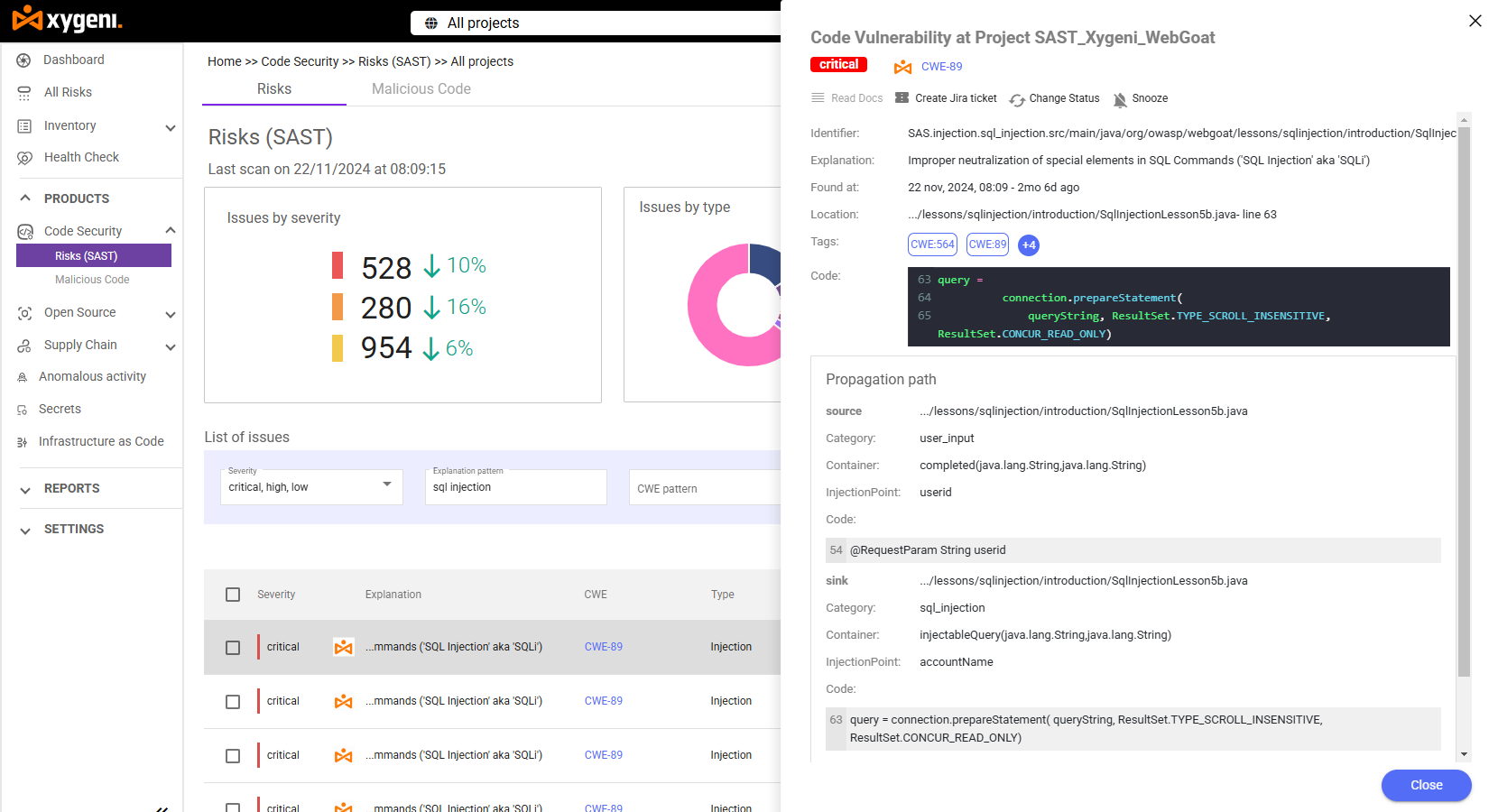
How Xygeni-SAST Prevents SQL Injection Vulnerabilities
Xygeni-SAST combines deep static analysis with a low false positive rate, so SQL injection vulnerability prevention does not come at the cost of alert fatigue.
- Advanced query analysis: identifies unsafe SQL query patterns, including concatenated strings with unsanitized input, and flags missing safeguards like parameterized queries or input validation.
- Proven detection accuracy: in the OWASP Benchmark, the industry standard for evaluating Application Security Testing tools, Xygeni-SAST achieved a 100% True Positive Rate for SQL Injection (CWE-89), meaning it missed zero known SQL injection test cases in the benchmark.
- AI AutoFix: instantly remediates issues like SQL injection and cross-site scripting with developer-ready fixes, generating pull requests with secure code suggestions aligned with language best practices.
- Seamless CI/CD integration: runs in real time inside your development pipeline, catching SQL injection vulnerabilities before deployment rather than after.
- IDE integration: view issue details, severity, and remediation guidance directly in your editor as you write the query, not after you commit it.
FAQ
What is the best way to prevent SQL injection?
The strongest SQL injection vulnerability prevention combines parameterized queries in your code with a SAST tool that continuously scans for unsanitized input patterns. Manual code review alone misses too much at the speed modern pipelines ship code.
Can a SAST tool fully replace secure coding practices?
No. A SAST tool for SQL injection vulnerability detection catches what is already in the code, but parameterized queries, input validation, and least-privilege database permissions reduce how often unsafe patterns get written in the first place. The two work together.
Why do SQL injection breaches still happen if the fix is well known?
Parameterized queries have been the standard fix for years, but existing codebases accumulate legacy queries that never get revisited until a breach forces the issue. Continuous SAST scanning closes that gap by flagging unsanitized queries on every commit, not just during a periodic audit.
Does a low false positive rate matter for SQL injection detection specifically?
Yes. SQL injection findings that get lost in a long list of false positives are the ones that make it to production. A SAST tool with a low false positive rate keeps SQL injection vulnerability prevention actionable instead of overwhelming.
Protect Your Applications with Xygeni-SAST
SQL injection vulnerabilities are preventable with the right SAST tool and the right practices in place. Start a free trial of Xygeni-SAST today, or explore how it fits alongside SCA and open source security in the full Xygeni platform. Book a demo or take the product tour to see it on your own code.