
Knowing how to avoid malware has stopped being a checklist item and become a daily discipline for anyone shipping software. Open-source dependencies, CI/CD pipelines, and now AI coding assistants all give attackers new entry points into your supply chain. A modern malware prevention strategy has to cover all three, not just the code your team writes by hand.
This guide walks through the seven steps that make up an effective malware prevention approach today: from real-time detection and CVE checks to the newest risk on the list, malware introduced through AI-generated code and AI coding agents.
What “Avoiding Malware” Actually Means in a Software Supply Chain
Malware prevention in application security is not one control. It is layered coverage across four places attackers actually operate:
- Open source dependencies: malicious packages published to npm, PyPI, Maven, and other registries, often before any antivirus signature exists for them.
- Application code: backdoors, trojans, and obfuscated logic hidden inside first-party or contributed code.
- CI/CD pipelines: reverse shells, malicious downloads, and unauthorized pipeline changes that run with far more privilege than a laptop ever gets.
- AI-assisted development: packages hallucinated by AI coding assistants and then registered by attackers before a developer accepts the suggestion.
Each layer needs its own detection logic. That is the core idea behind how to avoid malware at the organizational level: no single scanner covers all four.
How to Avoid Malware: 7 Key Steps
| Step | Action | Why It Matters |
|---|---|---|
| 1 | Adopt real-time malware detection | Stops zero-day threats before a signature exists. |
| 2 | Scan open source dependencies and run CVE checks | Surfaces known and hidden vulnerabilities in libraries. |
| 3 | Secure your CI/CD pipeline | Blocks malware from entering during builds and deployments. |
| 4 | Watch for malware risk in AI-generated code | Closes the newest entry point: hallucinated and slopsquatted packages. |
| 5 | Maintain full visibility across your AppSec stack | Removes blind spots between native and third-party tools. |
| 6 | Align with emerging regulation (NIS2, DORA, EU AI Act) | Turns compliance pressure into a forcing function for hygiene. |
| 7 | Train developers and teams | Reduces the human error that most attacks still rely on. |
1. Adopt Real-Time Malware Detection
Traditional security tooling depends on known signatures, which means it only catches malware after someone else has already been hit by it. Zero-day threats do not wait for a CVE to be filed.
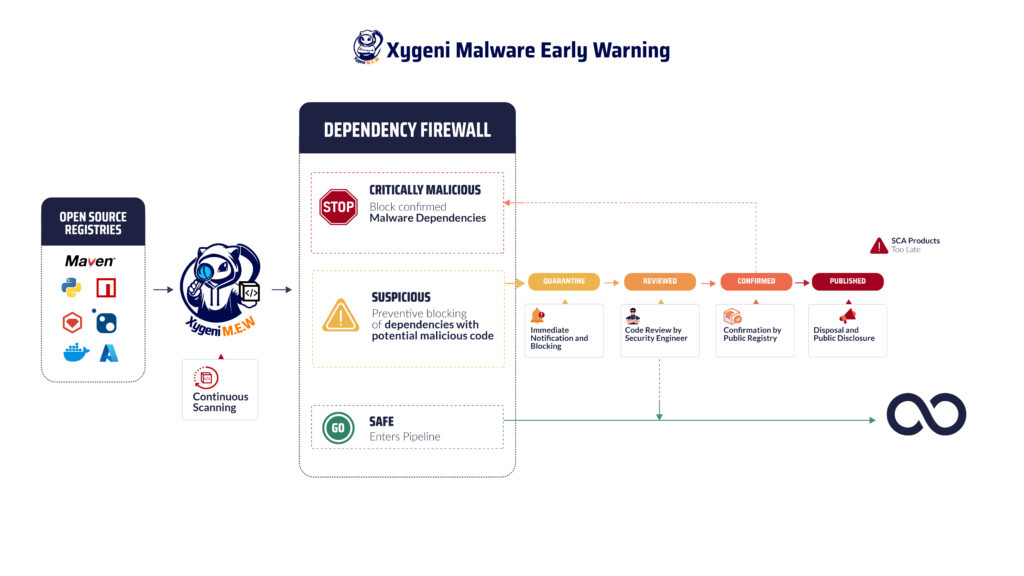
Xygeni’s Early Warning System closes that gap. It continuously scans public registries like NPM, PyPI, and Maven and flags malicious packages the moment they are published, using its own malware intelligence rather than waiting for a public signature. This is what a real-time malware prevention strategy actually requires: detection that runs at publication speed, not audit speed.
2. Scan Open Source Dependencies and Run CVE Checks
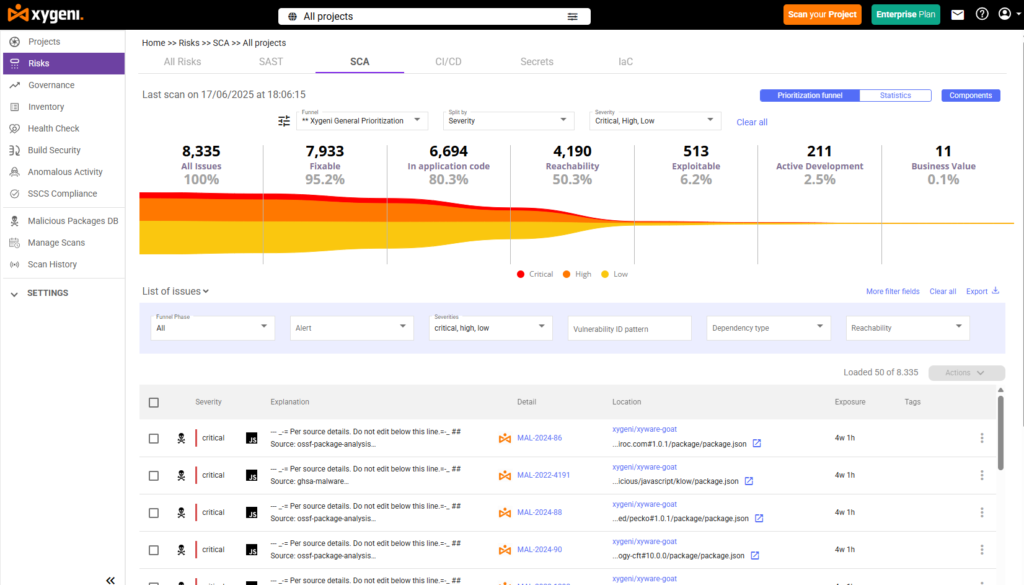
A CVE check, meaning a scan against the Common Vulnerabilities and Exposures database, is a baseline step in any malware prevention program. It is also, on its own, not enough. CVE checks only cover vulnerabilities that have already been disclosed, which leaves a window open for anything newer or less visible.
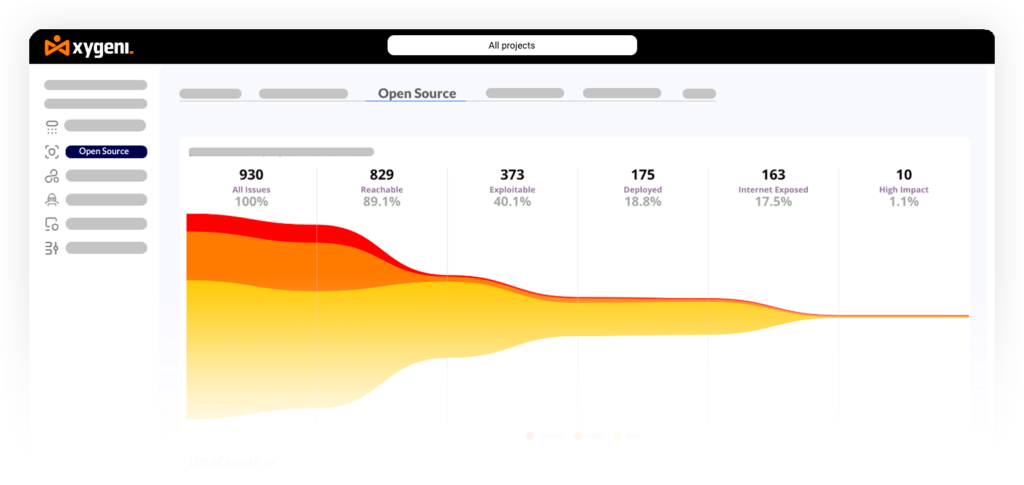
Xygeni’s Software Composition Analysis goes further by combining CVE checks with reachability and exploitability analysis, so your team prioritizes the vulnerabilities that are actually reachable in your code rather than chasing every entry in a feed. That context is what turns a long vulnerability list into a manageable one.
3. Secure Your CI/CD Pipeline
A pipeline runs with more privilege and less human oversight than any laptop, which makes it a high-value target. Xygeni’s CI/CD Security and Anomaly Detection watch for the behaviors attackers actually use: reverse shell attempts, malicious downloads mid-build, unsafe Infrastructure as Code commands in Terraform or Kubernetes configs, and unauthorized changes to build scripts or branch protections.
Build Integrity, based on SLSA and in-toto, adds provenance to the artifacts your pipeline produces, so you can verify what actually built a given release and catch tampering between commit and deployment. Pipeline security is where a lot of malware prevention plans stop short, and it is exactly where attackers have moved.
Protect Your Open Source Dependencies from Malware
Discover proactive strategies to secure your open-source software from malware threats. Download our whitepaper for essential insights on malware protection.
4. Watch for Malware Risk in AI-Generated Code
This is the newest line item in how to avoid malware, and it deserves its own step rather than a footnote. AI coding assistants sometimes recommend packages that do not exist. Attackers watch for these hallucinated names and register them on public registries ahead of time, a technique known as slopsquatting. A developer who accepts the AI’s suggestion without checking installs whatever the attacker put there.
The scale of this is not theoretical. A peer-reviewed USENIX Security 2025 study analyzed 2.23 million code samples across 16 large language models and found that 19.7% of recommended packages did not exist, producing more than 205,000 unique hallucinated package names. Worse, 43% of those hallucinated names recurred consistently across repeated prompts, which means they are predictable enough for an attacker to farm in advance.
Xygeni’s MEW (Malware Early Warning) validation applies regardless of whether a package was requested by a human developer or suggested by an AI coding assistant: it checks new and existing packages against Xygeni’s own malware intelligence before they are trusted in a build. On the code side, Xygeni’s DevAI flags vulnerabilities in both human-written and AI-generated code directly in the IDE, so issues introduced by an AI suggestion surface before the code ships, not after.
tus nec ullamcorper mattis, pulvinar dapibus leo.
5. Maintain Full Visibility Across Your AppSec Stack
You cannot prevent malware in components you cannot see. Most organizations run more than one scanner today, often a mix of native tools and third-party point solutions. Xygeni’s ASPM (Application Security Posture Management) layer unifies findings across native scanners and third-party tools into one risk view, and applies the same AI-powered triage, explanation, and prioritization to all of them, not just the findings Xygeni’s own scanners produce. That matters for malware prevention specifically: a malicious dependency flagged by one tool and a suspicious pipeline change flagged by another are easier to connect when they sit in the same view.
6. Align Malware Prevention with Emerging Regulation
Regulations like NIS2, DORA, and the EU AI Act are pushing supply chain security from a best practice into a compliance requirement, particularly around third-party software and vulnerability disclosure. Xygeni supports continuous monitoring, risk management, and reporting that map to these frameworks, which means the same malware prevention controls that protect your pipeline also build the audit trail regulators expect. Compliance pressure is not the reason to do this work, but it is a useful forcing function for organizations still treating it as optional.
7. Train Developers and Teams
Detection tooling closes most of the gap, but awareness still matters. Developers who know what a slopsquatted package or a phishing-delivered dependency looks like are less likely to be the entry point in the first place. Malware prevention software reduces the attack surface; trained teams reduce how often that surface gets tested.
How Xygeni’s Early Warning System Works
- Continuous Monitoring: Xygeni continuously scans public repositories, including NPM, PyPI, and Maven, watching new package publications as they happen rather than waiting for a scheduled scan.
- Block Known Malware Dependencies: Packages that match Xygeni’s malware intelligence are blocked from entering your development environment immediately.
- Automatic Quarantine: Suspicious but unconfirmed packages are quarantined so they cannot cause harm while under review.
- Threat Validation: Xygeni’s security research team analyzes quarantined packages and collaborates with registries to confirm status, which keeps false positives from disrupting your workflow.
- Real-Time Alerts: Every block or quarantine triggers an alert through email, Slack, or webhooks, with the detail your team needs to act.
- Public Disclosure: Once a threat is confirmed, Xygeni discloses details to the wider community, helping contain the spread beyond your own environment.
FAQs on How to Avoid Malware
What is the most effective way to avoid malware in open-source software?
The most effective approach combines real-time detection that catches malware before a public signature exists with regular CVE checks and reachability analysis for known vulnerabilities. Signature-based scanning alone misses zero-day threats; pairing it with early warning monitoring of public registries closes that gap.
What is malware prevention software?
Malware prevention software is tooling that detects and blocks malicious code, packages, or pipeline behavior before it reaches production. Modern malware prevention software goes beyond signature matching to include behavioral analysis, dependency monitoring, and CI/CD anomaly detection.
What is slopsquatting and how does it relate to malware prevention?
Slopsquatting is when an attacker registers a package name that an AI coding assistant is known to hallucinate, then waits for developers to install it by accepting the AI’s suggestion. A 2025 USENIX Security study found that nearly 1 in 5 AI-recommended packages did not exist, making this a real and measurable malware prevention risk for any team using AI coding tools.
Can open source packages be trusted?
Most are safe, but not all. Attackers regularly publish malicious versions that look legitimate or exploit naming confusion. Reducing risk means combining malware prevention software with continuous registry monitoring and validation of package maintainers, not relying on trust alone.
Do CVE checks alone prevent malware?
No. CVE checks only cover vulnerabilities that have already been publicly disclosed. Malware, especially zero-day threats and pre-signature packages, requires real-time detection in addition to CVE checks to close the gap between publication and disclosure.
Prioritize, Remediate, and Secure Your Software Risks
Avoiding malware in open source, CI/CD, and AI-assisted development takes real-time detection, not just periodic scanning. Book a demo or start free to see how Xygeni’s Early Warning System and full AppSec platform work together.