


TL;DR: the NIST risk management framework for AppSec teams
The NIST risk management framework is a process, not a control list. It decides which risks an organization accepts. AppSec findings are the evidence those decisions rest on.
- The RMF is the umbrella. Other NIST publications plug into it: SP 800-53 for controls, the SSDF for secure development, SP 800-204D for CI/CD pipelines and CSF 2.0 for the organization-wide view.
- The classic bottleneck is the authorization. Traditional ATOs can take months and assume a system barely changes for three years, which no modern team can promise.
- The fix is already in the framework. The RMF's Monitor step supports ongoing authorization, which is what continuous ATO programs build on.
- Continuous authorization needs continuous evidence. That means security findings from code, dependencies and pipelines, collected automatically instead of in spreadsheets.
- The SSDF is changing. NIST published the draft of SSDF version 1.2 in December 2025, so secure development evidence requirements are moving too.
The NIST risk management framework is often treated as paperwork: something the compliance team fills in before a system goes live. That misses the point. The RMF is a decision process, and application security produces most of the evidence those decisions depend on.
This post looks at the NIST risk management framework from the AppSec side: which NIST frameworks actually plug into it, where organizations get stuck, and how to turn your security findings into the continuous evidence the RMF was designed for.
What the NIST risk management framework is, and what it isn’t
The NIST risk management framework is defined in NIST SP 800-37 Revision 2. It gives organizations a structured way to manage security and privacy risk across a system’s whole life cycle, in seven steps: Prepare, Categorize, Select, Implement, Assess, Authorize, and Monitor.
What it isn’t is a list of security requirements. The RMF tells you how to decide which controls you need and whether the remaining risk is acceptable. The controls themselves come from other NIST publications. It was built for US federal systems, but many private organizations use it too, especially suppliers that sell to government or regulated industries.
Which NIST framework answers which question?
The NIST risk management framework is the process. These publications supply what goes into it.
| Publication | The question it answers | Where AppSec shows up |
|---|---|---|
| SP 800-37 (RMF) | How do we decide which risks to accept, and keep that decision current? | Assess and Monitor steps, where findings become evidence |
| SP 800-53 | Which security and privacy controls can we choose from? | Controls on flaw remediation, configuration and supply chain risk |
| SP 800-218 (SSDF) | What does secure software development look like? | SAST, SCA, secrets and vulnerability response practices, plus supplier attestation |
| SP 800-204D | How do we secure the software supply chain in CI/CD pipelines? | Pipeline permissions, dependency management, artifact integrity |
| CSF 2.0 | How mature is cybersecurity across the whole organization? | The Govern and Identify functions, where AppSec posture is reported upward |
| AI RMF | How do we manage the risks of AI systems? | Inventory and risk evidence for the AI running in your code |
For a quick primer on the NIST family, see our glossary entry What is NIST?, which also covers SP 800-204D.
Where organizations get stuck with the RMF
The authorization becomes the bottleneck. The Authorize step produces an Authority to Operate (ATO), and in practice it’s often slow and manual. Federal teams commonly report waits of 6 to 12 months for ATO approvals, built on documentation, spreadsheets and late reviews.
The ATO assumes a system that doesn’t change. A traditional ATO is typically valid for three years, on the assumption that the system’s security posture stays stable. Teams that deploy every day break that assumption within a week, and every significant change can mean reassessment.
Monitoring is the step that gets skipped. The US Department of Defense said it plainly in its 2022 continuous ATO memo: RMF implementation has focused on obtaining authorizations, and falls short on continuously monitoring risk once they’re granted.
The frameworks keep moving. NIST published the draft of SSDF version 1.2 in December 2025, adding new and improved practices for secure software development. Organizations that attest to the SSDF will need to track what changes when it’s finalized.
How to plug your AppSec program into the NIST risk management framework
The goal is simple to state: stop producing security evidence for the RMF by hand, and let it flow from the tools you already run.
- Prepare and Categorize with a real inventory. You can’t categorize systems you haven’t mapped. Start from an inventory of repositories, pipelines, dependencies and the AI components in your code.
- Select controls you can verify automatically. Favor controls such as flaw remediation, configuration management and supply chain protection, where scanners produce objective evidence.
- Implement security in the pipeline, not after it. Follow the SSDF and SP 800-204D so scanning, permissions and artifact integrity checks run on every build.
- Assess continuously. Treat every scan as an assessment event. Findings from code, dependencies, secrets and pipelines become evidence that’s always current.
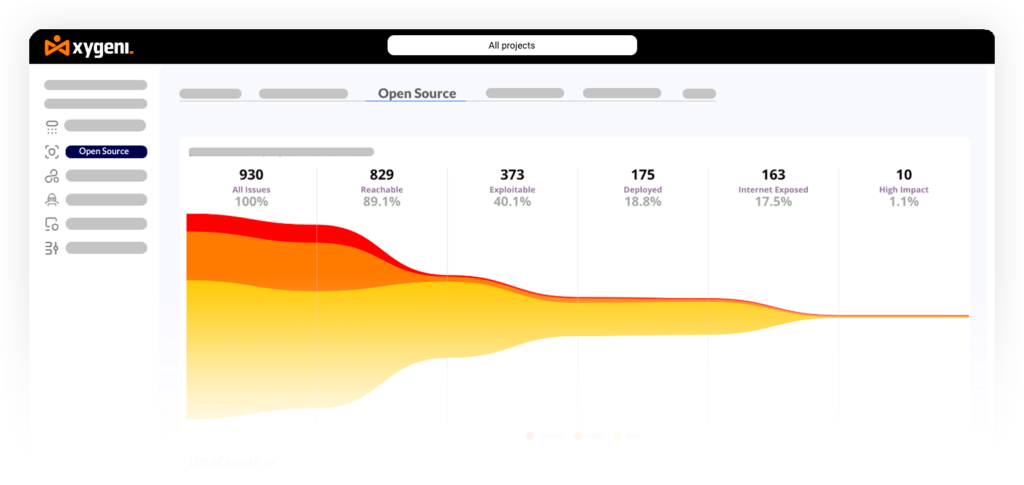
- Authorize with context, not volume. Prioritize findings by real exploitability and business impact, so authorizing officials see the risks that matter instead of thousands of alerts.
- Monitor as the default state. Alert on new critical risks and on drift in pipeline configurations and permissions, which is what ongoing authorization depends on.
The same logic applies to application-level standards. If you also benchmark against OWASP ASVS, read our guide on how to benchmark your AppSec program against OWASP ASVS.
How Xygeni feeds evidence into the NIST risk management framework
Xygeni produces the evidence the Assess and Monitor steps need, continuously and from one place.
- CI/CD pipelines: Xygeni CI/CD Security aligns its checks with industry standards like OWASP and NIST SP 800-204D, and supports compliance assessments against standards such as CIS, NIST, and OpenSSF.
- Prioritized risk: Xygeni ASPM brings together findings from code, dependencies, secrets, IaC, and pipelines, including third-party scanners, and prioritizes them by real risk, which is the view an authorization decision needs.
- AI risk: Xygeni AI Security discovers the AI assets in your code and maps findings to the OWASP LLM Top 10 and the NIST AI RMF, giving you inventory and risk evidence for the AI part of your systems. For a function-by-function walkthrough, see our guide.
Turn your security findings into RMF evidence
An authorization based on last quarter’s spreadsheet describes last quarter’s system. Book a demo to see how Xygeni turns code, dependency, and pipeline findings into continuous, prioritized evidence, or start free and scan your first repositories today.
FAQ
What are the seven steps of the NIST RMF?
Prepare, Categorize, Select, Implement, Assess, Authorize, and Monitor, as defined in NIST SP 800-37 Revision 2.
Is the NIST risk management framework only for US federal agencies?
It was designed for federal systems, but many private organizations use it voluntarily, and suppliers to government often need to align with it.
What’s the difference between the NIST RMF and the NIST CSF?
The RMF is a system-level process for selecting controls and authorizing systems. CSF 2.0 is an organization-wide framework for describing and improving cybersecurity outcomes.
What is a continuous ATO?
A continuous ATO replaces the periodic, document-based authorization with ongoing authorization, based on automated monitoring and evidence collected throughout the software life cycle.