





A team spends the sprint patching a CVSS 9.8 finding buried in a library nothing in production ever calls. Meanwhile, a CVSS 6.5 sitting in a reachable, internet-facing endpoint stays open for another month, because it never made it to the top of the list. This isn’t a hypothetical, it’s the default outcome of vulnerability prioritization built entirely on severity score, and it’s a more common failure than most security programs are willing to admit.
What Vulnerability Prioritization Is Actually Supposed to Do
Vulnerability prioritization is the process of deciding which findings get fixed first, out of a list that’s almost always too long to clear in full. Done well, it answers a narrower and harder question than “how bad is this vulnerability in theory”: it answers “how much does fixing this one, right now, actually reduce risk to this specific system.” Those are not the same question, and conflating them is where most vulnerability prioritization efforts go wrong.
Why Severity Score Alone Fails
CVSS was never designed to be a complete prioritization system on its own, it’s a severity score, a description of how bad a vulnerability could theoretically be in a generic context. It says nothing about:
- Reachability. Whether the vulnerable code path is actually called anywhere in the application, or sits dead in a dependency nothing invokes.
- Exploitability. Whether a working exploit exists in the wild, or the vulnerability is theoretical outside a lab setup.
- Exposure. Whether the affected component faces the internet or sits three layers behind an internal service with no external access.
- Business context. Whether the affected system touches customer data or payment flows, or is a low-value internal tool nobody depends on.
A vulnerability prioritization approach that ranks purely by CVSS treats a 9.8 in unreachable code as more urgent than a 6.5 sitting in a reachable, internet-facing path with a known exploit. That ordering is backwards, and it’s the direct result of scoring severity while ignoring everything else that determines actual risk.
The Hidden Cost of Getting Vulnerability Prioritization Wrong
The cost isn’t just wasted engineering hours, though that’s real: teams routinely spend cycles on high-severity findings that pose no practical risk, while genuinely exploitable issues sit open. The subtler cost is trust. When developers repeatedly get pulled off real work to fix vulnerabilities that turn out to be unreachable or already mitigated elsewhere, they start discounting the next alert too, and the whole point of vulnerability prioritization, getting the right things fixed first, quietly stops happening even though the list is technically being worked through in order.
What Good Vulnerability Prioritization Actually Requires
Effective vulnerability prioritization layers several signals on top of severity, rather than replacing it outright:
- Reachability analysis. Confirm the vulnerable function is actually called from application code, not just present in a dependency tree.
- Exploit availability. Check whether a public exploit or active campaign targets the specific vulnerability, not just the CVE family.
- Deduplication across scanners. The same underlying issue reported by three different tools shouldn’t count as three separate line items competing for attention.
- Business and exposure context. Weight findings by what the affected asset actually touches, not just by the CVE’s generic score.
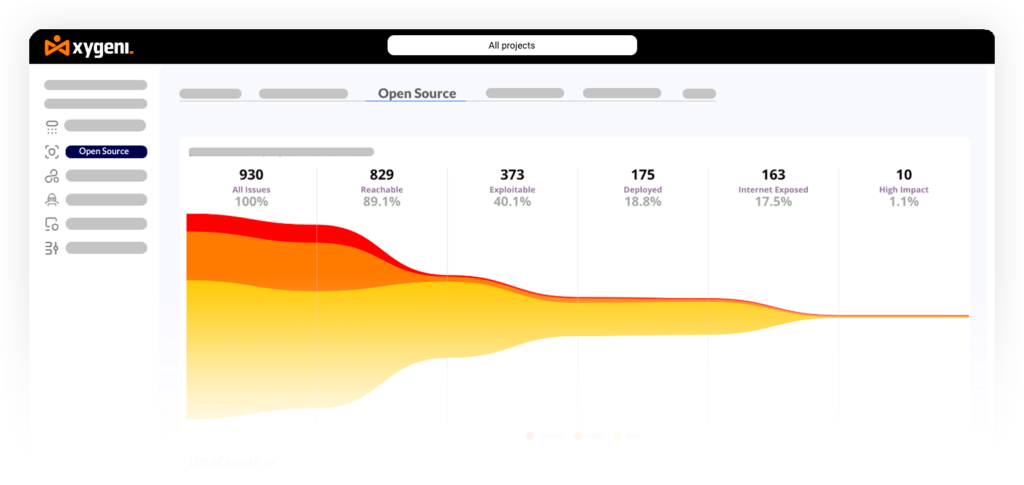
- A visible funnel, not a flat list. Being able to see how many findings survive each filter, from every issue down to what’s genuinely exploitable, makes prioritization defensible instead of a black box.
That last point matters more than it sounds. A flat, severity-sorted list gives a team no sense of scale: is 40% of the backlog real, or 2%? A funnel view, all findings, then fixable ones, then reachable ones, then ones with a known exploit, then ones that are truly exploitable in this environment, turns an overwhelming list into a short, defensible one.
What to Look for in Vulnerability Prioritization Tools
Not every platform marketed around vulnerability prioritization actually does the work described above. When evaluating vulnerability prioritization tools, a few questions cut through the marketing quickly:
- Does it show reachability, or just report the presence of a vulnerable package?
- Does it deduplicate findings across scanners, including third-party tools already in use, or does every source add a separate, uncorrelated list?
- Can a security lead see the funnel, how many findings got filtered out and why, or only the final “prioritized” list with no visibility into the logic behind it?
- Does it factor in exploit availability from real threat intelligence, or only the static CVSS score published at disclosure?
- Does prioritization apply equally to findings from native scanners and from ingested third-party tools, or only to the vendor’s own results?
That last question matters more than it seems. A lot of vulnerability prioritization tools only prioritize what they themselves found, leaving everything ingested from SAST, SCA, or third-party scanners sitting in a separate, unranked pile.

How Xygeni Approaches Vulnerability Prioritization
Xygeni’s ASPM applies a four-stage funnel: ingest findings from native scanners and third-party tools alike, build unified visibility across the resulting inventory, then correlate and prioritize using deduplication, reachability, and AI-driven context, before findings ever reach a developer’s queue. In practice, that funnel narrows a full findings list down through what’s fixable, what’s reachable in application code, what has a known exploit, and finally what’s genuinely exploitable in that specific environment, so the list a team actually works from is small enough to be worked through completely, not just triaged forever.
Because this vulnerability prioritization layer applies to findings ingested from third-party scanners as well as Xygeni’s own native scanners, a team doesn’t have to rip out an existing tool to get a unified, correlated view. The prioritization logic runs on top of what’s already there, closing the gap that most vulnerability prioritization tools leave open when they only rank their own findings.
FAQ
Why isn’t CVSS enough for vulnerability prioritization on its own?
CVSS measures theoretical severity, not actual risk in a specific environment. It doesn’t account for whether the vulnerable code is reachable, whether an exploit exists in the wild, or how exposed the affected system is, all of which materially change whether a finding deserves to be fixed first.
What’s the difference between severity and exploitability in vulnerability prioritization?
Severity describes how damaging a vulnerability could theoretically be. Exploitability describes whether that damage is actually achievable right now, given a working exploit and a reachable code path. A high-severity, low-exploitability finding is often less urgent than a moderate-severity, highly exploitable one.
Do vulnerability prioritization tools need to cover third-party scanner findings too?
Yes, otherwise a team ends up with several separate, uncorrelated priority lists, one per tool, instead of one unified view of what actually matters most across the whole stack.
How much can reachability analysis realistically cut down a findings list?
It varies by codebase, but it’s common for the majority of flagged vulnerabilities to sit in code paths that are never actually called, meaning reachability alone often removes a large share of findings from serious consideration before exploitability is even assessed.
Is a smaller, prioritized list a sign that risk is being ignored?
No, the opposite. A shorter list produced by genuine vulnerability prioritization means the noise has been filtered out, not the risk. The alternative, a long unfiltered list nobody can fully work through, produces worse outcomes because real risk gets lost in volume.