Risk-based vulnerability prioritization is ranking security findings by the risk they actually pose to your application, rather than by the severity score attached to them. The distinction matters because severity is a property of the vulnerability in the abstract, while risk is a property of the vulnerability in your code: whether the vulnerable function is ever called, whether anyone is exploiting it in the wild, how exposed the affected service is, and how hard the fix would be. A CVSS 9.8 in a dependency your application never invokes is a lower priority than a 6.1 on an internet-facing endpoint with a public exploit. Severity cannot tell you that. Risk-based prioritization is the set of signals that can.
What is risk-based vulnerability prioritization? A working definition #
Every scanner you run produces more findings than your team can fix. That is not a tooling failure, it is arithmetic: coverage goes up every year, headcount does not. The question stopped being “what did we find” a long time ago. It is “what do we do on Monday”.
Severity-based triage answers that badly. It sorts by a number calculated without any knowledge of your system, which means it ranks a theoretical catastrophe above a practical one. Teams learn this quickly and respond by ignoring the list, which is the worst possible outcome because the three findings that mattered were in it.
So the working definition: risk-based vulnerability prioritization is the practice of ordering findings using contextual signals about exploitability, reachability, exposure and remediation cost, so that the top of the queue reflects what an attacker could actually do to this system rather than what a scoring body judged possible in general.
The shift is from a property of the vulnerability to a property of the vulnerability plus your application. Same CVE, different priority, depending on where it lives.
Risk-based vulnerability prioritization meaning, in four signals #
The clearest route into the risk-based vulnerability prioritization meaning is to look at what gets added to severity, because severity itself does not disappear. It becomes one input among several.
- Reachability. Is the vulnerable function actually called from your code? A vulnerable package is not a vulnerable application. Reachability analysis traces the call path and shows it, which converts “we have 400 critical dependency findings” into a much shorter list of ones that execute.
- Exploitability. Is anyone exploiting this in the real world? EPSS estimates the probability of exploitation in the next 30 days, the CISA Known Exploited Vulnerabilities catalogue records what is already being used in the wild, and public exploit availability tells you how much work an attacker would have to do. These are the attacker’s view, and they move daily while a CVSS score stays fixed from the day it was assigned.
- Business context. How exposed is the affected asset, and what does it do? An internet-facing payment service and an internal reporting tool with the same finding do not carry the same risk, and only your organization knows which is which.
- Remediation cost. How hard is the fix, and what breaks if you apply it? A trivial patch bump and a major version upgrade that breaks compilation are different decisions, and a priority that ignores effort produces a queue nobody can plan a sprint around.
Put together, the risk-based vulnerability prioritization meaning most teams converge on: stop asking how bad this could be, start asking how bad this is here, and how much it costs to end it.
The practical difference shows up in the conversation between security and engineering. A severity-sorted ticket says “this is critical, fix it”. A risk-sorted one says “this is reachable from your checkout controller, there is a public exploit, and the fix is a patch bump”. Only one of those gets actioned without an argument.
This is now the official position, not just good practice #
Risk-based vulnerability prioritization used to be the sophisticated alternative to patching by severity. It is becoming the baseline.
SSVC, developed by Carnegie Mellon’s Software Engineering Institute and adopted by CISA, replaces the score with a decision tree that outputs an action rather than a number, based on exploitation status, automatability, technical impact and mission prevalence. And in June 2026 CISA issued Binding Operational Directive 26-04, superseding BOD 22-01, which directs federal agencies to prioritise updates using asset exposure, KEV status, exploit automation and technical impact rather than severity alone.
The signal for everyone else is straightforward. The agency that maintains the authoritative catalogue of exploited vulnerabilities no longer tells its own agencies to sort by CVSS. If you are still doing that, you are using a method its own custodians have moved past.
How a prioritization funnel works? #
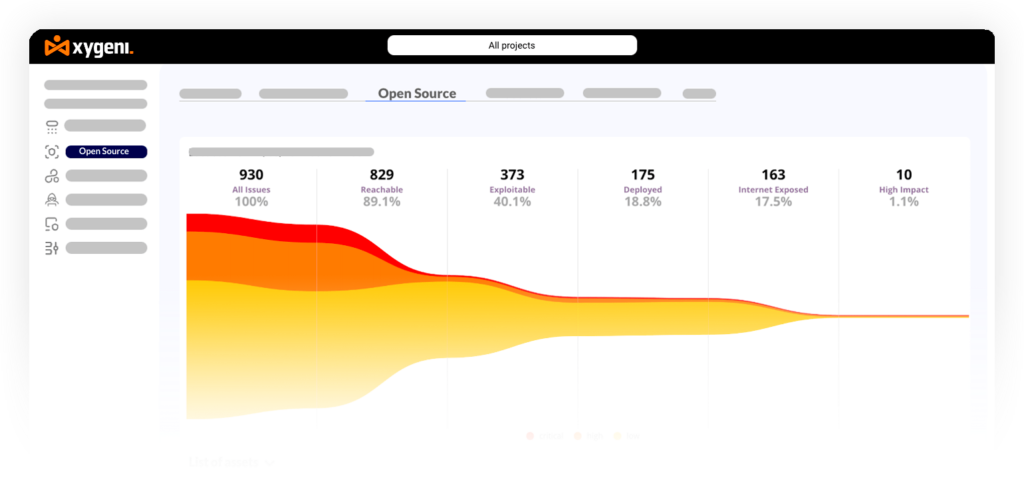
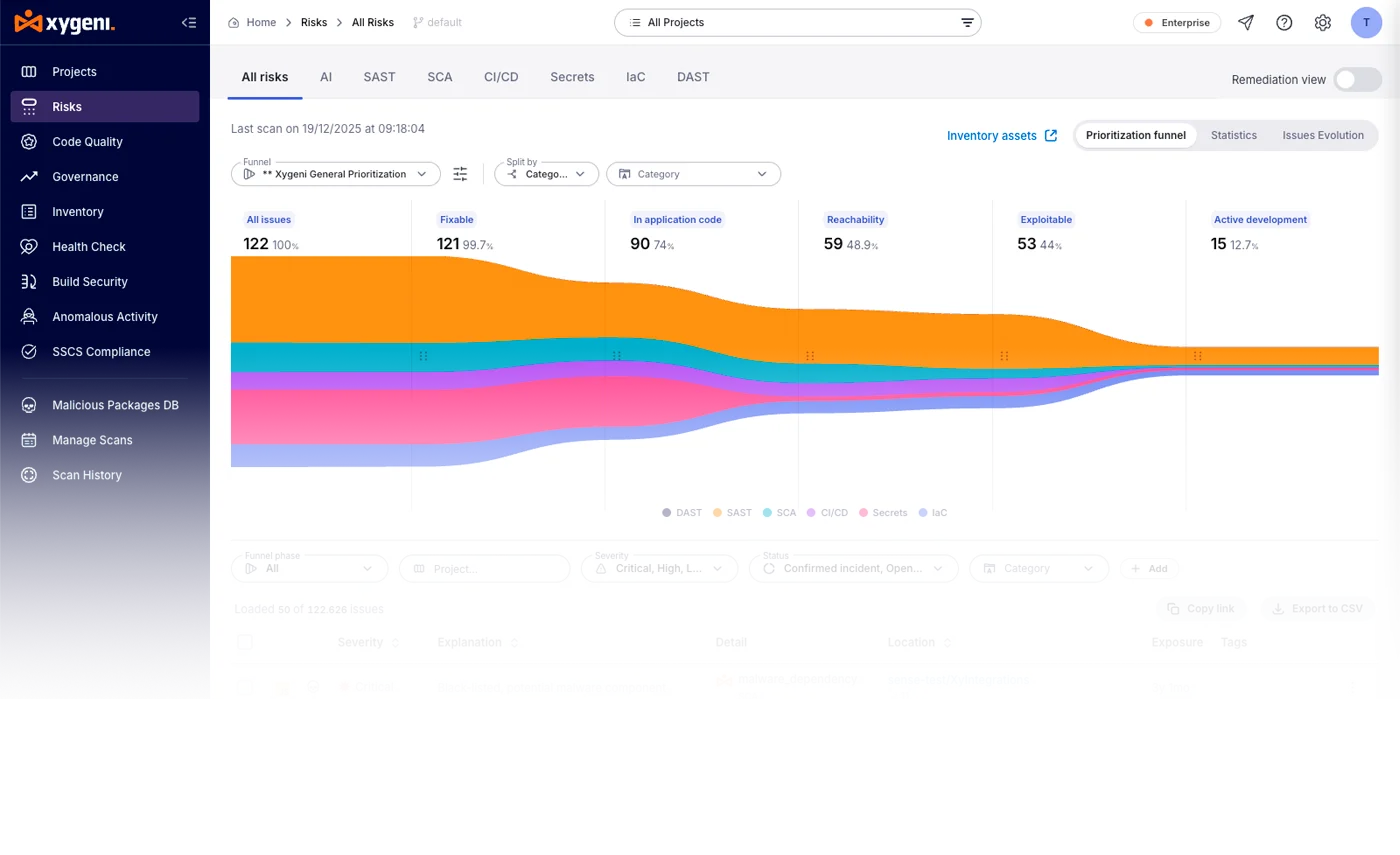
Signals on their own do not prioritize anything. They have to be chained, so that each one narrows what the next one has to consider. That chain is what Xygeni calls a prioritization funnel.
A funnel runs findings through up to eight ordered stages. The pre-configured ones are reachability, exploitability, fixable, AI Triage result and remediation urgency, and you can add your own properties such as business criticality or exposure. Out-of-the-box funnels cover each risk family, and you can filter any table by funnel phase to see what survived each stage. A queue of several hundred findings narrows to the handful that are real, reachable, exploitable and worth this sprint.
Two of those stages come from AI Triage. For findings in your own code, AI Triage reads the finding in context, the code flow for static analysis or the HTTP evidence for DAST, and returns a verdict of true positive, false positive or needs review, plus a remediation urgency from Immediate to Backlog and a fix complexity from Easy to Hard. Each comes with the reasoning behind it, every output is labelled as AI-generated, and your team can override any verdict. For open-source findings the design is deliberately different: there is no AI verdict, because reachability does that job better. AI Triage contributes urgency and complexity instead.
The part that matters most for teams with an existing stack: the same funnels and the same triage apply to findings ingested from other scanners, not only to Xygeni’s own. Findings from 40 or more tools and formats, including any SARIF output, are deduplicated and ranked in the same queue. Your current tools keep running. The prioritization stops being per-tool.
The measurable effect, in the words of customers who did it: around 90% less time identifying, prioritizing and assigning security findings at Banco Serfinanza, across more than 100 repositories under continuous analysis, and a 90% reduction in vulnerability prioritization time at Fintonic.
Book a demo and bring your own backlog.
FAQ: risk-based vulnerability prioritization, in short answers #
Sorting security findings by what an attacker could actually do to your system, instead of by the severity score attached to the vulnerability. The same CVE can be urgent in one application and irrelevant in another, and risk-based prioritization is what tells the two apart.
No, it is incomplete. CVSS describes the vulnerability; it was never designed to describe your exposure to it. Risk-based prioritization keeps severity as one signal and adds the ones that depend on your environment: whether the code is reachable, whether exploitation is happening, how exposed the asset is, and what the fix costs.
Whether the vulnerable function inside a dependency is actually invoked by your application. If it is not, the finding is real but not exploitable through your code, so it drops down the queue rather than disappearing. It is the single highest-leverage filter on open-source findings, because most dependency vulnerabilities sit in code that is never called.
It should, and that is the test worth applying to any platform claiming to do this. Prioritization that only ranks its own findings leaves you with one ranked queue and several unranked ones, which is not prioritization. Xygeni applies the same funnels and the same AI Triage to ingested findings from other tools.
Not the number of open criticals. Measure the time from a finding being raised to reaching a developer who can act on it, the proportion of assigned findings that get fixed rather than deferred, and how many tickets developers push back on. Risk-based prioritization is working when the pushback stops.