What is AI Triage? It is the application of AI-driven analysis to security findings, so that instead of a flat list of alerts, a team gets a verdict on whether each finding is a true positive (a genuine issue) or a false positive (not actually exploitable, or based on bad data). It is not another scanner. It is the layer that sits on top of scanner output and decides which findings actually deserve a developer’s attention.
Understanding what AI Triage is (and what AI Triage meaning looks like in practice) matters because the traditional alternative, a human manually reading every finding from every scanner, does not scale. Security teams running SAST, SCA, secrets detection, IaC, and DAST in parallel generate far more findings than any team can review one by one, and a large share of those findings are false positives that don’t warrant action. This glossary explains what AI Triage is, how it works across different finding types, and why it matters for reducing alert fatigue.
AI Triage Meaning: Quick Definition #
AI Triage meaning, formally: an AI-driven assessment applied to a security finding that produces a verdict on whether the issue is a genuine true positive or a false positive.
The term extends the older idea of “triage” from medical and incident-response contexts (deciding what gets attention first when there’s more work than time) to the specific problem of security alert overload. Where a traditional scanner just reports “this pattern matches a known-risky pattern,” AI Triage reasons about the surrounding context, the code, the configuration, the request/response evidence, and reaches a conclusion a human reviewer would otherwise have to reach manually.
AI Triage meaning, in practical terms, is this: a finding stops being a flat, undifferentiated alert and becomes a confirmed or dismissed item, before it ever reaches a developer’s queue.
What It Actually Produces #
Every triaged finding gets a verdict: whether the AI is confident the issue is a real vulnerability (a true positive), confident it is not (a false positive, for example because the data is sanitized or the code path is unreachable), or unable to reach a confident conclusion (needs review). A verdict of “needs review” is a deliberate outcome, not a failure: AI Triage is built to say “I’m not sure” rather than guess when the evidence is ambiguous.
Why AI Triage Isn’t the Same for Every Finding Type #
One of the more important things to understand about AI Triage is that it does not apply uniformly across every kind of security finding, because false positives look different depending on what’s being triaged.
- For code and configuration findings (SAST, IaC, secrets). AI Triage reasons directly about the surrounding code context to decide whether a flagged pattern is actually exploitable, and explains that reasoning in plain text alongside the verdict.
- For open-source dependency findings (SCA). The verdict question works differently here: a known CVE in a dependency either applies or it doesn’t, so false-positive detection is handled through reachability analysis rather than through a traditional AI Triage verdict.
- For dynamic testing findings (DAST). AI Triage reasons from runtime evidence, the actual request and response, rather than from source code, specifically to catch the false-positive patterns unique to dynamic scanning: a web application firewall silently blocking an attack and the scanner mistaking that block page for a real vulnerability, or a payload reflecting in a response that’s actually neutralized rather than exploitable.
- For malware scan findings. This one works differently again: rather than producing a verdict on an individual finding, AI Triage assesses the confidence of the evidence a malware scanner produces and feeds that into an overall project-level risk score, so a handful of high-confidence signals score differently from the same number of weak, ambiguous ones.
Where It Fits in a Prioritization Workflow #
AI Triage is not meant to be read one finding at a time by choice; it’s designed to slot into the same places a team already reviews security output.
- Individually, for a specific finding. A developer or security engineer can open a single issue and see the verdict and the reasoning behind it, useful when deciding whether to trust a specific automated call.
- In bulk, across many findings at once. Rather than triaging one issue at a time, a whole batch of open findings can be sent through triage together, which is the realistic way most teams actually clear a backlog rather than reviewing items one by one.
- As part of an automated pipeline. Triage can run automatically the moment a scan finishes, so that by the time anyone looks at results, the noise has already been separated from what’s worth their attention, rather than triage being a separate manual step someone has to remember to run.
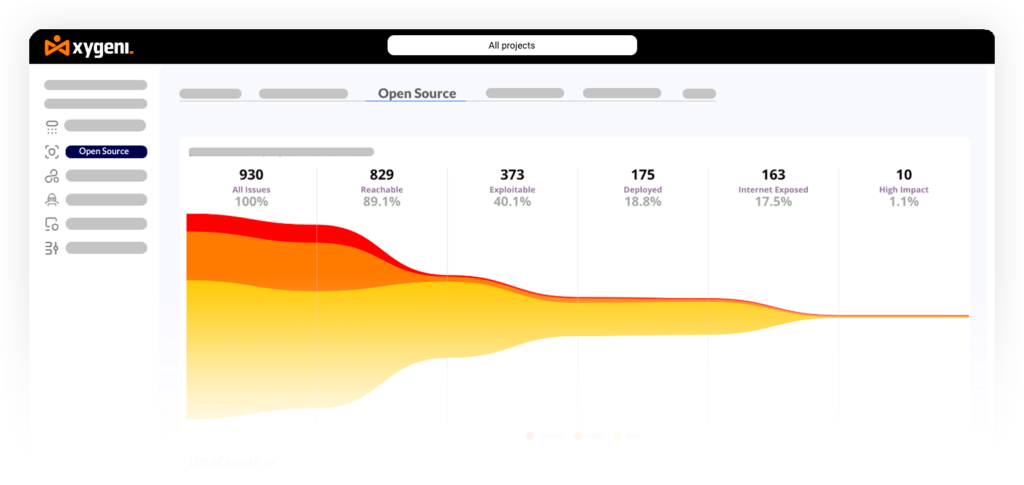
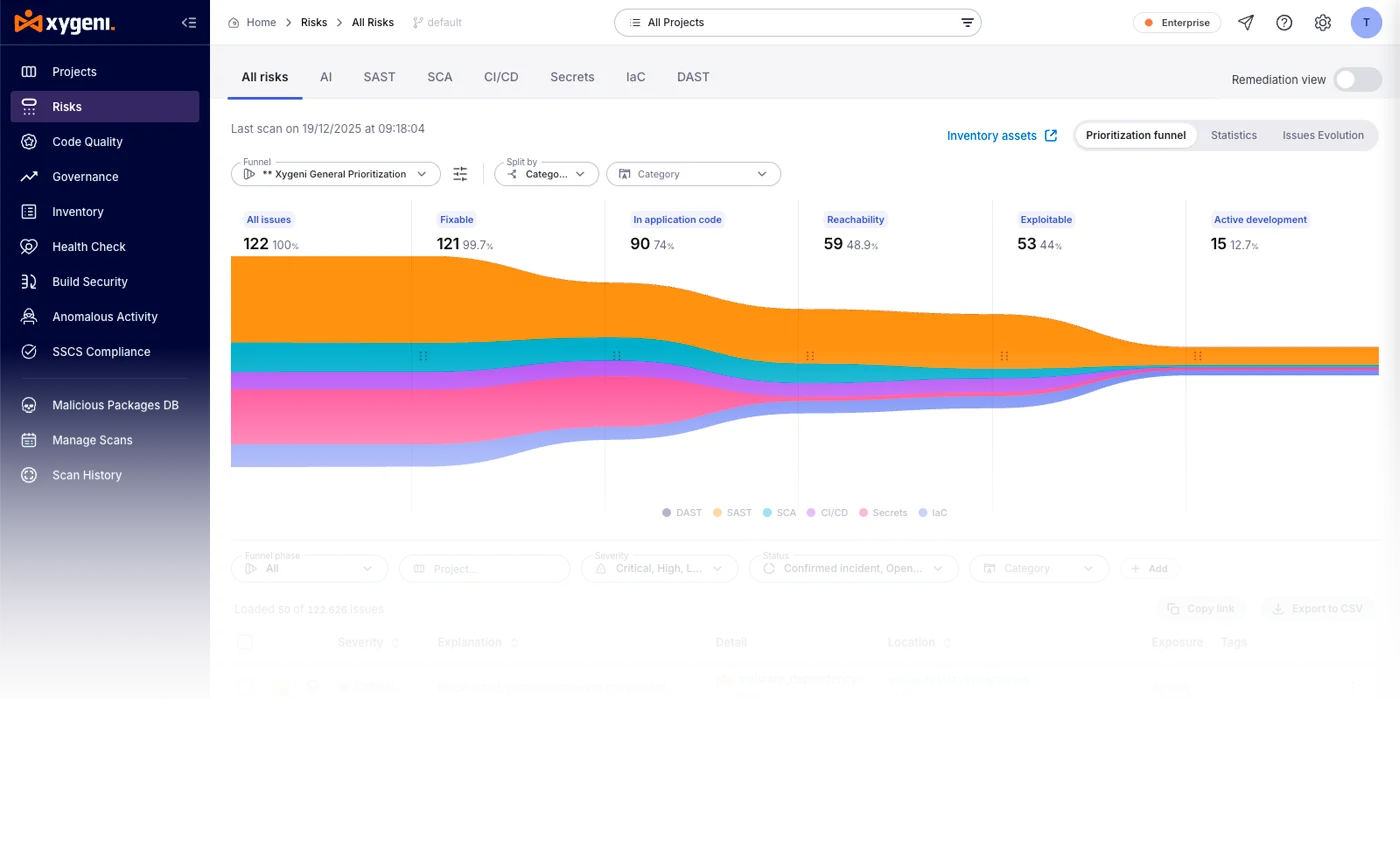
- As a stage inside a broader prioritization funnel. Rather than existing on its own, AI Triage’s verdict can act as a filtering stage within a larger prioritization process, so confirmed false positives are filtered out early, leaving only genuine findings for further ranking.
Why AI Triage Matters #
The core problem AI Triage addresses isn’t a shortage of detection; it’s an oversupply of undifferentiated alerts. Modern AppSec programs run multiple scanners in parallel, each generating findings using its own logic, its own confidence level, and no shared sense of what’s real. Without a triage layer, every one of those findings arrives at a human with equal apparent weight, whether it’s a critical, actively exploited flaw or a false positive from a pattern match in code nobody runs.
That undifferentiated volume is what produces alert fatigue, the well-documented tendency for people to stop reading carefully once volume crosses a threshold. Alert fatigue isn’t just an efficiency problem: it’s a security problem, because the one finding that actually mattered is statistically more likely to get missed in a pile of a thousand that didn’t.
AI Triage directly targets that gap by doing the first pass of reasoning a human reviewer would otherwise have to do for every single finding, and by being explicit about its own uncertainty rather than forcing a binary call when the evidence doesn’t support one.
Securing Your Pipeline With Xygeni’s AI Triage #
Xygeni’s AI Triage is built directly into the platform’s prioritization workflow rather than as a bolt-on report. Beyond the core true-positive/false-positive verdict, Xygeni extends AI Triage with two additional outputs: remediation urgency (how soon a confirmed issue needs attention, from immediate to backlog) and remediation complexity (how much effort the fix is expected to take, from a trivial one-line change to a hard, cross-cutting rework). Together, these give teams not just a cleaner list of real findings, but a ready-made prioritization order.
This full assessment, verdict, urgency, and complexity is produced for SAST, IaC, secrets, SCA, and DAST findings, with the specific triage logic adapted to each finding type: reachability-informed false-positive detection for SCA, request/response evidence analysis for DAST, and code-context reasoning for SAST, IaC, and secrets.
Every triaged finding is tagged with its verdict, urgency, and complexity, so teams can filter and build views around exactly the findings that matter, and the AI’s reasoning is shown alongside each verdict rather than hidden behind a black-box score. Triage can be run per finding, in bulk across a whole backlog, on demand from the CLI, or automatically the moment a scan completes, and its outputs feed directly into Xygeni’s SAST and DAST prioritization funnels, so confirmed false positives are filtered out before a developer ever sees them.
For malware scanning specifically, AI Triage works differently: it evaluates the confidence of the evidence a scan produces and folds that into the project’s overall maliciousness score, so a handful of strong signals are weighted appropriately against a larger number of weak ones.
FAQ #
AI Triage is the use of AI to evaluate a security finding and produce a verdict on whether it’s a true positive or a false positive, replacing the manual, one-by-one review of raw scanner output.
No. AI Triage works on top of what scanners (SAST, SCA, secrets, IaC, DAST) already find; it doesn’t discover new vulnerabilities itself; it reasons about the findings a scanner has already produced to decide which ones are real.
It means the available evidence wasn’t strong enough for a confident automated conclusion, so the finding is flagged for a human to look at rather than the system guessing. This is a deliberate design choice to avoid false confidence on ambiguous findings.
Yes, for SAST, IaC, secrets, SCA, and DAST findings, triage can be triggered to run automatically the moment a scan finishes, so results already include a verdict by the time anyone reviews them, rather than requiring a separate manual step.
Confirming true positives vs. false positives is the core of AI Triage. Prioritization signals like remediation urgency and complexity are an additional layer Xygeni adds on top of that core verdict.